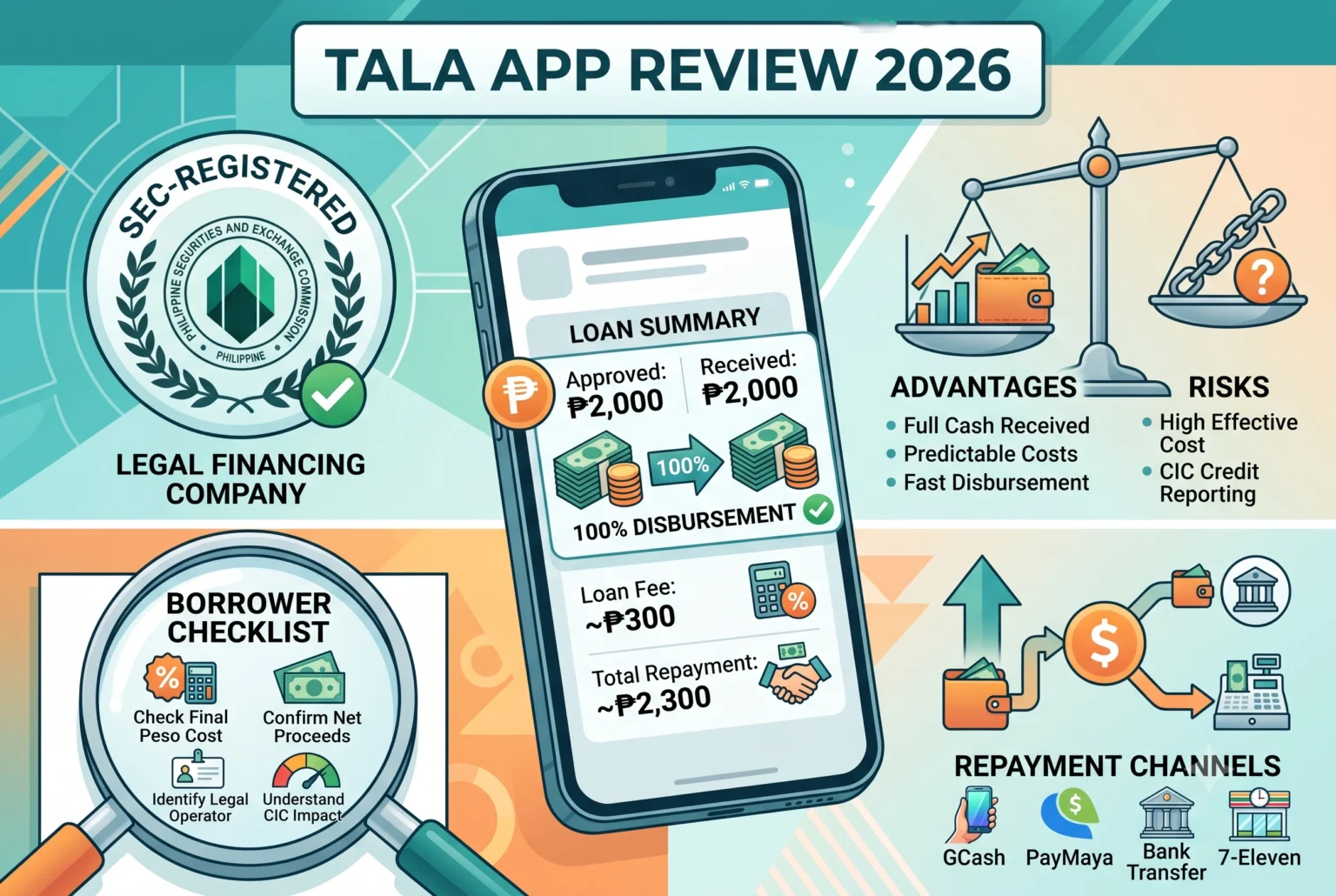
Borrowing money online in the Philippines often means accepting hidden fees, aggressive collection tactics, and loan proceeds that are substantially smaller than the approved amount. Many digital lenders deduct heavy “processing fees” upfront, leaving the borrower with a fraction of the cash they actually need. Evaluating an app like Tala requires looking past its popularity to understand exactly how its contracts treat consumers.
This review investigates the legal status, actual borrowing costs, privacy requirements, and collection practices of Tala in 2026. By examining public disclosures, regulatory records, and contractual terms, we map the exact gap between the advertised promises and the reality of taking a loan through this platform.
Summary:
Tala is a legally registered financing company in the Philippines that provides short-term unsecured loans. Its strongest consumer advantage is transparent disbursement: unlike many local competitors, Tala does not deduct upfront processing fees, meaning borrowers receive the exact principal they requested. However, its interest and service fees are dynamic and can be expensive when annualized. While the app advertises limits up to ₱25,000, first-time applicants should expect initial approvals closer to ₱1,000. Borrowers must pay on time, as Tala reports to the Credit Information Corporation (CIC), meaning a default will damage your formal credit record.
| Borrower question | Current finding | Why it matters |
| Legal Operator | Tala Financing Philippines Inc. | Confirms the app is run by a registered entity, not an anonymous offshore syndicate. |
| Regulatory Status | SEC-registered financing company (CA No. 1132). | Ensures the company is subject to Philippine lending laws and SEC oversight. |
| Advertised Loan Range | ₱1,000 to ₱25,000. | Sets expectations, though new users rarely receive the maximum amount. |
| Net Proceeds | 100% of the approved principal. | You receive exactly what you borrow. There are no hidden upfront deductions. |
| Cost | Varies by term and borrower profile (often 11% – 15% for 30 days). | While transparent, the effective cost is still high compared to traditional bank credit. |
| Credit Reporting | Submits data to the Credit Information Corporation (CIC). | Paying late will permanently damage your ability to get bank loans in the future. |
Is Tala legitimate and properly authorized in the Philippines?
Yes. Tala is legally operated by Tala Financing Philippines Inc., holding a valid Certificate of Authority (No. 1132) from the Securities and Exchange Commission (SEC). This confirms it is a regulated business, but borrowers must still evaluate the pricing independently.
Who legally operates the app?
The consumer-facing brand “Tala” is managed locally by Tala Financing Philippines Inc. (SEC Registration No. CS201710582). The company operates under the authority granted by the Philippine SEC, which explicitly permits it to function as a financing company rather than a traditional bank. This means it can legally lend money but cannot accept public deposits.
Is Tala itself the lender?
Yes. Unlike some platforms that act merely as brokers or marketplaces matching users with third-party lenders, Tala directly funds the loans it issues to Philippine borrowers. When you sign a contract in the app, your legal obligation is directly to Tala Financing Philippines Inc.
How much can you actually borrow from Tala?
The app advertises maximum limits of up to ₱25,000, but public data and borrower feedback indicate first-time users typically receive limits between ₱1,000 and ₱2,000 until they establish a repayment history.
What limits are advertised?
Tala markets itself as offering loans ranging from ₱1,000 to ₱25,000. The marketing language often highlights the maximum amount to attract users needing substantial emergency funds for medical bills, tuition, or small business capital.
Why might a first-time borrower receive less?
Online lenders relying on alternative credit scoring manage risk by limiting initial exposure. Because Tala does not require collateral or traditional income documents, it tests borrower reliability through small initial limits. If you need ₱15,000 immediately but have never used Tala, this app is unlikely to solve your problem on the first attempt. Limits only increase after a borrower completes multiple borrowing and repayment cycles successfully.
What does a Tala loan really cost?
Tala charges a daily interest rate that accumulates based on your chosen term, rather than a flat monthly rate. Crucially, the company disburses 100% of the approved loan amount without deducting standard processing fees.
Full disbursement versus upfront deductions
The most significant difference between Tala and many predatory Philippine lending apps is the disbursement mechanism. Many unregulated or high-risk lenders approve a ₱2,000 loan but immediately deduct a 30% to 40% “service fee,” disbursing only ₱1,200 to your e-wallet while forcing you to repay ₱2,000.
According to its public terms, Tala transfers the full principal. If you request ₱2,000, you receive ₱2,000. All associated costs are added to the final repayment amount.
How much would a sample loan cost in pesos?
Tala utilizes risk-based pricing, meaning exact rates vary by user profile and term length. Based on current product disclosures, a standard 30-day loan often carries a total fee ranging from 11% to 15% of the principal.
If a borrower is approved for ₱2,000 at a 15% rate for 30 days:
-
Requested amount: ₱2,000
-
Upfront deductions: ₱0
-
Amount actually received: ₱2,000
-
Interest and service fee: ₱300
-
Total repayment due: ₱2,300
While the peso cost (₱300) may seem manageable for an emergency, a 15% fee for a 30-day period translates to a high Annual Percentage Rate (APR). It is a short-term liquidity tool, not a sustainable long-term financing option.
How fast are approval and disbursement?
Approval is heavily automated and can occur within minutes. Once approved, disbursement to connected channels like GCash, Maya, or standard bank accounts is typically processed on the same day.
What can slow approval?
The application relies entirely on algorithmic evaluation of the data provided, including the required government ID and a live selfie. The most common operational friction points include:
-
ID Glare or Blur: The automated optical character recognition (OCR) will reject unreadable IDs.
-
Name Mismatches: If the name on the ID does not exactly match the name registered on the receiving e-wallet (e.g., GCash) or bank account, the disbursement will fail.
-
Unsupported IDs: Tala restricts its acceptable ID list to specific government-issued documents like the UMID, Driver’s License, Postal ID, or National ID (PhilSys).
What happens if you pay late?
If you fail to pay on time, Tala applies a one-time late fee of 8% on the outstanding balance. More importantly, the company reports negative payment behavior to the national credit registry.
What charges may apply?
Instead of charging compounding daily penalties that trap borrowers in debt spirals – a practice common among illegal apps – Tala limits its penalty to a flat 8% late fee. If your outstanding balance on the due date is ₱2,300, a missed payment adds ₱184, bringing the total debt to ₱2,484. The terms stipulate this is a one-time charge per loan cycle.
Can delinquency affect your credit record?
Yes. Unlike underground apps, Tala is integrated with the Philippine financial system. As a regulated entity, it is mandated to submit borrower data to the Credit Information Corporation (CIC). A delayed payment will appear on your formal credit report, directly harming your ability to secure car loans, housing loans, or credit cards from traditional banks in the future.
How does Tala handle your personal data?
Tala requires access to specific device data to evaluate creditworthiness, but it operates under a formal privacy policy regulated by the National Privacy Commission (NPC), forbidding unauthorized access to your contact list.
What data does the application collect?
To offset the lack of financial paperwork, Tala’s algorithm assesses alternative data points from the applicant’s smartphone. The privacy disclosure indicates the app collects device information, location data, and app activity.
Can the lender contact people in your phone?
A major fear among Philippine borrowers is the “contact blasting” tactic used by predatory lenders, where the app steals the user’s phonebook and texts their family and friends about the debt. As a regulated entity monitored by the NPC, Tala’s current policy does not permit harvesting contacts to shame borrowers. Collections are restricted to the borrower and any specifically authorized reference persons provided during the application.
What are borrowers saying about Tala in 2026?
Recent borrower feedback across app stores and local finance forums highlights fast disbursement and transparent fees as strengths, while complaints frequently center on stagnant credit limits and strict ID verification.
What positive patterns appear?
Independent borrower discussions consistently point to predictability. Users report that the amount promised on the screen is exactly the amount they receive, and the due date total matches the original contract. This reliability separates Tala from lenders that alter terms mid-cycle.
What complaints appear repeatedly?
The most recurring friction point involves credit limit progression. Many borrowers report maintaining perfect repayment records for months, yet their limits remain frozen at low amounts (e.g., ₱2,000 to ₱3,000). Other common complaints involve the app’s camera interface failing to recognize newer versions of the Philippine National ID, causing application delays.
Who should use Tala and who should be cautious?
A Tala loan is highly relevant for a borrower who:
-
Needs a small amount of cash immediately.
-
Knows the exact source of income they will use to repay the loan in 30 days.
-
Prefers full cash disbursement over deducted processing fees.
-
Understands the peso cost of the service fee and accepts it as a convenience charge.
A borrower should be especially cautious if:
-
They are trying to borrow a large sum (like ₱20,000) on their first attempt, as the limit will likely be too low.
-
They plan to pay off another existing loan with the Tala loan, a practice that quickly leads to an inescapable debt cycle.
-
Their incoming salary will be delayed past the loan’s due date, which will trigger the 8% penalty and a negative CIC report.
Frequently Asked Questions
Can I repay my Tala loan before the due date?
Yes. The app allows early repayment through its standard payment channels (GCash, Maya, 7-Eleven, ShopeePay). Depending on the specific terms of your contract, paying early may reduce the daily interest accrued, lowering your final borrowing cost.
How long does it take to get another loan after paying?
Once a payment successfully posts to your account – which is usually real-time if paid through linked e-wallets, but may take 24 hours via over-the-counter partners – you can apply for a new loan immediately.
Will Tala send debt collectors to my house?
Tala utilizes internal and third-party collection agencies that primarily communicate via SMS, email, and phone calls. While Philippine law allows field visits for debt collection, financing companies typically reserve physical visits for much larger loan amounts rather than standard microloans.
Final Decision: What should you check before accepting?
When evaluating a loan from Tala, the decision should rest entirely on the math. The company is clearly identifiable, legally authorized, and operates with a level of transparency that is rare in the Philippine digital lending market. You do not have to worry about the app stealing your contacts or hiding a 40% upfront deduction.
However, legitimacy does not equal affordability. Before tapping the “Accept” button, look at the final repayment number. Subtract the money you are receiving today from the amount you must pay next month. That difference is your true cost of borrowing. If you are confident your upcoming paycheck can cover that total without forcing you to borrow again immediately, the product functions as intended. If it will leave you short on rent or food next month, no online loan is the right answer.
References
-
Securities and Exchange Commission PhilippinesOrganization: Securities and Exchange Commission (SEC)Resource: List of Registered Financing Companies
-
Tala PhilippinesOrganization: Tala Financing Philippines Inc.Resource: Official Privacy Policy and Terms of Use
-
Credit Information CorporationOrganization: Credit Information Corporation (CIC)Resource: Accessing Entities and Submitting Entities List
Last Updated: September 29, 2026 by The Nomad Finance Girl (Jaycee)
