
Running a small online shop or managing sudden household emergencies is stressful enough without a predatory countdown clock ticking on your smartphone. I have sat across the table from borrowers who borrowed PHP 15,000 for inventory, fully expecting three months of revenue cycles to pay it back. Instead, they woke up to threatening text messages just one week later because they missed the fine print. Unpaid digital debts feel terrifying, but let’s ground ourselves in reality: you cannot go to prison for a civil debt in the Philippines.
If you are trapped in a cycle of weekly “bullet payments,” the system is working exactly as those shady operators designed it. As a fintech analyst auditing these platforms over the past ten years, I want to guide you away from these aggressive micro-loans. We need to look at regulated applications that respect your cash flow and actually spread your payments over time.
Summary:
A true monthly installment cash loan in the Philippines allows borrowers to amortize their principal and interest over 30 to 180 days in equal, predictable payments. Borrowers must avoid apps that advertise 90-day terms but demand a massive “bullet payment” in the first 7 days. Securing a regulated loan through SEC-licensed and BSP-supervised platforms ensures transparent Effective Interest Rates (EIR) and protects borrowers from illegal harassment and hidden processing fees.
True Installment Apps vs. High-Risk Loan Apps (2026 Comparison)
| Lending Platform | True Monthly Installments | Advertised Interest Rate | E-KYC Friction Level | Best Use Case |
| BillEase | 30 to 180 days | 0% to 3.49% per month | Medium (Requires solid proof of billing) | E-commerce checkout & cash loans |
| Salmon | 60 to 120 days | Subject to risk profiling | Low to Medium | Quick cash for gig workers |
| Tonik Big Loan | Up to 6 months | Fixed monthly add-on | High (Banking grade requirements) | Major business inventory purchases |
| Unregistered OLAs | Fake (Often 7 to 14 days) | 1% to 3% per day | Zero to Low (High data privacy risk) | Avoid entirely |
What Is the Danger of “Bullet Repayment” Apps Masked as Installment Loans?
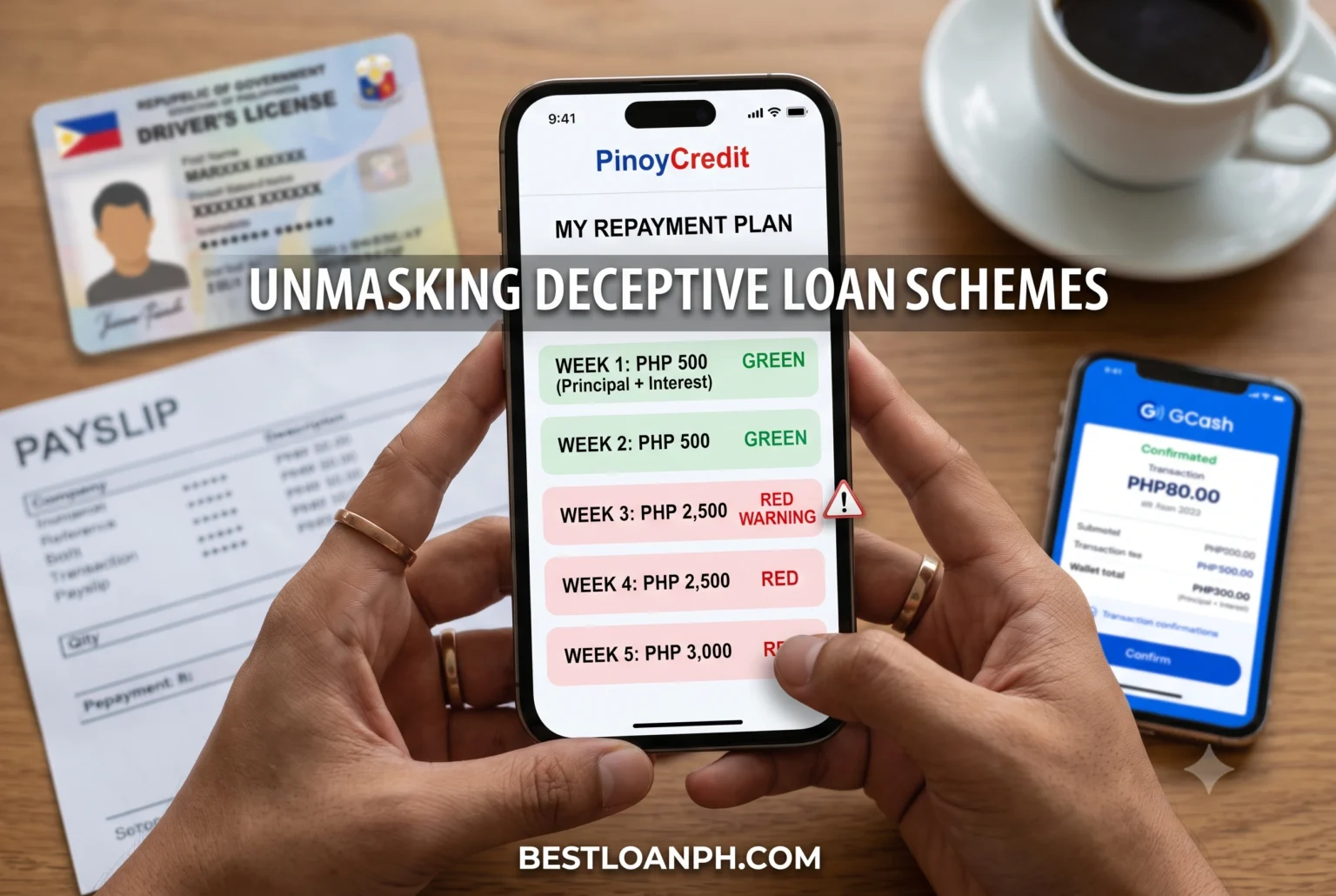
The primary danger is deceptive user interface design. Many unregistered apps advertise a 90-day term to bypass app store regulations, but contractually demand up to 80% of the principal in just 7 days, forcing immediate default.
Why Do Some Apps Advertise 90 Days But Demand Payment in 7 Days?
Predatory lenders use a “90-day” label to comply with Google Play Store policies against ultra-short-term loans, while using hidden repayment schedules that actually require full payment within a week.
When our team audited several controversial lending apps earlier this year, we documented exactly how this trap functions. A borrower applies for PHP 10,000. The app interface clearly shows a “90-day term” during the selection phase. However, once the funds are disbursed (often with a 20% processing fee instantly deducted), the dashboard updates. The borrower realizes their first “installment” of PHP 9,500 is due next Tuesday. The remaining PHP 500 is technically stretched over the next 83 days.
This is not a mistake; it is a calculated feature. It relies on the borrower rushing through the digital contract. The goal is to force you into rolling over the debt, where you pay an extension fee just to stop the harassment for another seven days. You never actually touch the principal balance.
How Does the Bangko Sentral ng Pilipinas (BSP) Protect Borrowers from Fake Installments?
The BSP enforces strict guidelines, such as Circular No. 1111, which caps interest rates and mandates that all lending apps explicitly display the Effective Interest Rate (EIR) before a user accepts a loan.
Regulated lenders cannot hide behind confusing fee structures. If an app tries to charge you a massive upfront processing fee while claiming to have “zero interest,” the BSP requires them to calculate that fee into the EIR. This means the actual cost of borrowing is exposed.
Furthermore, the Securities and Exchange Commission (SEC) strictly prohibits abusive debt collection practices. Regulated apps are not allowed to access your contact list to shame you to your friends and family. If an app requires permission to read your entire phonebook before releasing funds, you are dealing with a rogue operator, not a legitimate financial institution.
Which Apps Offer the Safest Monthly Installment Cash Loan in the Philippines?
The safest options are SEC-registered and BSP-supervised platforms like BillEase, Tonik, and Salmon, which offer genuine 3-to-6-month amortization schedules without hidden daily penalties.
What Are the Best Options for 3 to 6-Month Payment Terms?
Platforms like BillEase and Tonik Bank provide strict, transparent monthly billing cycles, allowing borrowers to budget their income properly over several months.
If you are a small business owner who needs PHP 15,000 for inventory, you need revenue cycles – not days – to generate a return on that investment.
In my practical experience testing these applications, BillEase remains one of the most reliable. They start you with a smaller credit limit, but once you prove your repayment capacity, they unlock longer terms of up to six months. Their transparency is excellent; you see the exact peso amount due each month before you sign.
Salmon is another strong contender in the 2026 market for pure cash disbursement, specifically catering to those who might not have formal bank statements but can prove consistent income streams. They genuinely space payments out over 60 to 120 days.
Tonik Bank offers larger, longer-term cash loans, but they operate with banking-grade scrutiny. They are ideal if you have a solid credit history and want the lowest possible interest rates.
How Can I Rebuild Credit If Blacklisted by Shady Lenders?
You can restore your financial standing by settling outstanding balances with formal, reporting institutions and slowly establishing a positive payment history with SEC-licensed installment platforms.
A common panic I hear from borrowers is that a 7-day loan app “blacklisted” them. The reality is that unregistered, illegal loan sharks do not report to the Credit Information Corporation (CIC) of the Philippines. They only threaten to do so.
However, if you have defaulted on legitimate bank loans or SEC-licensed apps, your CIC record will reflect it. To rebuild credit if blacklisted by automated banking systems, you must stop interacting with predatory micro-lenders. Instead, secure a small, manageable monthly installment cash loan in the Philippines from a reporting entity like Tala or BillEase. Pay it back flawlessly over three months. These positive, completed installment contracts are pushed to the CIC, which slowly repairs your credit score and proves to future lenders that you are a reliable borrower.
How Do You Calculate True Monthly Amortization and Effective Interest Rates (EIR)?
You calculate true amortization by factoring in the principal, the monthly interest rate, and the loan tenor, while the EIR reveals the real cost by including all hidden processing and service fees.
What Is the Difference Between Add-On Rates and EIR?
An add-on rate calculates interest based purely on the original principal, whereas the EIR reflects the actual annualized cost of the loan, factoring in the decreasing balance and all upfront deductions.
Many apps advertise a “low 3% monthly add-on rate.” This sounds manageable. But if they deduct a 10% processing fee upfront, you are paying interest on money you never actually received.
To determine your standard monthly payment on a true amortizing loan, financial institutions use a specific mathematical formula. If you want to calculate exactly what you owe per month ($A$), knowing your principal ($P$), the monthly interest rate ($r$), and the number of months ($n$), the formula is:
When we evaluate platforms, we ignore the marketing banners and look strictly at the EIR. A true installment loan will have an EIR that closely matches its advertised rate because it does not hide behind massive service fees.

What Actually Happens to Your Balance If You Miss an Installment Payment?
Missing a payment on a regulated app triggers a fixed, transparent late fee, whereas unregulated apps will apply daily compounding penalties that can double your debt in weeks.
Let us look at a realistic scenario. You hold a legitimate 3-month installment loan, and your payroll is delayed by five days. If you are using a platform like BillEase or Tala, you will typically be charged a flat, one-time late penalty fee (often around PHP 200 to PHP 500, depending on the tier). Your account is flagged, but your balance does not explode.
If you miss a payment on a predatory 7-day app, they often charge a 5% to 10% penalty per day on the total outstanding balance. Because they use compound interest aggressively against the borrower, a PHP 5,000 debt can legitimately turn into PHP 12,000 in less than a month. Always read the penalty disclosure before accepting the terms.
What Should You Look For When Comparing Philippine Cash Loan Options?
Borrowers must look for explicit SEC registration numbers, transparent repayment schedules that span at least 30 days, reasonable late fees, and customer service channels that actually respond to inquiries.
How Long Does E-KYC Identity Verification Actually Take?
While many apps advertise instant approval, the actual Electronic Know Your Customer (E-KYC) process can take up to 24 hours if manual intervention is triggered by blurry IDs or mismatched data.
When examining Philippine cash loan options, do not let “5-minute approval” banners dictate your choice. In our experience testing these systems in real-time, automated verification is highly sensitive.
For instance, when our team tested Tala’s e-KYC system, the automated scanner immediately rejected a UMID card with slightly faded borders. The AI could not read the micro-text. We were forced into a manual review queue. The promised “instant” disbursement took a full 24 hours because a human compliance officer had to verify the documents. Ensure your ID is perfectly lit and completely glare-free to avoid these friction points when you urgently need funds.
Which Disbursement Methods Are Most Reliable During Weekends and Holidays?
InstaPay transfers to e-wallets like GCash and Maya are the most reliable for weekend disbursements, whereas PESONet transfers will not clear until the next banking day.
A 3-month loan does you no good if the funds are stuck in transit during a weekend emergency. Always select an app that utilizes InstaPay for disbursements. When you link your traditional bank account (like BDO or BPI) via PESONet on a Friday afternoon, those funds will float in the banking system and will not reflect in your account until Monday evening. E-wallets bypass this limitation, providing true 24/7 liquidity once the lending platform hits “approve.”
Walking away from high-risk, short-term debt is the first step toward financial stability. Always prioritize lenders who offer true monthly amortizations. Read the contract, ignore the marketing, and verify the EIR. You deserve a lending partner that provides actual breathing room, not a countdown to your next panic attack.
References
- Bangko Sentral ng PilipinasOrganization: BSPResource: Circular No. 1111 – Ceilings on Interest Rates and Other FeesURL: https://www.bsp.gov.ph/Regulations/Issuances/2021/1111.pdf
- Securities and Exchange Commission PhilippinesOrganization: SECResource: List of Registered Online Lending PlatformsURL: https://www.sec.gov.ph/lending-companies-and-financing-companies-2/list-of-registered-online-lending-platforms/
- Credit Information CorporationOrganization: CICResource: Understanding Your Credit ReportURL: https://www.creditinfo.gov.ph/understanding-your-credit-report
Last Updated: July 13, 2026 by The Nomad Finance Girl (Jaycee)
