Seeing a text message threatening to expose your unpaid debt to your family, friends, and coworkers is terrifying. If you are reading this while fielding abusive calls from a lending app, take a slow breath. You are not alone, and there is a legal reality you must know right now: under Philippine law, no one can be imprisoned for an unpaid civil debt. Many borrowers fall into the trap of predatory lenders simply because the app displayed a fake registration number on its download page. Protecting your privacy and your peace of mind starts with learning exactly how to separate legitimate financial institutions from illegal data-mining operations.
Summary:
To verify SEC registered cash loan apps, you must cross-reference the app’s Certificate of Authority (CA) number with the official Securities and Exchange Commission (SEC) database. Predatory lenders frequently fake these numbers. You can confirm legitimacy by ensuring the developer’s name on the Google Play Store exactly matches the corporate name listed on the SEC website. If an app resorts to public shaming, unauthorized contact scraping, or death threats, they are violating the Data Privacy Act and SEC Memorandum Circular No. 18. Victims should immediately file formal complaints with the National Privacy Commission (NPC) and the PNP Anti-Cybercrime Group.
Key Takeaways: Legitimate Lenders vs. Predatory Apps
| Verification Point | Legitimate Cash Loan App | Predatory / Fake Loan App |
| SEC Registration Match | Play Store developer matches SEC corporate entity exactly. | Uses a “cloned” CA number from an unrelated legal company. |
| Upfront Fees | Zero. Processing fees are deducted from the approved loan principal. | Demands a “security deposit” or processing fee via GCash before approval. |
| App Permissions | Requests access only to camera (for eKYC/selfies) and location. | Forces you to grant access to your entire phonebook and SMS history. |
| Collection Tactics | Follows BSP guidelines; calls only the borrower and declared guarantor. | Uses scraping software to text your contacts, often threatening violence or shame. |
How Do You Know If A Cash Loan App Is Legally Registered With The SEC?
You can confirm a cash loan app is legally registered by checking the SEC’s official list of financing and lending companies. A legitimate app will possess a valid Certificate of Authority (CA) number that perfectly aligns with its registered corporate name.
In my decade of reviewing Philippine digital lending platforms, the most common mistake borrowers make is trusting the description box on an app store. Anyone can type “SEC Registered” into a text field. The actual verification process requires a bit of manual investigation.
What Is The Exact Process To Check A Certificate of Authority (CA) Number?
To check the CA number, you need to visit the official SEC Philippines website and navigate to their list of registered Lending Companies and Financing Companies.
When our team tests newly launched financial products, we do not rely on the app’s internal “About Us” page. We download the latest SEC PDF master list. You must locate the specific app name and check the corresponding CA number. Legitimate platforms will boldly display this exact number on their website footers and marketing materials.
However, be aware of the friction involved. The SEC list is updated periodically, meaning a brand-new, legally compliant app might take a few weeks to appear on the public PDF. If you cannot find the company on the list, or if the list shows their license as “Revoked” or “Suspended,” stop the application immediately. Do not upload your UMID or any primary identification, as providing your data to a revoked entity exposes you to severe identity theft risks.
Why Does The Google Play Developer Name Need To Match The SEC Corporate Name?
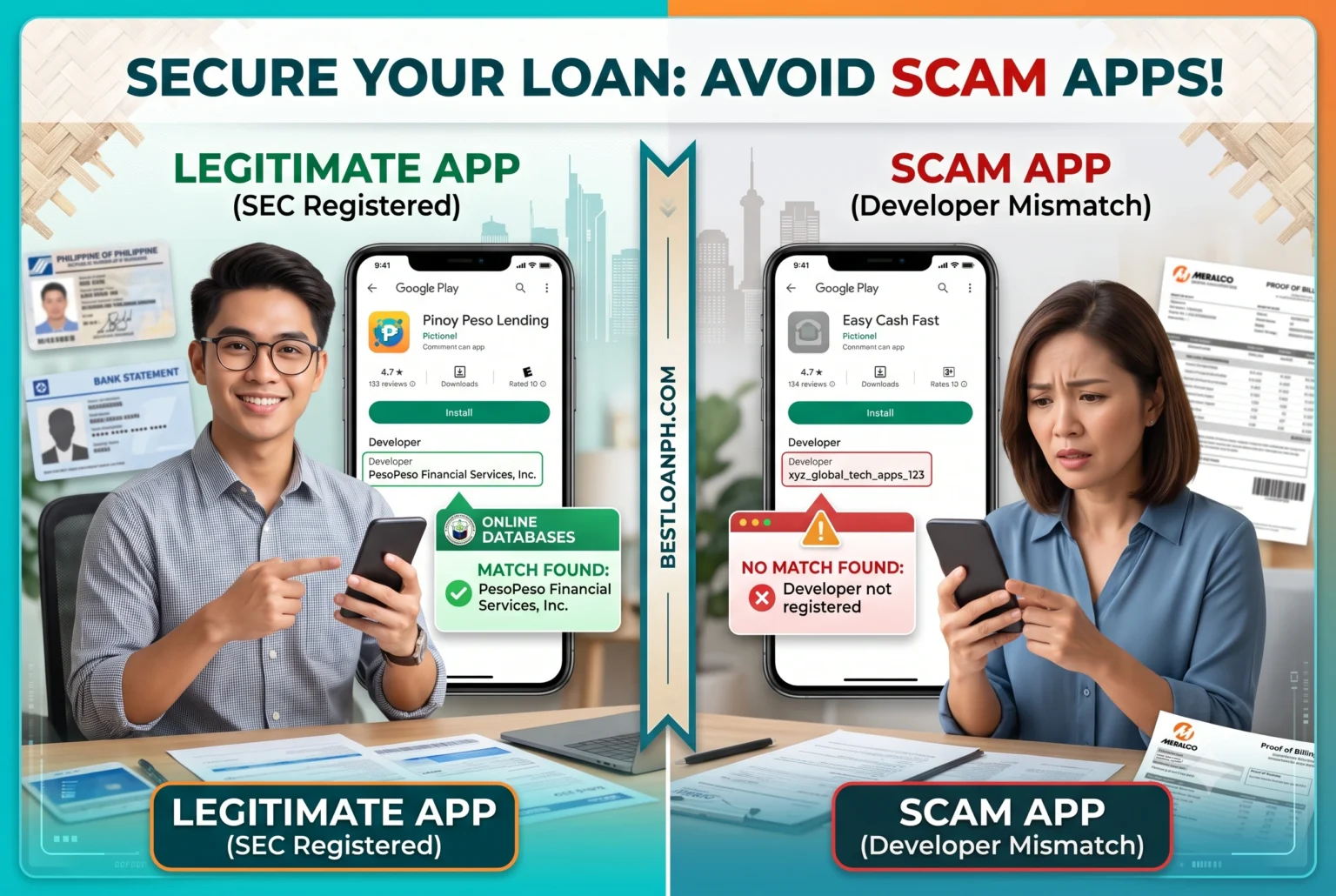
Matching the app store developer name to the SEC corporate entity is the only way to expose “cloned” lending apps that steal legitimate CA numbers to trick borrowers.
This is a specific technical check that standard financial advice often misses. Scammers know borrowers are starting to look for CA numbers. To bypass this, illegal operators simply copy the CA number and corporate name of a highly reputable, quiet financing company and paste it into their fake app’s description.
When you look at the app in the Google Play Store or Apple App Store, look just beneath the app’s title. You will see the developer’s name. If a legit app is registered to “Acme Finance Philippines Corp” on the SEC list, the developer name should be identical, or clearly tied to the parent company. When we investigated a notorious scam app last year, the app claimed the CA number of a Makati-based financing firm, but the Google Play developer was listed as a random personal email address or a vaguely named foreign tech entity. That mismatch is your loudest warning bell.
What Are The Warning Signs That An SEC Registered Cash Loan App Is Actually A Scam?
Warning signs of a scam app include demanding upfront fees before disbursing funds, forcing access to your phone contacts, and offering guaranteed approvals without identity verification.
Even if an app manages to spoof its way into looking somewhat legitimate, the operational mechanics of the platform will quickly reveal its true nature. Legal lending companies assess risk; scammers rely on extortion.
Why Do Scam Lenders Ask For Upfront Processing Fees?
Scam lenders ask for upfront fees to steal your money directly without ever intending to release a loan, exploiting borrowers who are desperate for fast cash.
If you are ever told your ₱10,000 loan is approved but you must first send a ₱500 “processing fee” or “insurance deposit” via an e-wallet, you are dealing with a fraudster. In the legal, regulated banking and digital lending space, all origination fees, service charges, and documentary stamp taxes are deducted straight from the principal loan amount. If you borrow ₱10,000 and the fees are ₱500, the lender deposits ₱9,500 into your account. No legitimate institution will ever require out-of-pocket payments before releasing funds.
How Do Shark Lenders Illegally Scrape Your Phone Contacts?
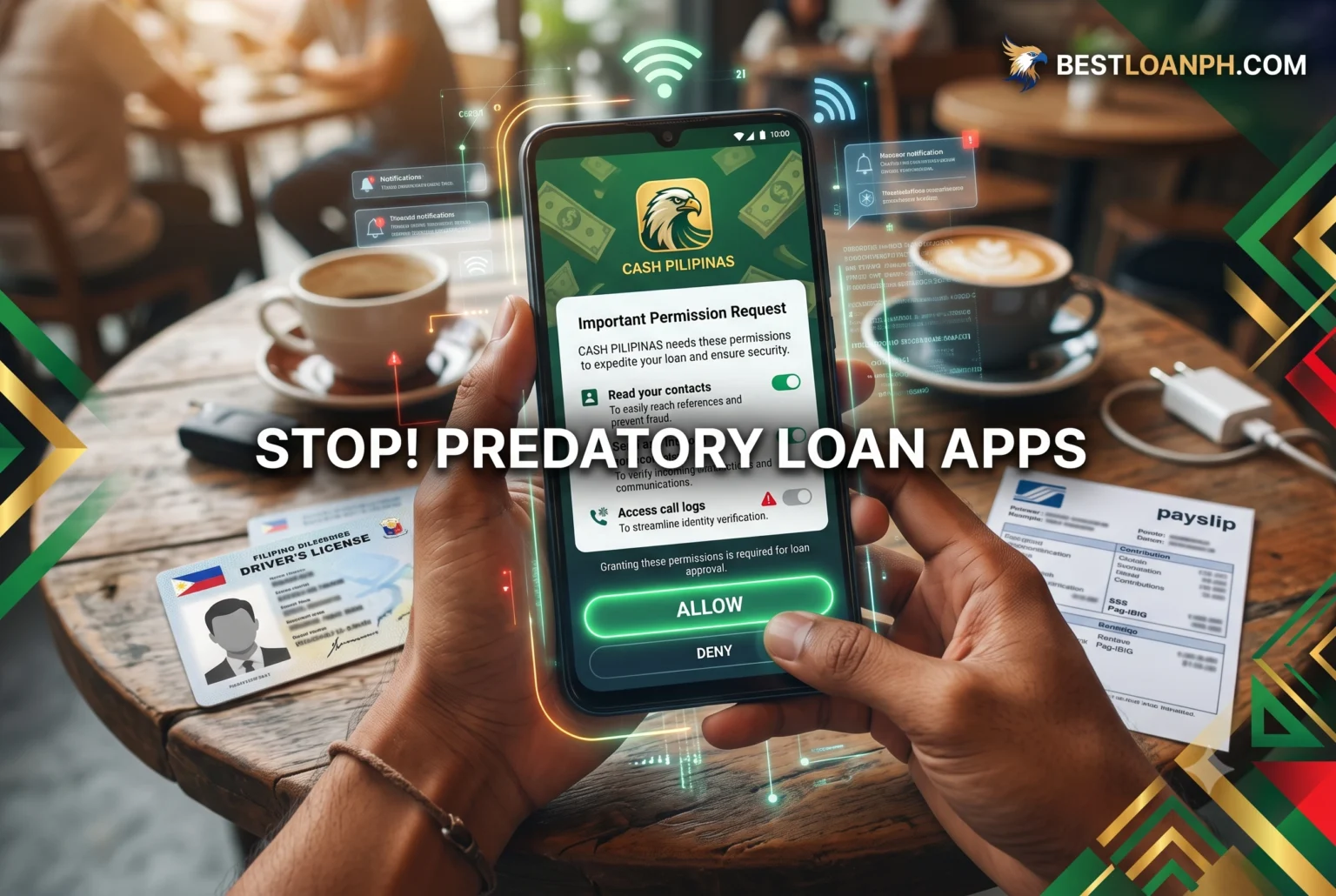
Shark lenders scrape your contacts by hiding broad permission requests within the app installation process, granting them remote access to your entire address book and text messages.
This is the exact mechanism that enables public shaming. When you install a predatory app, a prompt appears asking to “Allow access to Contacts” and “Allow access to SMS.” Borrowers, eager to get the funds, blindly tap accept. At that exact moment, the app’s underlying code copies your entire phonebook to their offshore servers.
When we deconstruct the code of these abusive apps, we see exactly how they build their extortion lists. They isolate contacts labeled “Mama,” “Boss,” or “HR,” guaranteeing they know exactly who to text to cause you the maximum amount of embarrassment. A safe, regulated app will only require camera permissions to scan your ID and take a liveness selfie, and location permissions to verify you are inside the Philippines. They do not need to read your texts or know who your mother is.
How Do You Report Harassing Loan Apps And Stop Unfair Collection Practices?
You can report abusive loan apps by filing a documented complaint with the SEC Financing and Lending Companies Division, the National Privacy Commission (NPC), and the PNP Anti-Cybercrime Group.
If you are already trapped in a cycle of harassment, you need to shift from passive victim to active reporter. Regulatory bodies in the Philippines are actively shutting down these syndicates, but they require detailed evidence from borrowers to issue Cease and Desist Orders.
What Are Your Rights Under SEC Memorandum Circular No. 18?
SEC Memorandum Circular No. 18 strictly prohibits unfair debt collection practices, including the use of threats, insults, public shaming, and contacting people not listed as your official guarantors.
You have the right to be treated with basic human dignity, regardless of your financial standing. This memorandum was explicitly drafted to combat the rise of digital loan sharks. It explicitly bans collection agents from threatening you with physical harm, using obscenities, or contacting anyone in your phonebook who did not explicitly sign as a co-maker. If an agent texts your coworker claiming you are a thief who ran away with company money, the lending company is violating national regulations and can lose their license to operate.
How Do You File A Formal Complaint With The NPC And PNP Anti-Cybercrime Group?
You must compile screenshots of all abusive messages, call logs, and app details, then submit them through the official complaint portals of the NPC and the PNP Anti-Cybercrime Group.
Do not delete the threatening texts. Take clear screenshots showing the sender’s number, the date, and the exact threatening language. We strongly advise organizing these into a single PDF or a well-labeled folder.
- National Privacy Commission (NPC): Because the app stole your contacts and shared your debt status with unauthorized third parties, this is a massive violation of the Data Privacy Act (DPA). Visit the NPC website and use their formal complaint form regarding unauthorized processing of personal information.
- PNP Anti-Cybercrime Group (ACG): For death threats and severe extortion, this becomes a police matter. You can message the PNP ACG through their official social media channels or visit a local desk to file a cyber-harassment report. Provide the exact GCash numbers or bank accounts the scammers are telling you to send payments to; authorities use these to freeze accounts.
What Happens If You Cannot Pay A High-Interest Online Loan Right Away?
If you cannot pay a high-interest online loan, your balance will accrue late fees and interest, and your credit score may drop, but you cannot face criminal charges or imprisonment for the debt itself.
The psychological toll of debt is heavy, but separating facts from empty threats will help you make rational financial decisions rather than panicked ones.
Can You Go To Jail For Unpaid Civil Debts In The Philippines?
No. The Philippine Constitution explicitly states that no person shall be imprisoned for debt, meaning unpaid loans remain a civil liability, not a criminal offense.
Scam collectors frequently use fake legal documents to intimidate borrowers. They will email PDFs that look like court subpoenas or text you claiming the barangay police are on their way to arrest you for “Estafa.” In my years analyzing this sector, I have reviewed hundreds of these messages – they are entirely fabricated. Estafa (fraud) involves deliberate deceit at the time the money was taken, not an inability to pay later due to financial hardship. If you took out a loan with the intention to pay, but simply ran out of funds, it is a civil issue. The worst a legitimate lender can do is file a civil case for collection in a small claims court, which is a calm, administrative process, not a police raid.
How Can You Secure Harassment-Free Installment Loans Instead?
You can secure safer funding by applying directly through BSP-regulated traditional banks, digital banks, or fully vetted fintech platforms that offer clear, capped interest rates.
If you need emergency funds, stop relying on random apps advertised on social media. Transition your search toward a legit online cash loan Philippines backed by recognized digital banks like Maya, CIMB, or Tonik. These institutions utilize robust credit scoring models rather than contact scraping, ensuring your privacy is respected.
When you seek out harassment-free installment loans, look for providers that clearly state their Effective Interest Rate (EIR) and late penalty caps. The Bangko Sentral ng Pilipinas (BSP) has strict caps on the interest rates small-value online loans can charge. Legitimate platforms adhere to these caps and offer restructured payment plans if you fall behind, focusing on recovering the funds professionally rather than destroying your reputation.
References
- Securities and Exchange CommissionOrganization: SEC PhilippinesResource: List of Registered Lending and Financing CompaniesURL: https://www.sec.gov.ph/lending-companies-and-financing-companies-2/list-of-registered-entities/
- National Privacy CommissionOrganization: NPC PhilippinesResource: How to File a ComplaintURL: https://www.privacy.gov.ph/complaints-assisted/
- Bangko Sentral ng PilipinasOrganization: BSPResource: Financial Consumer ProtectionURL: https://www.bsp.gov.ph/SitePages/InclusiveFinance/ConsumerProtection.aspx
Last Updated: July 13, 2026 by The Nomad Finance Girl (Jaycee)
