When financial emergencies strike in the Philippines, many borrowers turn to mobile loan applications for immediate relief. The appeal is understandable: digital platforms promise fast approvals and exact cash delivery without the paperwork required by traditional banks. However, the speed of online lending often masks expensive borrowing costs and aggressive repayment enforcement. Borrowers considering the Pera4u app frequently worry about whether the platform is legally authorized, what fees are hidden in the fine print, and whether the company utilizes embarrassing collection tactics if a payment is delayed. This review examines Pera4u based on official corporate records, public regulatory filings, published application terms, and independent borrower feedback to provide a clear picture of how the product actually operates.
Summary:
Pera4u is legally operated by U-PESO.PH LENDING CORPORATION, a registered Philippine lending company holding an active Certificate of Authority. While the platform advertises high loan limits and low daily interest rates, public regulatory records reveal a complicated operational history. The operator has faced scrutiny, including a 2023 SEC En Banc case and numerous Freedom of Information complaints, regarding allegations of unfair debt collection and unauthorized contact with borrowers’ phonebook connections. First-time applicants typically receive small limits, and upfront deductions can materially increase the true cost of borrowing. Prospective users should carefully evaluate the exact net proceeds and the platform’s data permissions before accepting a loan agreement.
| Borrower question | Current finding | Why it matters |
| Who is the legal operator? | U-PESO.PH LENDING CORPORATION | Establishes the exact corporate entity responsible for the loan contract and regulatory compliance. |
| Is it SEC-authorized? | Yes, under Certificate of Authority No. 2718 | Confirms legal standing, though it does not guarantee a frictionless or inexpensive borrowing experience. |
| What are the advertised limits? | ₱2,000 to ₱120,000 | Marketing figures often reflect theoretical maximums; first-time borrowers generally receive much lower amounts. |
| Are there collection concerns? | High friction reported | Official government complaint logs show a pattern of borrowers reporting aggressive tactics and third-party contact. |
| Does it require sensitive data? | Yes, app requests SMS permissions | Borrowers must carefully manage smartphone permissions to limit exposure of personal data. |
Is Pera4u a legitimate and SEC-registered lending company in the Philippines?
Yes. Pera4u is legally operated by U-PESO.PH LENDING CORPORATION under SEC Registration No. CS201814908 and Certificate of Authority No. 2718. However, holding a registration does not mean the platform is free from regulatory scrutiny or borrower complaints.
To determine legitimacy, borrowers must separate a company’s consumer-facing brand from its legal operating entity. According to official Securities and Exchange Commission (SEC) records, the Pera4u application is managed by U-PESO.PH LENDING CORPORATION. This entity possesses the required Certificate of Authority to operate a lending business in the Philippines, which technically classifies Pera4u as a legitimate financial product rather than an underground operation.
However, possessing a corporate registration does not mean a lender operates without friction. In 2023, U-PESO.PH LENDING CORPORATION became the subject of an SEC En Banc Case (No. 07-23-003). This regulatory action investigated the company’s online lending platforms – which include Pera4u, UPeso, PeraLending, and Loanmoto – regarding allegations of unfair debt collection practices. Borrowers must understand that while they are dealing with a registered company, the operational history includes documented regulatory friction concerning how debts are recovered.
How does the Pera4u application actually work?
The platform operates entirely online, requiring applicants to download the app, submit personal details, upload a valid government ID, and complete facial recognition. Borrowers must also grant the app specific permissions to access mobile device data.
Pera4u functions exclusively through a mobile ecosystem. The application process eliminates physical paperwork, replacing it with digital verification. Prospective borrowers are required to create an account, fill out a digital form with employment and contact information, and submit a photograph of a recognized government ID.
During installation, the application requires the user to grant access to various smartphone functions. The official app listing notes that core functionality depends on SMS content access (READ_SMS), which the company claims is used to send notifications and verify loan agreements. Applicants undergo an automated underwriting process that evaluates their submitted data. If approved, the platform generates a digital disclosure statement that the borrower must sign electronically before funds are dispatched to their chosen bank account or e-wallet.
How much can you borrow, and what does a Pera4u loan really cost?
While Pera4u advertises limits up to ₱120,000 with maximum annual rates of 20%, actual first-time approvals are usually much smaller. Borrowers must watch for upfront processing and service fees that heavily reduce the net cash received.
The marketing materials on the official Pera4u app listing present highly attractive terms. The platform advertises potential loan amounts ranging from ₱2,000 to ₱120,000, with flexible repayment terms spanning 91 to 365 days. The app also cites a maximum Annual Percentage Rate (APR) of 20%, which translates to a seemingly low daily interest rate of roughly 0.05%.
For most applicants, the reality of online lending differs significantly from marketing examples. Risk management algorithms typically restrict first-time borrowers to the minimum brackets – often limiting initial credit to just a few thousand pesos.
The true financial weight of the loan is usually found in deductions. Borrowers must examine the Disclosure Statement to verify the difference between the approved principal and the net proceeds. If a lender deducts processing fees or service charges prior to disbursement, the borrower receives less cash than requested but remains responsible for repaying the full principal plus interest. The Bangko Sentral ng Pilipinas (BSP) regulates interest rates on specific short-term unsecured loans, but high upfront fees can still cause the effective borrowing cost to spike aggressively.
How fast is Pera4u approval and disbursement?
The lender advertises automated processing, often claiming to send funds within 24 hours. However, actual disbursement speeds depend heavily on the chosen receiving channel, with weekends and banking holidays occasionally delaying settlement.
One of the primary selling points of Pera4u is its speed. Because the underwriting process relies heavily on automated data analysis rather than manual human review, applicants often receive an approval decision within minutes.
Disbursement of funds is generally executed through partnerships with major Philippine banks and electronic wallets like GCash and Maya. The platform states that approved amounts are deposited within 24 hours. While e-wallet transfers frequently clear in near real-time, borrowers choosing traditional bank transfers should anticipate standard banking cutoff times. Applications approved late on a Friday or during a national holiday may not reflect in a traditional bank account until the next operational business day.
What happens if you pay Pera4u late?
Missed payments trigger late fees and immediate collection efforts. Public records show a pattern of borrower complaints filed with the SEC regarding aggressive tactics, including agents contacting individuals in the borrower’s phonebook to demand payment.
When a borrower fails to settle a balance on or before the exact due date, the platform applies late penalties that rapidly inflate the outstanding debt. Beyond the financial cost, delinquency triggers the lender’s collection protocols.
Philippine law – specifically SEC Memorandum Circular No. 18, Series of 2019 – strictly prohibits unfair debt collection practices, including the use of threats, insults, or contacting individuals who are not explicitly named as guarantors. Despite these regulations, government Freedom of Information (FOI) portals contain numerous public complaints regarding Pera4u’s collection behavior. Multiple filers in 2023 reported that agents threatened them, sent messages to people in their contact lists, and threatened to contact their employers. Borrowers should treat the due date strictly to avoid triggering these high-friction recovery processes.
How does Pera4u handle your personal data?
The app requests extensive permissions upon installation, including access to SMS messages and contact lists. Despite Philippine privacy laws, multiple government complaints suggest the platform has used this data to pressure third parties during debt collection.
Data privacy is a major concern with digital lending platforms. The National Privacy Commission (NPC) has issued clear directives prohibiting lending applications from harvesting entire phonebooks or indiscriminately scraping social media data to evaluate creditworthiness or track down delinquent clients.
Despite these safeguards, the technical architecture of many lending apps requires broad permissions to function. Pera4u explicitly requests SMS access. More troubling are the persistent borrower reports documented by the SEC indicating that the platform has accessed personal contact lists. Complaints explicitly state that agents messaged family members and friends to publicly shame borrowers into paying. Additionally, some users have reported receiving unprompted loan disbursements they never applied for, which raises serious questions about how securely user data and account linkages are managed after an initial transaction.
What are borrowers saying about Pera4u?
Feedback is starkly divided. The official app listing shows high ratings praising fast cash delivery. Conversely, independent public records and government portals contain numerous reports of unexpected charges, short terms, and aggressive debt collection practices.
On official digital storefronts, Pera4u maintains a strong rating (approximately 4.8 stars), backed by millions of reviews. Positive feedback generally highlights the convenience of the app, the lack of collateral requirements, and the speed at which funds are deposited for successful applicants.
However, looking outside of controlled app listings reveals a different narrative. The Philippine government’s eFOI portal hosts dozens of complaints aimed at U-PESO.PH platforms. Independent reports frequently focus on actual repayment periods feeling much shorter than the advertised 91 days, sudden deductions reducing the cash in hand, and the intense psychological stress caused by collection agents contacting extended family networks. This dichotomy suggests that while the app functions well as a fast cash delivery system, it becomes highly volatile for borrowers who stumble on repayment.
What are the main advantages and disadvantages of Pera4u?
The primary advantage is fast, paperless access to unsecured credit from a registered corporate entity. The major drawbacks include documented reports of aggressive collection tactics, invasive smartphone data permissions, and potentially high effective borrowing costs.
Potential Advantages:
-
Identifiable Operator: The platform is backed by a registered SEC entity, providing a documented trail of accountability.
-
Digital Convenience: Applications require zero physical paperwork and process rapidly.
-
Accessibility: Unsecured loans are available to individuals without formal credit histories or collateral.
Potential Disadvantages:
-
Collection Friction: Significant public documentation indicates aggressive debt recovery methods involving third-party contacts.
-
Cost Deductions: Processing and service fees can heavily dilute the net cash actually disbursed to the borrower.
-
Data Privacy: Required device permissions create vulnerabilities regarding personal contacts and SMS messages.
Who may find Pera4u relevant, and who should be especially cautious?
This service may suit individuals facing sudden emergencies who have guaranteed income arriving within days. Borrowers should avoid this product if they lack stable employment, need long-term financing, or plan to use the funds to repay existing debts.
Pera4u occupies the space of short-term emergency financing. It is most relevant for a borrower who experiences an unexpected cash shortfall – such as a medical expense or urgent utility bill – and knows with absolute certainty that sufficient funds to cover the total repayment will arrive on their next salary date.
Conversely, this product poses high risks for individuals with unstable cash flow. A borrower should be especially cautious if they are considering taking out a Pera4u loan to pay off another lending app. Because of the rapid accumulation of late fees and the documented intensity of the collection process, using this service without a concrete exit strategy can quickly trigger an unmanageable debt cycle.
What should you check before accepting a Pera4u loan offer?
Always read the official Disclosure Statement before confirming the transaction. Calculate the exact difference between the approved principal and the net cash you will receive, and verify the exact date the full repayment is due.
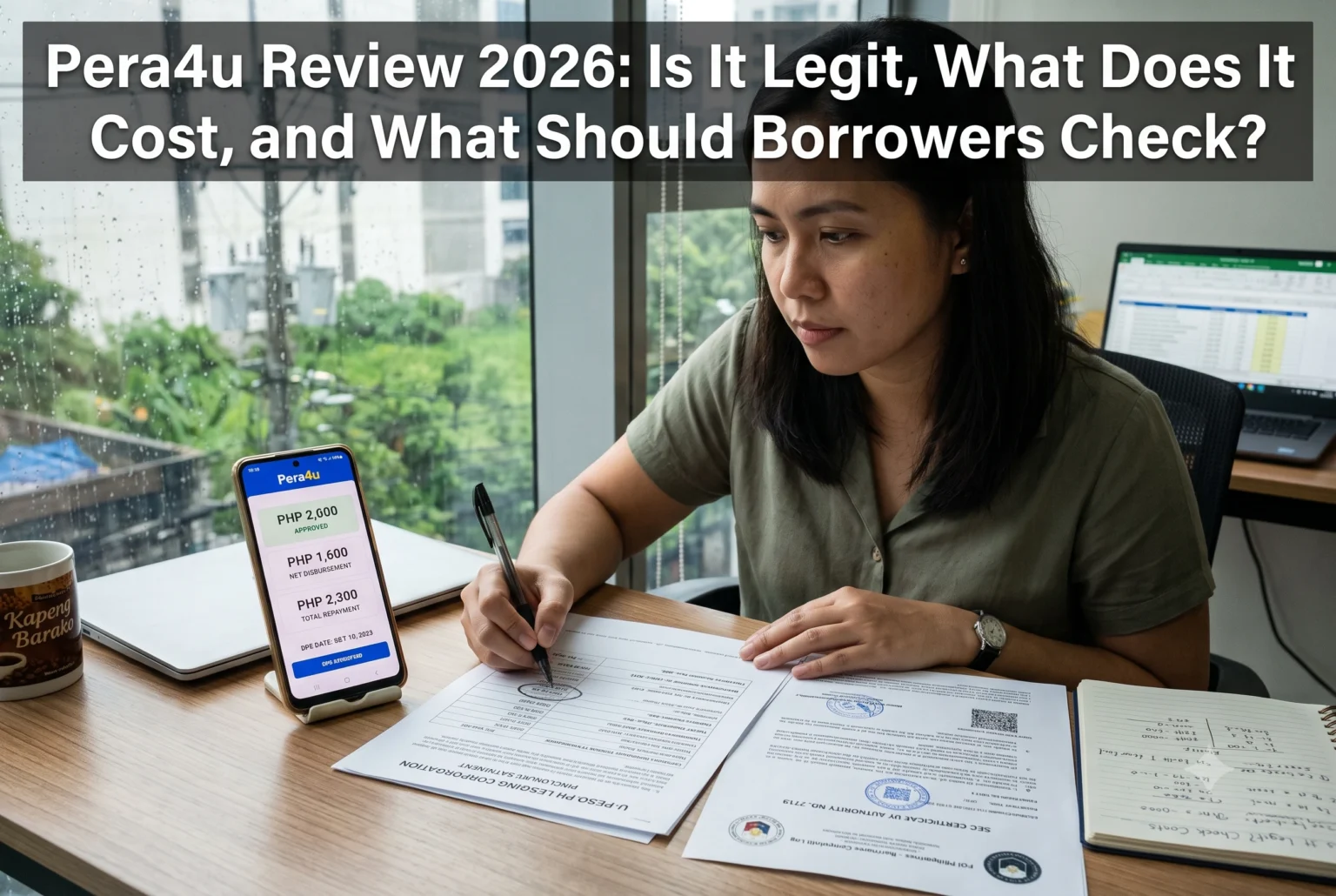
Philippine lending regulations require all financing companies to provide a transparent Disclosure Statement before a loan is finalized. Before tapping “accept” inside the Pera4u app, a borrower must confirm three critical numbers.
First, verify the Net Proceeds – this is the actual peso amount that will enter your bank account, not the total loan limit. Second, verify the Total Repayment Amount, which includes the principal, interest, and any deferred fees. Finally, check the Exact Due Date. Do not rely on marketing claims of “up to 365 days.” The contract will state the specific day the funds must be returned. If the repayment timeline conflicts with your expected salary schedule, cancel the application to avoid immediate late penalties.
Frequently Asked Questions
Can Pera4u send you to jail for unpaid debt?
In the Philippines, non-payment of an ordinary civil debt does not carry a prison sentence. The constitution protects citizens from imprisonment purely for owing money. However, if a borrower uses forged documents, fake IDs, or deliberate deception to acquire the funds, they may face distinct criminal charges for fraud or estafa, which are punishable by law.
How can I file a complaint about unfair collection practices?
If a lending company uses threats or contacts individuals outside of your listed guarantors, you can file a formal grievance. Complaints regarding debt collection harassment should be directed to the SEC’s Financing and Lending Companies Division (FLCD). Issues specifically involving the unauthorized scraping of phonebook contacts can be reported to the National Privacy Commission (NPC).
Can I repay my Pera4u loan before the due date?
Yes. Philippine consumer protection standards generally allow borrowers to settle their obligations early. Check the application for specific early repayment channels, usually processed via e-wallets or over-the-counter payment centers. Keep all payment receipts and screenshots as proof of settlement until the app dashboard reflects a closed account.
Conclusion
Pera4u operates legally in the Philippines under a verified corporate entity, providing fast access to emergency funds without collateral requirements. However, the convenience of the application is balanced against serious documented risks. Public records show a persistent pattern of borrowers struggling with the platform’s collection tactics, particularly regarding the unauthorized use of smartphone contact lists to enforce payments. When considering this lender, decisions must be driven by strict affordability. If the upfront fees significantly reduce the value of the loan, or if you cannot guarantee full repayment by the exact contractual due date, the severe late penalties and aggressive collection environment make this an unsuitable financial option.
References
-
Securities and Exchange Commission – FOIOrganization: Securities and Exchange Commission PhilippinesResource: U-Peso.Ph Lending Corporation with Online Lending Platforms Operating Under The Name Of Upeso, Pera4u, Peralending, And Loanmoto. SEC En Banc Case No. 07-23-003. RESOLUTION.
-
Pera4u Lending App Harassment – FOIOrganization: Freedom of Information PhilippinesResource: FOI Request #SEC-837966677458
-
Harassment by Pera4u Lending App – FOIOrganization: Freedom of Information PhilippinesResource: FOI Request #SEC-578375727613
-
Pera4u App Store ListingOrganization: Google PlayResource: Pera4u Application Details
Last Updated: October 1, 2026 by The Nomad Finance Girl (Jaycee)
