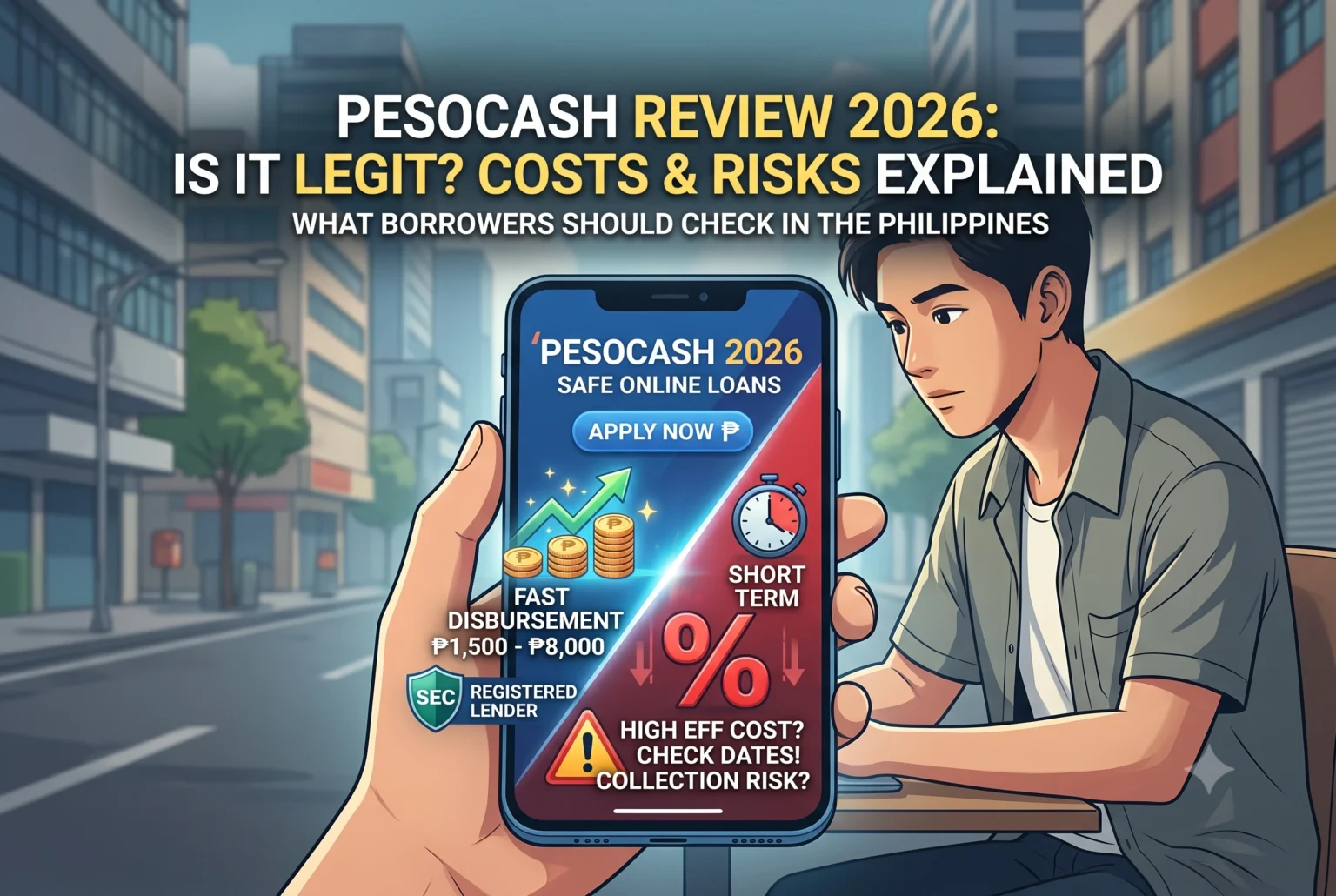
Many Filipinos turn to online lending apps during cash emergencies, prioritizing fast approval over strict terms. While quick disbursement solves immediate problems, borrowers frequently face unexpected deductions, short repayment windows, and aggressive debt collection tactics. This review investigates Pesocash, analyzing its legal standing in the Philippines, true borrowing costs, data privacy practices, and recurring borrower complaints to help you evaluate the financial risk before accepting a loan offer.
Summary:
Pesocash is a legally registered lending platform operated by MyLoan Lending Investors Inc. under the oversight of the Philippine Securities and Exchange Commission (SEC). While it possesses the necessary regulatory authority to issue loans, prospective borrowers must clearly separate legal registration from favorable lending conditions. Advertised terms suggest maximum limits of ₱8,000 with up to 210-day tenors, yet recent borrower feedback strongly indicates shorter terms and high effective costs in practice. Most notably, a high volume of consumer complaints in 2025 and 2026 cite severe collection harassment, including unauthorized contact with employers. Borrowers must verify their exact net proceeds and due dates in the final disclosure statement before confirming any transaction.
| Borrower question | Current finding | Why it matters |
| Legal Operator | MyLoan Lending Investors Inc. (Android) / Ceimmarj Financing Inc. (iOS) | Establishes an identifiable corporate entity accountable to the SEC. |
| Regulatory Status | SEC-registered; Certificate of Authority No. 2866 | Confirms authority to lend, but does not guarantee fair or inexpensive terms. |
| Advertised Loan Range | ₱1,500 to ₱8,000 | First-time borrowers generally qualify only for the minimum amount. |
| Advertised Tenor | 120 to 210 days | Actual contracts generated in the app may enforce significantly shorter terms. |
| Net Proceeds | Principal minus a transaction fee (e.g., ₱25 to ₱130) | Determines the actual cash disbursed to your e-wallet or bank account. |
| Collection Risk | High volume of harassment complaints | Borrowers repeatedly report the lender contacting their employers and private contacts over late payments. |
Is Pesocash legitimate and properly authorized in the Philippines?
Yes. On Android, Pesocash is operated by MyLoan Lending Investors Inc. (SEC Registration CS201900197, Certificate of Authority No. 2866). While legally authorized by the SEC to operate as a lending company, regulatory registration does not shield borrowers from high costs or aggressive collection practices.
Who legally operates Pesocash?
The legal identity of Pesocash depends slightly on the platform you use. According to the current Google Play Store listing, the Android application “Pesocash – Safe Online Loans” is published by MyLoan Lending Investors Inc. This corporation holds an active SEC registration (CS201900197) and a Certificate of Authority to Operate as a Lending Company (No. 2866).
Interestingly, iOS users searching the Apple App Store will find “Mega Peso-PesoCash&Lending App,” which lists CEIMMARJ FINANCING INCORPORATED (SEC Registration CS200308112, CA No. 330) as the developer. Both are legitimate, SEC-registered financial entities. This dual-entity structure is common in the Philippine fintech sector, where platform branding and legal lending partners frequently overlap.
Does legal registration guarantee a safe experience?
A Certificate of Authority confirms that a company has met the minimum capital and compliance requirements to operate legally. It means the lender is identifiable and subject to Bangko Sentral ng Pilipinas (BSP) and SEC regulations regarding interest rate caps and disclosure rules. However, holding a license does not mean a lender’s product is inexpensive, nor does it guarantee that third-party collection agencies acting on their behalf will follow fair collection guidelines.
How much can you actually borrow from Pesocash?
The platform advertises limits between ₱1,500 and ₱8,000. However, public documentation and typical Philippine fintech underwriting indicate that first-time borrowers are almost exclusively approved for the minimum amount until they build a positive repayment history.
Advertised limits versus actual approvals
The official app listing promotes a maximum loan ceiling of ₱8,000. While this figure attracts applicants, the amount you actually receive depends heavily on the platform’s automated underwriting system. Like most Philippine online lending apps, Pesocash limits risk on new accounts. An applicant without an established repayment history on the app should expect an initial limit closer to the ₱1,500 minimum.
Why might a first-time borrower receive less?
Online lenders do not typically rely on traditional Credit Information Corporation (CIC) credit scores alone. Instead, they use alternative data points gathered during the application process, such as device information and basic identity verification. Because this poses a higher default risk to the lender, initial credit limits are kept low. Upon successful repayment of the first loan, algorithms generally trigger incremental limit increases for subsequent applications.
What does a Pesocash loan really cost?
According to the lender’s published sample, an ₱8,000 loan for 150 days incurs a ₱25 transaction fee and ₱600 in total interest. However, actual borrowers frequently report higher effective costs and shorter repayment periods once the real loan contract is generated.
Advertised interest and deductions
Transparency in pricing is a primary concern for Philippine borrowers. Based on the public disclosure on their app page, Pesocash claims a maximum Annual Percentage Rate (APR) of 18.25%, translating to a 0.05% daily interest rate. The listing also notes a variable transaction fee ranging from ₱25 to ₱130, charged in advance by the disbursement channel, and claims a 0% service fee.
Net proceeds calculation
Using the lender’s own 2026 marketing example:
-
Requested Principal: ₱8,000
-
Term: 150 days
-
Transaction Fee: ₱25 (deducted upfront)
-
Amount Received (Net Proceeds): ₱7,975
-
Total Interest: ₱600 (₱8,000 * 0.05% * 150 days)
-
Total Repayment: ₱8,600
While this calculation appears highly competitive, borrowers must apply a high degree of skepticism. Online lending platforms frequently present long-term (120 to 210 days) scenarios in their public marketing. In practice, actual first-time borrowers often encounter short-term contracts (e.g., 7 to 15 days) with front-loaded processing fees that dramatically increase the effective cost of borrowing. Always calculate the exact difference between the cash you receive and the total amount due before clicking accept.
What happens if you pay Pesocash late?
Late payments trigger daily penalties and initiate immediate debt collection procedures. A consistent pattern of 2025 and 2026 borrower reviews indicates that Pesocash collections agents may begin calling days before the due date and frequently contact a borrower’s employer if payments are missed.
Debt collection and early reminders
The most prominent risk associated with Pesocash is its collection behavior. Recent user feedback across the Google Play Store and Philippine financial discussion boards highlights aggressive tactics. Borrowers report that collection agents do not wait for the loan to become delinquent; they often begin sending text messages and making phone calls several days before the actual due date. Some users have reported agents intentionally demanding payments days prior to standard salary schedules, causing significant financial stress.
Employer contact and harassment complaints
Under SEC regulations, lending companies are strictly prohibited from using abusive, deceptive, or unfair debt collection practices, which includes threatening to ruin a borrower’s reputation or making unauthorized contact with third parties. Despite this, numerous specific complaints in 2025 and 2026 allege that Pesocash collection agents have emailed employers directly and threatened to distribute the borrower’s submitted identification photos. While a loan default is a civil matter and does not result in imprisonment in the Philippines, the reputational damage caused by these collection practices represents a material risk for any applicant.
How does Pesocash handle your personal data?
The app requires access to personal information, financial data, device identifiers, and potentially contact lists. Multiple public complaints filed with the National Privacy Commission (NPC) allege that related entities misuse this data to harass third parties during collection efforts.
App permissions and privacy risks
To evaluate creditworthiness without traditional collateral, Pesocash requests a variety of permissions upon installation. According to its data safety listing, the app collects personal info, financial info, and device IDs. While the developer states that data is encrypted in transit and users can request deletion, the application of this privacy policy remains a point of contention among users.
Borrower complaints regarding data use
The National Privacy Commission (NPC) has historically monitored online lending apps for violations of the Data Privacy Act of 2012. Independent FOI (Freedom of Information) requests and public forums reveal a trail of grievances related to how Pesocash handles personal data. Borrowers consistently express alarm that the contacts and employment information provided during the application process are weaponized against them during debt recovery.
What are borrowers saying about Pesocash in 2026?
While some users praise the fast application process and reliable disbursements, the vast majority of recent feedback centers on severe debt collection harassment. Numerous borrowers report extreme stress caused by unauthorized emails to their workplaces and relentless early payment reminders.
Recurring complaints
An analysis of recent independent borrower reviews reveals several distinct patterns:
-
Premature collections: Users report receiving aggressive calls up to three days before their loan is actually due.
-
Workplace harassment: Multiple forum discussions highlight agents sending emails directly to company HR departments or managers regarding the borrower’s debt.
-
High effective rates: Many borrowers note that the actual interest and fees charged make repayment exceptionally difficult, contradicting the low advertised marketing rates.
Positive feedback
Where positive reviews exist, they typically focus on the speed of the transaction. Borrowers who pay on time or early note that funds are credited reliably to their accounts and that the application process is largely free of complex paperwork.
Who may find Pesocash relevant, and who should be cautious?
Pesocash may serve borrowers who require a small, immediate cash injection and have absolute certainty they can repay on time. However, anyone with unstable income should exercise extreme caution due to the aggressive collection tactics deployed upon default.
Conditional suitability
This application may be suitable for a borrower who:
-
Requires a minor amount (under ₱3,000) for a strict emergency.
-
Has a guaranteed, verifiable source of income arriving on or before the due date.
-
Understands the exact peso cost of the loan and is comfortable with the upfront deductions.
When to avoid this platform
A borrower should avoid applying if:
-
They are borrowing merely to pay off another online loan (debt spiraling).
-
Their income timing is unpredictable or relies on promised funds that may be delayed.
-
They are highly sensitive to aggressive phone calls or potential workplace embarrassment.
What should you verify before accepting a Pesocash loan?
Before confirming the loan, heavily scrutinize the electronic disclosure statement. Specifically check the exact net proceeds, the final due date, and the total repayment amount, as these frequently differ from the platform’s marketing claims.
Do not rely solely on the promotional material found on the app store listing. Philippine lending regulations require companies to provide a clear Disclosure Statement before you finalize the loan. You must verify:
-
The Net Proceeds: How much cash will actually arrive in your account after all transaction and service fees are subtracted?
-
The Due Date: Ensure the exact date matches your payroll or expected cash inflow. Do not assume you will receive a 150-day term.
-
The Total Repayment: Calculate the exact peso amount required to close the account.
-
The Penalty Structure: Review the daily late fees applied if you miss the deadline.
If the terms presented in the final contract do not align with your financial capacity, you have the right to cancel the application before the funds are disbursed.
References
-
Pesocash – Safe Online LoansOrganization: Google Play StoreResource: Official App Listing (MyLoan Lending Investors Inc.)
-
Beware of PesocashOrganization: Reddit (r/ola_harassment)Resource: Borrower Experience Discussions
-
Mega Peso-PesoCash&Lending AppOrganization: Apple App StoreResource: Official App Listing (CEIMMARJ FINANCING INCORPORATED)
-
National Privacy Commission – FOIOrganization: eFOI PhilippinesResource: Public Requests and Complaints Registry
Last Updated: September 30, 2026 by The Nomad Finance Girl (Jaycee)
