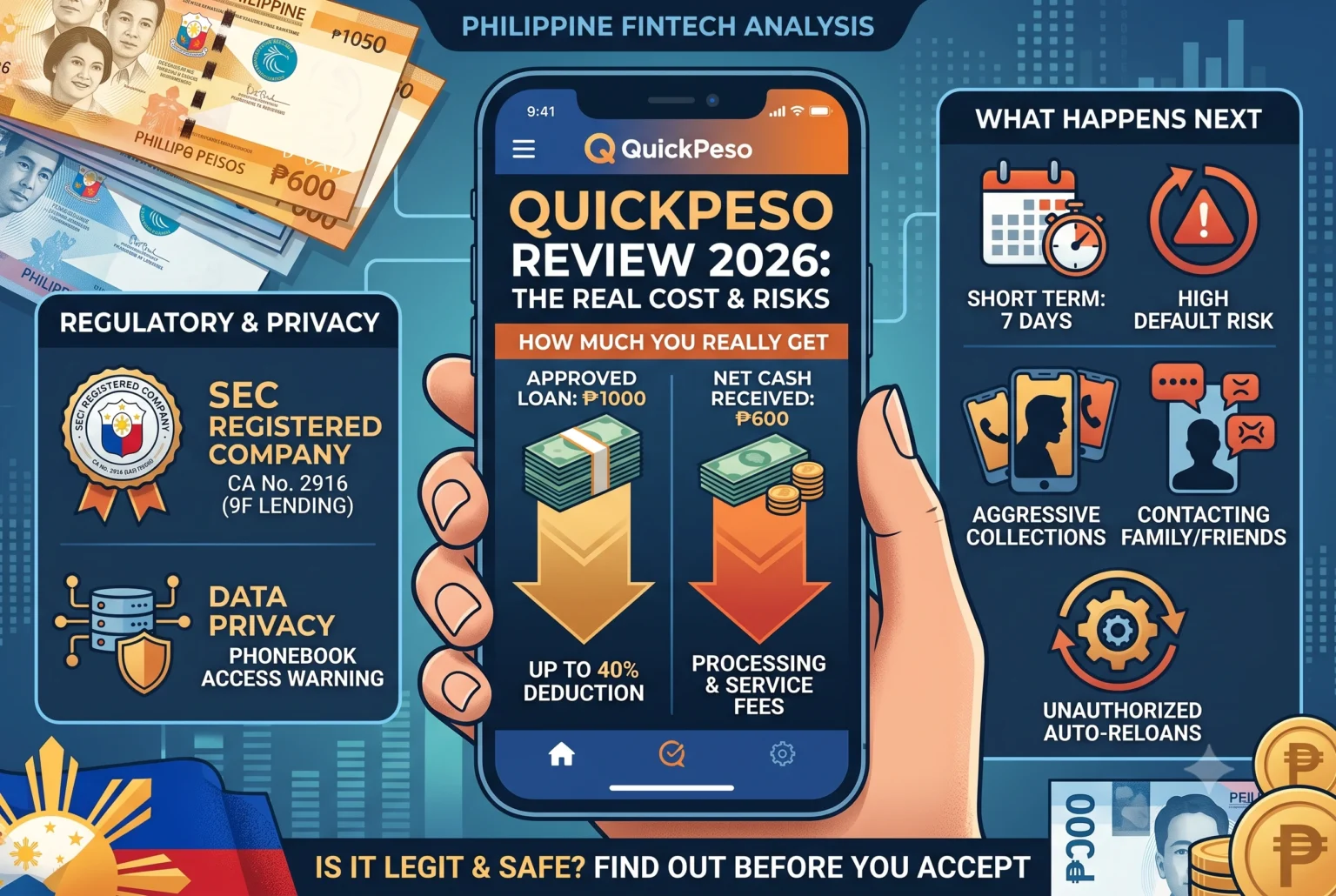
Many Filipinos turn to online lending apps during financial emergencies, expecting a straightforward transaction. The reality often involves a shock: seeing a significantly smaller amount deposited into their bank account than the loan they applied for, followed by collection texts arriving days before the money is actually due.
QuickPeso – which is also occasionally referred to in borrower communities as Peso Q or Peso notes – is a frequently discussed online lending application in the Philippines. This review investigates its legal operator, the actual peso cost of its loans, the gap between advertised terms and net proceeds, and the aggressive collection patterns reported by recent borrowers.
Summary:
QuickPeso is an online lending platform operated by 9F Lending Philippines Incorporated, a company that holds an active Securities and Exchange Commission (SEC) registration and Certificate of Authority. However, corporate legitimacy does not guarantee a safe borrowing experience. Recent borrower feedback highlights severe financial and privacy risks, including upfront fee deductions approaching 40% of the loan amount, unauthorized “auto-reloans” disbursed without final consent, and aggressive collection agents contacting phonebook contacts. Borrowers must weigh these extreme costs and data risks carefully against the convenience of fast cash.
| Borrower question | Current finding | Why it matters |
| Legal operator | 9F Lending Philippines Incorporated | Establishes the exact entity legally responsible for the platform. |
| Regulatory status | Registered with SEC (CA No. 2916) | Confirms basic corporate authorization to operate a lending business. |
| Net proceeds | Up to 40% deducted upfront | Borrowers receive significantly less cash than the principal they must repay. |
| Repayment term | Often reported as 7 days | Creates a high risk of default for borrowers waiting for standard 15-day salary cycles. |
| Collection practices | High risk of unauthorized contact | Reviewers consistently report agents messaging personal contacts and threatening social media exposure. |
| App availability | Frequently removed from official stores | Forces users to download APKs or use alternative brand names, increasing security risks. |
Is QuickPeso legitimate and properly authorized in the Philippines?
Yes. QuickPeso is operated by 9F Lending Philippines Incorporated, which appears in current SEC records as an authorized lending company (CA No. 2916). However, holding a corporate license does not mean the platform’s collection practices or fee structures comply with all consumer protection regulations.
Who legally operates QuickPeso?
The consumer-facing brand “QuickPeso” is owned and operated by 9F Lending Philippines Incorporated. According to the official list of SEC-registered financing and lending companies, the corporation operates multiple platforms, including Pesoclick and Amihan. Knowing the legal operator is essential because any formal complaints filed with regulators must be directed at the registered corporation, not just the app name.
Does SEC registration guarantee safe borrowing?
A common misconception among borrowers is that an SEC Certificate of Authority acts as a government endorsement of an app’s fairness. It does not. The SEC registration simply means the company has met the minimum capitalization and paperwork requirements to legally lend money. It does not prevent a lender from charging exorbitant processing fees, nor does it mean their third-party collection agencies always strictly adhere to fair collection guidelines.
What does a QuickPeso loan really cost?
The true cost is extremely high. While advertised rates may appear standard, borrowers report that QuickPeso deducts approximately 40% of the requested principal upfront as processing fees, forcing users to repay the full amount within 7 days.
Advertised claims vs. net loan proceeds
Many online lenders advertise low monthly interest rates to attract applicants. The actual financial burden usually hides in the service and processing fees deducted before the money is even sent.
Based on recurring reports from recent borrowers, the deductions on a QuickPeso loan are severe. A borrower who applies for a small short-term loan – for example, a ₱700 limit – often receives only around ₱420 in their e-wallet or bank account.
The reality of processing fees and short terms
When calculating the cost of credit, you must look at the net cash received versus the total repayment.
If you receive ₱420 but are contractually obligated to repay ₱700 one week later, the ₱280 difference acts as the cost of borrowing. That ₱280 represents a roughly 66% premium on the cash you actually held, charged over just seven days. Annualized, this effective interest rate reaches predatory levels, making it nearly impossible for a borrower to use the service regularly without falling into a debt trap.
How fast is QuickPeso approval and disbursement?
Approval is generally fully automated and rapid, often taking just minutes. However, multiple borrowers have reported a predatory “auto-disbursement” bug or feature, where funds are deposited into accounts without final consent.
The “auto-disbursement” phenomenon
QuickPeso utilizes an automated underwriting system, meaning applicants can receive funds almost immediately after submitting their ID and selfie verification. While speed is the primary reason borrowers use the app, it comes with a documented hazard.
Recent discussions in Philippine financial forums highlight a concerning pattern: users claim that after paying off a previous loan, QuickPeso automatically disbursed a new loan to their account without them pressing an “apply” or “accept” button. Because the upfront fees are so high, borrowers are instantly forced into a new debt cycle. If you only receive 60% of the loan amount but owe 100%, an unrequested disbursement immediately costs you money.
What happens if you pay QuickPeso late?
Late payments trigger aggressive collection tactics. Borrowers frequently report that QuickPeso agents begin sending threatening messages to the borrower and their unauthorized phonebook contacts even before the actual due date arrives.
Collection practices and borrower harassment
The Philippine lending sector has specific rules against unfair debt collection practices, outlined in SEC Memorandum Circular No. 18, series of 2019. Despite these regulations, QuickPeso’s collection efforts are frequently cited by borrowers as highly aggressive.
Users report receiving hostile text messages and calls starting a day or two before the loan is actually due. Once an account becomes past due, late penalties accumulate daily, rapidly inflating the original balance.
Unauthorized contact with third parties
The most severe risk of defaulting on a QuickPeso loan is privacy invasion. Numerous borrowers have documented instances where collection agents messaged their family members, coworkers, and friends – people who were never listed as guarantors or reference contacts. Agents often threaten to post the borrower’s ID and picture on Facebook, labeling them as a scammer or thief.
How does QuickPeso handle your personal data?
Despite standard privacy policy claims, operational evidence suggests QuickPeso extracts and utilizes personal contact lists to pressure borrowers. Downloading the app outside official stores can grant it excessively broad device permissions.
Device permissions and privacy risks
When you install an online lending app, you are required to grant it specific permissions on your smartphone. While legitimate apps restrict this to the camera (for identity verification) and location (for fraud prevention), aggressive lending apps often require access to the device’s contact list.
By accepting the terms and conditions, borrowers technically consent to data processing. However, using scraped contact data to harass a borrower’s associates violates the National Privacy Commission’s strict guidelines on proportionality and unauthorized disclosure. Because QuickPeso has frequently disappeared from the Google Play Store – forcing users to download direct APK files – borrowers bypass standard Android security checks, leaving their device data highly vulnerable.
What are borrowers saying about QuickPeso in 2026?
Recent feedback is overwhelmingly negative. The most common complaints involve unauthorized auto-reloans, extremely high upfront deductions, and severe harassment of the borrower’s family and friends.
Recurring themes in recent feedback
We reviewed recent borrower discussions across platforms like Reddit’s Philippine finance and harassment-support communities. The feedback rarely focuses on app functionality; it almost exclusively centers on distress regarding collections.
Key themes include:
-
Premature harassment: Agents demanding payment and sending threats 24 to 48 hours before the actual deadline.
-
Ghost loans: Borrowers receiving small, highly taxed loan disbursements they did not apply for, usually after clearing their first balance.
-
Contact blasting: Humiliation tactics where agents text the borrower’s employer or distant relatives demanding they force the borrower to pay.
What are the main advantages and disadvantages of QuickPeso?
Potential Advantages:
-
Operated by an identifiable, SEC-registered legal entity (9F Lending Philippines Incorporated).
-
Underwriting and disbursement to local e-wallets or banks are exceptionally fast.
-
Accessible to individuals without a formal credit history or credit card.
Potential Disadvantages:
-
Exorbitant upfront processing fees that drastically reduce the net cash received.
-
Extremely short loan tenors (usually 7 days) that do not align with standard 15-day Philippine payroll cycles.
-
High likelihood of third-party contact harassment if a payment is missed.
-
Documented reports of funds being disbursed without the borrower’s explicit final consent.
Who may find QuickPeso relevant, and who should be especially cautious?
A loan with 40% upfront deductions and a 7-day term is an emergency measure of absolute last resort. QuickPeso may only be relevant to a borrower who faces a severe, immediate crisis (such as a medical emergency), knows with absolute certainty that they will receive funds from another source within five days, and fully understands that they will pay a massive premium for the cash.
A borrower should be especially cautious – and ideally avoid the platform entirely – if they are already struggling to pay off other online lending apps. Using QuickPeso to pay off another debt will accelerate a financial collapse due to the extreme processing fees. Anyone sensitive to workplace reputation or family privacy should also avoid the platform, given the documented collection tactics.
What should you check before accepting a QuickPeso loan?
If you decide to proceed with an application, verify these exact details before signing the digital contract:
-
Net Disbursement Amount: Look past the “Approved Limit.” Find the exact line item stating what will be deposited into your account.
-
Total Repayment Amount: Verify exactly how much you must send back.
-
The Due Date: Confirm the exact date. If it is 7 days from today and your salary arrives in 10 days, you will incur late fees and harassment.
-
App Permissions: Go into your phone’s settings and manually revoke access to your “Contacts” immediately after your identity is verified.
Frequently Asked Questions (FAQ)
Can QuickPeso post my debt on social media?
No. Threatening to post a borrower’s debt on Facebook or exposing their ID publicly is a direct violation of SEC Memorandum Circular No. 18, series of 2019, and the Data Privacy Act of 2012. However, rogue collection agents often make this threat anyway to induce panic.
How do I report online lending harassment in the Philippines?
If you experience harassment, unauthorized contact of your phonebook, or threats, you can file a formal complaint with the SEC Enforcement and Investor Protection Department, the National Privacy Commission (NPC), and the Cybercrime Investigation and Coordinating Center (CICC).
Can I be imprisoned for unpaid online loans?
Under Article III, Section 20 of the 1987 Philippine Constitution, no person shall be imprisoned for debt. Unpaid online loans are civil liabilities, not criminal offenses. You cannot go to jail simply for being unable to pay a high-interest loan, provided you did not use forged documents or commit deliberate fraud during the application.
Why did QuickPeso disburse funds without my final approval?
Numerous borrowers report experiencing this “auto-reloan” issue. It is a predatory tactic designed to lock users into paying high processing fees repeatedly. If this happens, do not spend the money. Document the unauthorized deposit immediately and report the platform to the SEC.
Conclusion
QuickPeso technically operates within the legal framework of Philippine corporate registration, but the actual lending product it offers carries massive financial and privacy hazards. The core issue is the mathematical reality of the loan: accepting a product that deducts roughly 40% of the principal upfront while demanding full repayment in seven days is a mathematical trap for most wage earners.
Before using QuickPeso, borrowers must strip away the marketing and look purely at the net cash received versus the total cash owed. If the cost of the money exceeds your ability to comfortably repay it by the upcoming due date, you are not solving a financial problem – you are buying a much larger, more stressful one.
References
-
Securities and Exchange Commission PhilippinesOrganization: Securities and Exchange CommissionResource: List of SEC Registered Online Lending Companies
-
SEC Memorandum Circular No. 18, Series of 2019Organization: Securities and Exchange CommissionResource: Prohibition on Unfair Debt Collection Practices of Financing Companies and Lending Companies
-
Reddit Philippines OLA Harassment CommunityOrganization: RedditResource: Borrower experiences and complaints regarding QuickPeso
Last Updated: September 30, 2026 by The Nomad Finance Girl (Jaycee)
