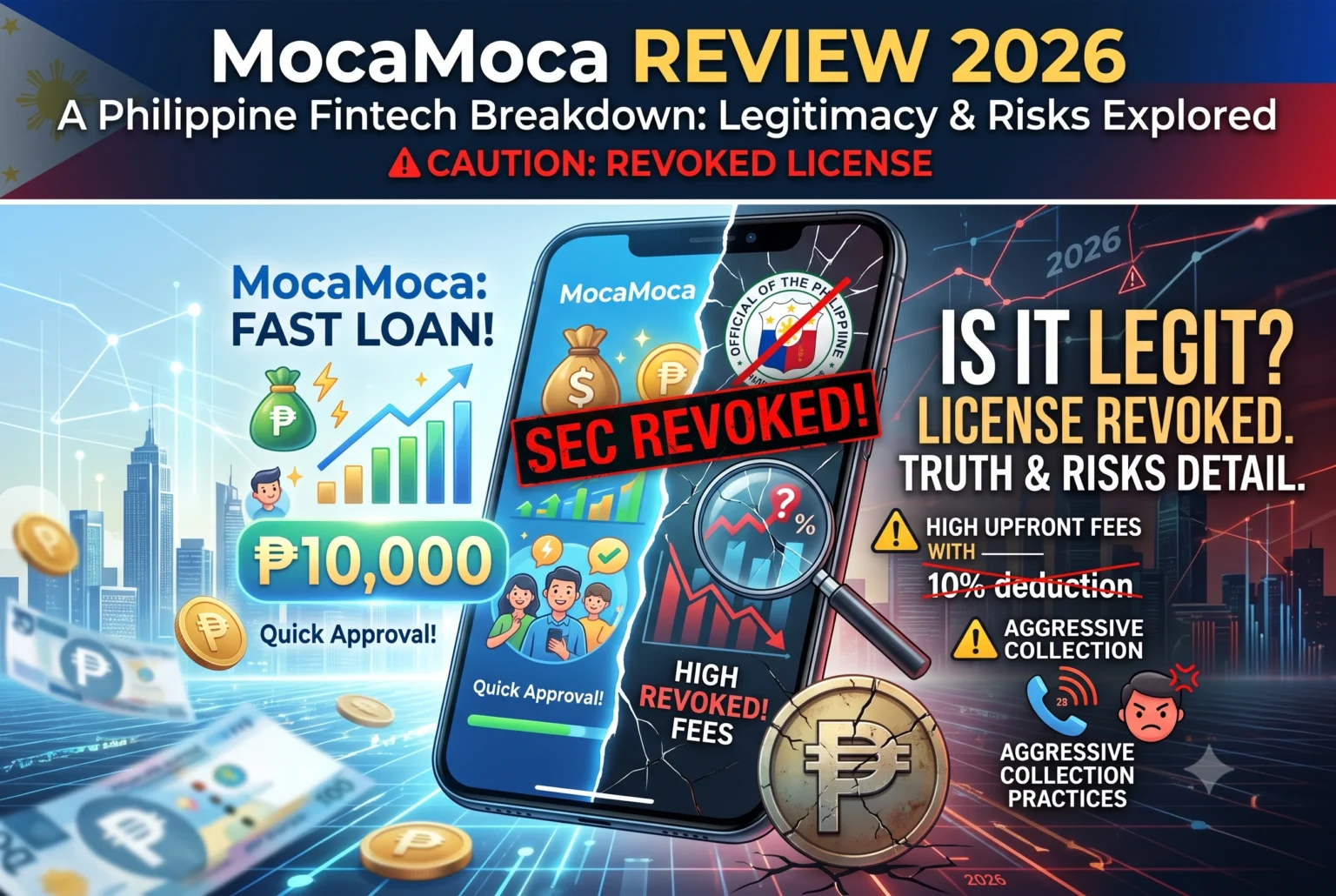
When researching fast cash applications in the Philippines, distinguishing between marketing claims and legal reality is critical. Many borrowers check an app’s store description, see an official-looking corporate registration number, and assume the platform operates under strict regulatory supervision. However, the presence of an app on Google Play does not guarantee that its operator remains authorized by the Philippine Securities and Exchange Commission (SEC). This review investigates MocaMoca, examining its legal status, actual borrowing costs, and the specific collection risks borrowers face.
Summary:
MocaMoca is a digital lending application operated by Copperstone Lending Inc. Crucially, while the app’s store listing continues to display corporate credentials, the SEC permanently revoked Copperstone Lending Inc.’s Certificate of Incorporation and lending license in April 2024 due to unfair debt collection practices. Despite this regulatory shutdown, the application remains accessible to Filipino borrowers in 2026. MocaMoca advertises loans from ₱2,000 to ₱50,000, but imposes upfront service fees of up to 10%, materially reducing the actual cash disbursed. Because it operates without a valid lending authority, borrowers lack standard regulatory protections and report facing aggressive, premature collection tactics. Proceeding with this unauthorized platform carries severe privacy and financial risks.
| Borrower question | Current finding | Why it matters |
| Is MocaMoca SEC-registered? | No. The SEC revoked Copperstone Lending Inc.’s license in April 2024 [2][3]. | Borrowing from an unauthorized entity severely limits your legal protections against abuse. |
| What are the actual fees? | Up to a 10% service fee and a maximum 20% APR [1]. | The service fee acts as an upfront deduction, meaning you receive less cash than your approved principal. |
| How much can you borrow? | Advertised at ₱2,000 to ₱50,000. | First-time applicants almost exclusively receive the minimum amount, not the advertised maximum. |
| Are there collection concerns? | Yes. The SEC cited the operator for illegal third-party contact and harassment [3]. | Recent borrower feedback indicates collection agents begin calling multiple days before the actual due date [1]. |
Is MocaMoca legitimate and SEC-registered in the Philippines?
No. While MocaMoca’s developer, Copperstone Lending Inc., previously held Certificate of Authority No. 3454, the SEC permanently revoked its corporate registration and lending license in April 2024 due to abusive practices. The platform is currently unauthorized to operate [3].
Who legally operates MocaMoca?
The consumer-facing brand MocaMoca is published by Copperstone Lending Inc. On its official website and app store listings, the company continues to claim SEC Registration No. 2021050012959-04 and Certificate of Authority (CA) No. 3454 [1][2]. In the Philippine regulatory framework, a CA is the specific license required to operate as a lending or financing company. Merely registering as a corporation is insufficient to legally issue loans.
Why did the SEC revoke the lender’s license?
According to official SEC enforcement actions published in April 2024, Copperstone Lending Inc. was stripped of its authority to operate due to severe violations of SEC Memorandum Circular No. 18 (MC 18), which governs fair debt collection practices. The regulatory body found that the company utilized threats, took actions that could not legally be taken, and contacted individuals in borrowers’ phone books who were not named as guarantors [3]. Furthermore, the SEC cited the company for failing to disclose the true and correct terms of its loan contracts. Despite this definitive revocation, the MocaMoca application remains visible online, presenting a significant hazard for consumers who do not independently verify SEC enforcement lists.
How much does a MocaMoca loan actually cost?
MocaMoca advertises an annual interest rate up to 20%, but the true cost is driven by an upfront service fee of 5% to 10%. This deduction means borrowers receive significantly less cash than the principal balance they must repay [1].
Advertised interest versus upfront deductions
The platform’s marketing materials emphasize a maximum Annual Percentage Rate (APR) of 20% and explicitly state there are “no hidden fees” [1]. However, MocaMoca applies a service fee ranging from 5% to 10% of the loan amount. While the app claims this fee is “charged upon repayment,” practical applications of similar models frequently treat service charges as direct deductions from the disbursed funds. When a lender subtracts a 10% service fee before releasing the funds, the effective cost of borrowing spikes dramatically, because the borrower is paying interest on money they never actually received.
Real-world peso cost calculation
Based on the public disclosure provided by the developer, a sample computation for a ₱5,000 loan over 180 days includes a 10% service fee (₱500) and a 10% APR calculation resulting in ₱246 of interest [1]. Under this exact scenario, the borrower is liable for a total repayment of ₱5,746. If the ₱500 service fee is deducted upfront – as is common practice among short-term online lenders – the net proceeds deposited into the borrower’s account would only be ₱4,500. Repaying ₱5,746 for a net receipt of ₱4,500 over six months represents a much higher effective interest rate than the nominal 10% advertised.
What are borrowers reporting about MocaMoca?
Recent 2026 borrower feedback highlights aggressive collection tactics, including relentless calls days before the due date, and loan approvals far below the advertised credit limits. Positive reviews generally center only on application speed [1].
Unfair collection patterns and early reminders
Anecdotal reports from the Google Play Store align closely with the reasons the SEC originally revoked Copperstone’s license. Multiple reviewers in late 2026 report intense communication friction, noting that collection agents begin calling and texting incessantly two to three days before the actual due date [1]. Borrowers who have excellent payment records express frustration that these early reminders cross the line into harassment, creating unnecessary anxiety for accounts that are not even delinquent.
Approved limits versus advertised maximums
While the app prominently advertises a maximum loan limit of ₱50,000, borrower reports indicate that first-time applicants rarely access amounts near this ceiling. A recurring theme in consumer feedback is the discrepancy between the “approved credit limit” shown in the app and the actual cash disbursed [1]. Users frequently report receiving only half of the amount they were led to believe they qualified for, which can leave them short of the funds required for their financial emergency.
What happens if you pay late or miss a payment?
Missing a payment triggers immediate financial penalties, but the primary risk involves severe collection harassment. The SEC previously cited Copperstone for contacting unauthorized third parties and using threats – practices that maximize borrower distress [3].
Late penalties and financial charges
The public terms suggest that failing to adhere to the repayment schedule results in additional charges on the account. While the exact daily penalty rate is not transparently detailed in the app’s primary marketing copy, standard industry practice for high-risk lenders involves aggressive daily compounding fees that can rapidly inflate a small debt into an unmanageable burden.
Privacy and unauthorized contact risks
The most critical danger of defaulting with an unauthorized lender is the loss of data privacy. The MocaMoca app requires extensive permissions during installation, including access to location and personal information [1]. The SEC’s 2024 revocation order specifically highlighted that Copperstone Lending contacted people in borrowers’ contact lists who were never designated as guarantors [3]. Borrowers who fall behind on payments face a high probability of public humiliation, as agents may text or call their family members, coworkers, and friends to coerce repayment.
What are the main advantages and disadvantages of MocaMoca?
Pros and cons must be weighed heavily against the platform’s legal status.
Potential Advantages:
-
Application speed: The digital process requires only a valid ID and minimal paperwork, with rapid automated processing [1].
-
No collateral: The loans are entirely unsecured, requiring no physical assets to pledge.
Verified Disadvantages:
-
Revoked legal authority: The operator’s SEC license was cancelled in 2024 for abusive practices [3].
-
High service fees: Deductions up to 10% materially reduce the cash disbursed.
-
Premature collections: Agents reportedly harass borrowers days before the official due date [1].
-
Privacy violations: The operator has a documented history of illegal third-party contact [3].
-
Misleading limits: Advertised maximums are largely inaccessible to new users.
Who should consider MocaMoca, and who should avoid it?
Given the documented regulatory actions, determining suitability is straightforward.
Who may find it relevant:
Because the operator currently lacks a valid SEC Certificate of Authority to operate as a lending company, no borrower can safely rely on this platform. Engaging with an entity that has been shut down by regulators for unfair practices removes the safety nets designed to protect Filipino consumers.
Who should be especially cautious:
Every prospective borrower should avoid platforms operating with revoked licenses. Individuals who are highly sensitive to workplace reputation or family privacy should be particularly vigilant, as the company’s documented history of contacting unauthorized third parties poses a direct threat to personal relationships and professional standing.
What should you verify before accepting any online loan?
Before submitting personal data or a government ID to any lending application, do not rely on the text in the app store description. App stores frequently host outdated or misleading legal credentials. Instead, independently verify the lender’s status by checking the official, current list of Registered Lending and Financing Companies published on the Securities and Exchange Commission (SEC) website. If a company does not appear on the active list, or appears on the revoked list – as Copperstone Lending Inc. does – abandon the application immediately to protect your data and financial security.
References
-
Google Play StoreOrganization: GoogleResource: MocaMoca – Safe and fast loan App Listing
-
MocaMoca Official WebsiteOrganization: Copperstone Lending Inc.Resource: MocaMoca Personal Loan App in the Philippines
-
Manila BulletinOrganization: Manila BulletinResource: SEC revokes lending firm’s license
Last Updated: September 30, 2026 by The Nomad Finance Girl (Jaycee)
