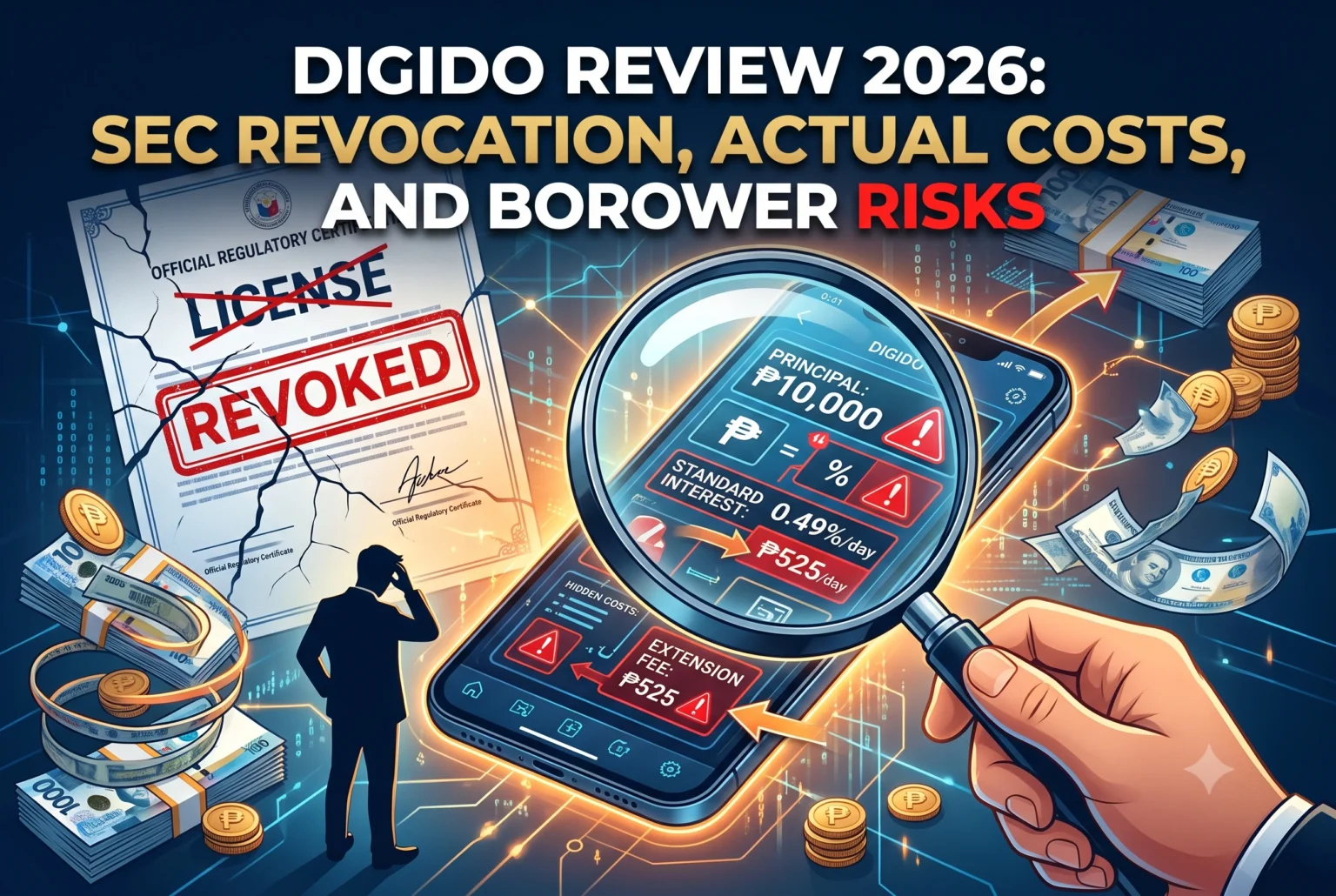
Many Filipinos turn to online cash loan apps for immediate financial relief during emergencies, and Digido has historically been one of the most visible platforms in this space. However, navigating the online lending market requires understanding exactly who is providing the funds and whether they are legally authorized to do so. In 2026, researching Digido requires looking closely at its regulatory history, specifically a major enforcement action taken against its corporate operator, rather than merely relying on its advertised promotions.
This review investigates the platform’s current legal status, calculates the actual peso cost of its daily interest charges against Philippine regulatory limits, and examines the exact risks borrowers face when accepting these terms.
Summary:
Digido is operated by Digido Finance Corp., a company that previously held a license to operate as a financing company in the Philippines. However, in May 2025, the Securities and Exchange Commission (SEC) revoked the company’s Certificate of Authority and corporate registration for operating unauthorized physical branches. While the company reportedly filed an appeal and stated it suspended loan issuances to comply with directives, its legal standing in 2026 remains precarious. For consumers, the platform advertises limits up to ₱25,000 and a 0% introductory rate, but standard rates reach 0.49% per day. Borrowers must verify the platform’s current regulatory status on the SEC website before submitting any personal data.
| Borrower question | Current finding | Why it matters |
| Legal Operator | Digido Finance Corp. | Defines the legal entity responsible for the terms of the loan contract. |
| Regulatory Status | SEC Certificate of Authority revoked (May 2025) | An unverified or suspended legal status severely reduces your consumer protection if a dispute arises. |
| Loan Range | ₱1,000 to ₱25,000 | The marketed maximum limit is highly conditional; first-time users typically qualify only for ₱1,000 to ₱10,000. |
| Advertised Rate | 0% for the first loan (up to 7 days) | Provides cost-free emergency cash, but strictly only if paid on or before the immediate due date. |
| Standard Cost | 0.49% per day (approx. 14.7% monthly) | Substantially exceeds the BSP 5% monthly effective interest rate limit for small loans. |
| Disbursement | InstaPay / PESONet | While system approval is fast, banking cut-offs dictate when you actually receive the cash. |
Is Digido legit and authorized to operate in the Philippines in 2026?
In May 2025, the SEC revoked Digido Finance Corp.’s Certificate of Authority for operating unauthorized branches. While the company filed an appeal, its legal authority to operate as a financing company is compromised in 2026, posing significant risks to borrowers.
Who legally operates the Digido app?
The consumer-facing brand Digido is owned and operated by Digido Finance Corp., an entity formerly registered with the SEC under Registration No. CS202003056. The same corporate entity has also managed other Philippine digital credit platforms, including UnaCash and UnaPay.
What does the 2025 SEC revocation mean for borrowers?
In the Philippines, holding a corporate SEC registration is not enough to legally lend money. A company must hold a specific Certificate of Authority (CA) under the Financing Company Act or Lending Company Regulation Act.
On May 9, 2025, the SEC Financing and Lending Companies Department (FinLenD) revoked Digido Finance Corp.’s primary registration and its CA. The regulator cited the company’s opening and operation of four unauthorized physical branches. Following the order, the company issued a statement indicating it had fully complied with the directives – including suspending loan issuances – while filing an appeal to challenge the SEC’s decision.
For a consumer in 2026, this means engaging with the Digido platform carries a distinct legal risk. If you borrow from a company operating without an active, verified CA, your ability to seek regulatory assistance through the SEC for issues like harassment or billing errors is severely diminished. Borrowers should always consult the SEC’s updated “List of Financing Companies” to check if the appeal was successful before downloading the app.
How much can you actually borrow from Digido?
Digido advertises a maximum loan limit of ₱25,000 for repeat borrowers. However, first-time applicants are generally restricted to a much lower ceiling, typically between ₱1,000 and ₱10,000, depending on their income verification.
Advertised limits versus first-time approvals
Fintech platforms frequently market their maximum possible credit limits to capture user attention, but these numbers represent the ceiling for long-term users with perfect payment histories. The actual approved principal depends heavily on the company’s internal algorithmic credit scoring.
First-time Digido borrowers rarely receive the ₱25,000 limit. Instead, initial approvals usually fall in the ₱1,000 to ₱5,000 range. While the platform advertises that no formal income proof is strictly required, the application flow indicates that borrowers who upload verifiable income documents typically unlock higher initial tiers.
What does a Digido loan really cost?
Beyond the promotional 0% first loan, Digido’s standard interest rate is widely reported at 0.49% per day. This equates to roughly 14.7% per month, which significantly exceeds the Bangko Sentral ng Pilipinas (BSP) 5% monthly limit for small loans.
The 0% interest promo for new borrowers
To acquire customers, Digido promotes a 0% interest rate for first-time borrowers on loan amounts up to ₱10,000 with a strict 7-day term. If an applicant is approved for ₱3,000, they are expected to repay exactly ₱3,000, provided they settle the entire balance on or before the seventh day. This functions as a standard fintech loss leader, designed to onboard the user onto the platform.
Standard interest rates and the BSP cap
For repeat borrowers, or for loans that fall outside the introductory promotion, the borrowing costs scale aggressively. The standard advertised rate sits at approximately 0.49% per day. When compounded or accumulated over a 30-day term, this represents a nominal monthly interest rate of 14.7%.
This pricing structure requires careful scrutiny against Philippine consumer protection laws. In 2022, the Bangko Sentral ng Pilipinas (BSP) issued Circular No. 1133, which placed a strict cap on unsecured, general-purpose loans of up to ₱10,000 with a tenor of up to four months. The circular caps the nominal interest rate at 2% per month and limits the Effective Interest Rate (EIR) – which must include processing and service fees – to 5% per month. Digido’s 14.7% monthly rate exceeds this mandated ceiling, dramatically increasing the risk of a debt spiral for the average borrower.
The trap of extension fees
When a borrower cannot pay on time, the platform offers a loan extension. However, this relief comes at an exceptionally steep price. Publicly available terms suggest that extending a ₱3,000 loan for an additional 7 days can cost ₱525. That constitutes a 17.5% surcharge for a single week of extension, completely altering the financial equation for a borrower already struggling with cash flow.
How fast is the Digido application and disbursement process?
When the platform is actively originating loans, applications are processed digitally within minutes. Disbursements to bank accounts or e-wallets like GCash typically occur within 24 hours, though weekend or holiday applications may face banking settlement delays.
Application requirements and friction
The standard application requires a Filipino citizen (aged 21 to 70) to submit a single valid government-issued ID and an active mobile number. The process is entirely digital.
The primary friction point for applicants is the automated identity verification system. Applications are frequently delayed or rejected due to glare on the ID upload or, more commonly, a name mismatch. The name on the submitted government ID must perfectly match the registered name on the receiving bank account or e-wallet; even a missing middle initial can cause a disbursement failure.
Bank settlement delays
While Digido’s internal software may approve a loan in under 10 minutes, the actual receipt of cash is governed by Philippine interbank clearing networks. Disbursements processed via InstaPay are generally real-time. However, larger amounts or certain banking channels routed through PESONet late in the afternoon will not reflect in the borrower’s account until the next banking day, effectively eating into the brief 7-day repayment window.
What happens if you pay your Digido loan late?
Late payments trigger immediate penalty fees and aggressive collection efforts. Unpaid balances will accumulate daily charges, and severe delinquency may be reported to the Credit Information Corporation (CIC), damaging your future borrowing capacity.
Late penalties and collection practices
Borrower reviews consistently highlight that missing a Digido due date by a single day results in relentless communication. The platform’s automated systems and third-party collection agents immediately initiate a sequence of text messages, emails, and phone calls.
Philippine regulations strictly prohibit unfair collection practices, such as insulting borrowers, using threats, or contacting individuals in a borrower’s phonebook who were not explicitly named as guarantors or co-makers. However, enforcement of these rules generally requires the affected borrower to file a formal complaint with the SEC and the National Privacy Commission (NPC).
Can late payments affect your credit score?
Yes. Authorized financing companies are legally mandated to submit borrower credit data to the Credit Information Corporation (CIC). Defaulting on an online loan creates a negative record in the national database. While unpaid civil debt cannot result in imprisonment in the Philippines, a defaulted loan will be visible to traditional banks and licensed lenders, potentially locking the borrower out of future car loans, home loans, and credit card approvals.
How does Digido handle your personal data?
The Digido app requests access to device information, location data, and sometimes contacts. Borrowers must read the privacy policy carefully, as online lenders have historically used invasive permissions to aid in debt collection.
App permissions and data privacy
Upon installing the Digido app, users are prompted to grant multiple device permissions. The National Privacy Commission (NPC) has issued stringent guidelines against lending apps scraping a borrower’s contact list to harass friends and family for unpaid debts. Borrowers should review their smartphone permission settings to ensure the application only has access to the minimum data strictly necessary for identity verification, such as camera access for the mandatory selfie and file access for the ID upload.
What are borrowers saying about Digido?
Recent borrower feedback is heavily polarized. Users praise the speed of the first-time 0% interest loan, while complaints overwhelmingly focus on the crippling cost of loan extensions and aggressive collection tactics once a payment is missed.
Positive feedback patterns
Users who successfully utilize the 0% introductory offer and clear their balance within the 7-day window generally report a positive experience. They cite the convenience of the digital interface, the lack of physical paperwork, and the swift transfer of funds directly to GCash or traditional bank accounts.
Recurring complaints
Conversely, borrowers who fail to settle their balances immediately express severe frustration. Several recent reviewers reported feeling trapped by the high extension fees. Many noted that the cost of rolling over the debt quickly surpassed the original loan principal, a direct consequence of the 0.49% daily interest rate. Furthermore, borrowers frequently raise concerns regarding operational friction, such as late-night payments made via 7-Eleven not posting to the Digido system until the following day, unfairly triggering automated late fees.
What are the main advantages and disadvantages of Digido?
Potential Advantages:
-
The initial 0% interest offer provides genuinely cost-free cash, provided it is paid strictly on time.
-
The fully digital underwriting process eliminates branch visits and excessive paperwork.
-
The platform accepts a broad variety of standard Philippine government IDs.
Potential Disadvantages:
-
The SEC revoked the company’s Certificate of Authority in May 2025, significantly undermining its legitimacy and consumer safety profile.
-
Standard interest rates (0.49% per day) violate the BSP’s 5% monthly effective interest rate cap for small loans.
-
Extension fees are exceptionally high and easily trigger a debt trap.
-
A rigid 7-day to 30-day repayment schedule rarely aligns with bi-monthly Philippine salary cycles.
Who may find Digido relevant, and who should be especially cautious?
Due to the SEC’s 2025 revocation order, all consumers should exercise extreme caution before transacting with this platform until its legal status is fully resolved and publicly confirmed by the regulator.
Assuming the company regains its active Certificate of Authority, the product is structurally viable only for an individual who knows with absolute certainty that they will receive expected funds within a week to clear the 0% introductory loan. You should avoid this product entirely if you are borrowing to pay off another debt, if your income is currently unstable, or if you plan to rely on the costly loan extension feature.
What should you check before applying for a Digido loan in 2026?
-
Current SEC Status: Visit the official SEC Philippines website and consult the latest “List of Financing Companies.” Verify whether Digido Finance Corp. has successfully appealed its 2025 revocation and regained its active Certificate of Authority.
-
Net Proceeds versus Approved Limit: Check the exact cash amount that will be deposited into your account versus the principal you are legally bound to repay, accounting for any deducted processing fees.
-
Effective Borrowing Cost: Calculate the total repayment amount and divide it by the loan term to expose the true cost. Ensure this does not run afoul of the BSP’s mandated caps.
-
Device Permissions: Check your phone settings and deny any app requests to access your phonebook, SMS inbox, or media gallery.
Frequently Asked Questions
Can Digido access and contact my phonebook contacts?
Under Philippine data privacy laws, lending apps are prohibited from harvesting your phonebook to contact people who were not listed as your official guarantors. Ensure you deny contact access permissions in your smartphone settings before applying.
Does Digido require a bank account?
No. While a bank account is an option, Digido allows disbursements and repayments through major Philippine e-wallets, such as GCash and Maya, making it accessible to unbanked individuals.
Can I repay my Digido loan before the due date?
Yes. You can settle your outstanding balance early through their recognized payment channels. However, you should check the exact loan agreement to confirm whether early repayment entitles you to an interest rebate on standard loans.
Will my Digido debt expire if I ignore it long enough?
No. Unpaid debts to registered financing companies remain on your credit record indefinitely and will damage your credit score with the CIC, preventing you from accessing lower-interest loans from traditional banks in the future.
Conclusion
The decision to use Digido in 2026 requires balancing the platform’s technological convenience against its high costs and uncertain legal status. While the 0% interest offer for first-time borrowers serves as an accessible lifeline for immediate cash flow gaps, the underlying pricing structure – charging 0.49% per day on standard loans – heavily penalizes anyone who cannot pay on time. More critically, the SEC’s revocation of the operator’s Certificate of Authority in May 2025 means borrowers must perform their own regulatory due diligence. Before clicking apply, independently verify the company’s standing with the SEC, read the exact peso cost of your repayment schedule, and never borrow simply to pay off an existing loan.
References
-
Securities and Exchange Commission (SEC) PhilippinesOrganization: Securities and Exchange CommissionResource: SEC cancels Digido’s financing license over unauthorized branches (Press/Media Coverage, May 2025)
-
Bangko Sentral ng Pilipinas (BSP)Organization: Bangko Sentral ng PilipinasResource: Circular No. 1133, Series of 2022 (Ceilings on Interest Rates and Other Fees Charged by Lending Companies, Financing Companies, and Their Online Lending Platforms)
-
Digido Official InformationOrganization: Digido Finance Corp.Resource: Public Loan Terms, App Store Listing, and Interest Rate Promos (2025-2026 data)URL: https://digido.ph/
Last Updated: September 29, 2026 by The Nomad Finance Girl (Jaycee)
