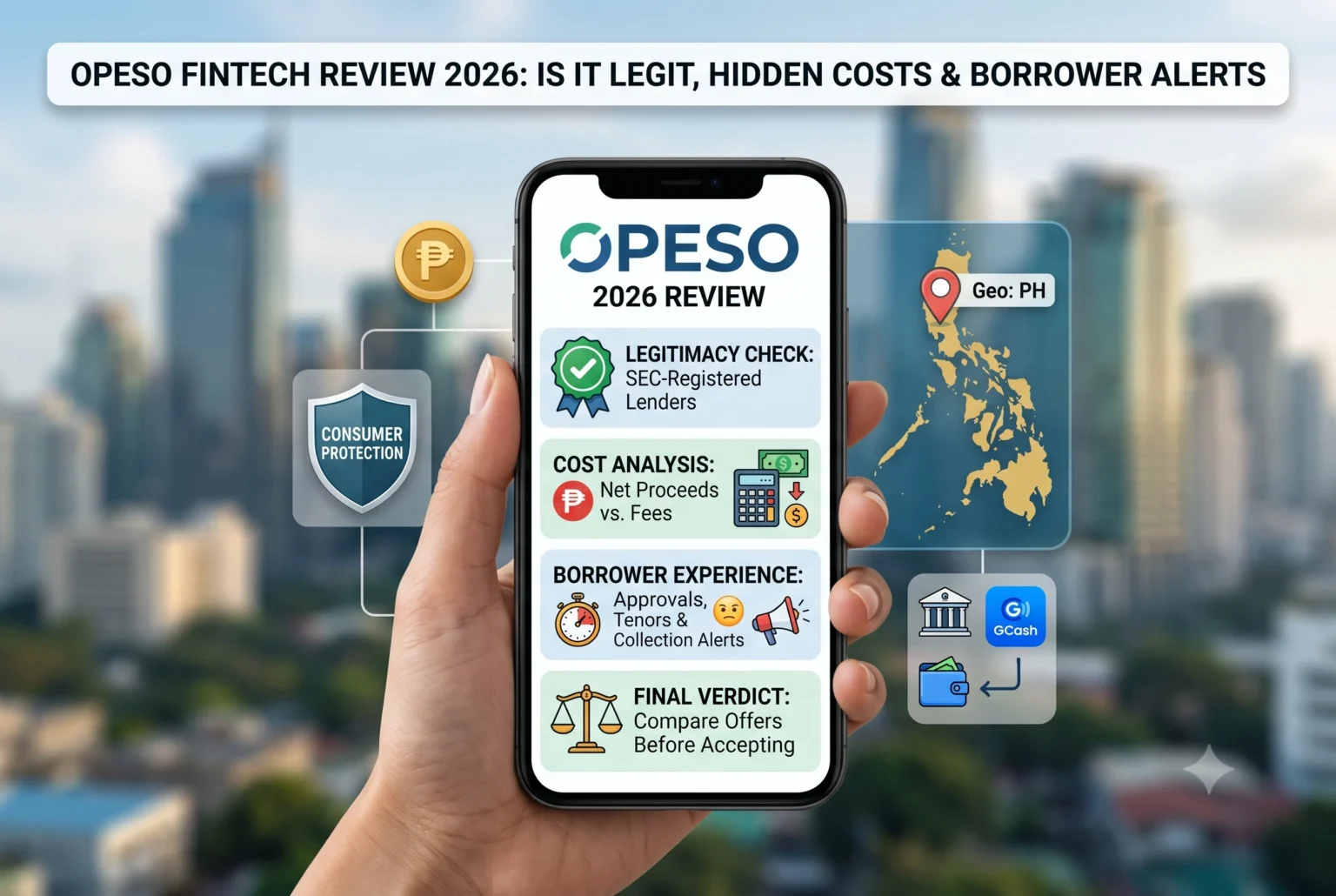
Borrowers turning to online lending apps often focus entirely on the maximum credit limit displayed in an advertisement, only to be surprised by the actual repayment terms and collection tactics. Opeso markets itself to Filipino borrowers with promises of loans up to ₱50,000, flexible repayment periods ranging from 91 to 120 days, and competitive interest rates. But in the Philippine fintech sector, marketing claims frequently differ from the contract a first-time applicant actually receives.
This review investigates the legal status, stated costs, and recurring borrower concerns surrounding Opeso in 2026. We examine official Securities and Exchange Commission (SEC) registration data, current app disclosures, and public borrower reports to help you determine if this platform fits your financial situation, and what to watch out for before accepting an offer.
Summary: Opeso operates as an authorized online lending platform in the Philippines, linked in SEC records and app listings to Codeblock Lending Inc. and Oklik Lending Company Inc. While it advertises loans from ₱2,000 up to ₱50,000 with tenors of 91 to 120 days, first-time borrowers should anticipate lower initial limits. The primary borrower risk involves aggressive debt collection practices, as evidenced by public complaints and forum discussions. Before accepting an offer, applicants must read the disclosure statement to confirm the exact net proceeds and due dates, ensuring no hidden upfront deductions apply.
| Borrower question | Current finding | Why it matters |
| Is Opeso SEC-registered? | Yes. Associated with Oklik Lending Company Inc. and Codeblock Lending Inc. | Confirms a legal entity exists, but does not guarantee inexpensive terms. |
| How much can I borrow? | Advertised limits are ₱2,000 to ₱50,000. | First-time approvals usually start near the minimum amount until a payment history is built. |
| What is the loan tenor? | Advertised as 91 to 120 days. | Many online apps default to much shorter terms for new borrowers. |
| What are the fees? | App claims a maximum 36% APR with zero transaction fees. | Borrowers must verify their contract to ensure upfront deductions do not increase the effective cost. |
| How are collections handled? | Users frequently report aggressive follow-ups. | Late payments may result in constant messaging and potential credit reporting. |
Is Opeso legitimate and properly authorized in the Philippines?
Yes. Opeso is associated with registered lending companies in the Philippines, appearing in SEC records under Codeblock Lending Inc. and app listings under Oklik Lending Company Inc. This confirms legal registration, but authorization does not guarantee low interest rates or suitable terms for every borrower.
Who legally operates Opeso?
In the Philippine digital lending market, the consumer-facing app brand is often distinct from the registered corporate entity. Official SEC records from the 2021 moratorium on online lending platforms list Opeso (alongside Kpeso and OKpeso) under Codeblock Lending Inc. (SEC Registration No. CS201913681, Certificate of Authority No. 3059).
However, current official app store documentation states that the operator is Oklik Lending Company Inc. (SEC Registration No. CS201903131, Certificate of Authority No. 2896). Both entities possess valid Certificates of Authority to operate as lending companies. It is common practice for fintech operators to transfer platform management between registered sister companies. For borrowers, this means there is an identifiable, legally registered entity accountable to Philippine regulators.
Does SEC registration mean the loan is safe?
SEC registration is a minimum legal requirement to operate; it is not a government endorsement of the product’s affordability. A licensed lender can still offer an expensive product or utilize stressful collection procedures. Registration primarily means that the Bangko Sentral ng Pilipinas (BSP) and the SEC have jurisdiction over the company if it violates lending or collection laws.
How much can you actually borrow from Opeso?
The app advertises loan amounts ranging from ₱2,000 to ₱50,000. However, first-time applicants rarely receive the maximum amount. Initial approvals typically start at the lower end of this range until the borrower establishes a positive repayment history.
What limits are advertised?
The current app listing promotes a starting limit of ₱2,000 scaling up to ₱50,000. The platform states that limits are determined by the applicant’s credit score – meaning higher credit metrics yield more substantial offers.
Why might a first-time borrower receive less?
Because Opeso requires no collateral, the lender mitigates risk by keeping initial exposure low. A new applicant with no prior transaction history on the platform should expect an offer closer to the ₱2,000 minimum. Only after successfully repaying the first loan on time will the system algorithmically increase the credit limit for subsequent applications.
What does an Opeso loan really cost?
Opeso advertises a maximum Annual Percentage Rate (APR) of 36% with no transaction fees for a 120-day loan. If accurate, a ₱20,000 loan would cost ₱22,367 in total. Borrowers must verify their specific loan contract to confirm no hidden processing fees are deducted upfront.
What interest and fees are disclosed?
Opeso’s official documentation provides a specific cost calculation to demonstrate its pricing. For a ₱20,000 loan over 120 days at a 36% APR, the stated transaction fee is zero. The interest calculation yields ₱2,367, bringing the total repayment to ₱22,367.
Mathematically, this represents a highly competitive rate compared to the broader Philippine alternative lending market, which often charges heavy service fees.
How does the advertised cost compare to industry realities?
Borrowers must approach marketing examples with skepticism. We could not independently verify if first-time applicants actually qualify for zero-fee, 120-day terms. In many cases, Philippine lending platforms approve smaller principal amounts, apply shorter repayment windows (such as 7 to 14 days), and deduct service fees directly from the disbursed funds.
Under BSP Circular No. 1133, unsecured, general-purpose loans up to ₱10,000 with a term of up to 30 days are capped at a nominal interest rate of 15% per month (roughly 0.5% per day), with late fees capped at 5% per month. While Opeso’s advertised 120-day terms fall outside this specific cap, any borrower who receives a loan matching the BSP’s short-term criteria is protected by these exact ceilings. Always review the final disclosure statement to see the actual peso amount you will receive.
How fast is Opeso approval and disbursement?
The app claims a streamlined online process, and online lenders typically approve clean applications within 24 hours. Actual disbursement speed depends on the borrower’s chosen receiving channel, with e-wallets like GCash often settling faster than traditional bank transfers.
What can slow down the approval process?
The public application flow indicates that borrowers are asked to provide a valid government ID and complete facial recognition (a selfie) to verify their identity. Friction usually occurs if the name on the ID does not exactly match the name on the registered e-wallet or bank account, or if the ID photo is blurry. Manual reviews triggered by mismatched information can delay approval by several days.
When can settlement delay the money?
Even if the app approves the loan immediately, banking infrastructure dictates when the cash actually arrives. E-wallet transfers (like GCash or Maya) typically post in near real-time. Transfers to traditional bank accounts processed late on a Friday or during a Philippine holiday may not reflect until the next banking day.
What happens if you pay Opeso late?
Like most lending apps, Opeso relies on automated reminders that escalate into direct demands if an account becomes past due. Late payments trigger additional penalty charges and can negatively impact your credit record with local credit bureaus.
What charges may apply?
If a payment is missed, penalty fees are added to the principal and regular interest. For loans falling under the BSP Circular 1133 criteria (under ₱10,000 for up to 30 days), this penalty is legally capped at 5% per month on the outstanding balance. For loans outside this scope, the penalties follow the terms explicitly agreed upon in the loan contract.
Can delinquency affect your credit record?
Yes. Authorized lending companies in the Philippines are mandated to submit borrower data to the Credit Information Corporation (CIC). A pattern of delinquency on Opeso can make it difficult to secure a car loan, home loan, or standard credit card from major commercial banks in the future.
What are borrowers saying about Opeso?
Anecdotal borrower feedback highlights persistent issues with collection practices. Public complaints filed with the National Bureau of Investigation (NBI) and discussions on local debt forums frequently mention aggressive follow-ups and unverified claims of field visits for late payments.
What complaints appear repeatedly?
Public records indicate that Opeso has been the subject of borrower frustration regarding debt collection. In 2022, requests filed via the Freedom of Information (FOI) portal with the National Bureau of Investigation requested intervention against several apps, explicitly naming Opeso, citing harassment and demanding letters for late payments.
Recent discussions on Philippine debt-support forums in late 2025 echo similar concerns regarding constant messaging and pressure tactics. While we could not independently verify every anonymous claim, the persistence of these reports across multiple years suggests borrowers should take the repayment timeline very seriously to avoid stressful collection communications. SEC Memorandum Circular No. 18 series of 2019 explicitly prohibits the use of threats, insults, or unauthorized access to a borrower’s phone contacts to collect a debt. Borrowers experiencing illegal harassment have the right to file formal complaints with the SEC and the National Privacy Commission.
What should you check before accepting an Opeso loan?
Always review the final disclosure statement before clicking accept. Verify the exact peso amount you will receive, the actual repayment date, and the total amount due to ensure you can afford the loan without borrowing again.
Check the net proceeds
Never assume the approved loan amount is the money you will receive. Check the disclosure statement for a line item labeled “Processing Fee” or “Service Fee.” If the app deducts a 20% service fee from a ₱5,000 loan, you will only receive ₱4,000, but you will owe interest on the full ₱5,000.
Verify the exact due date
Confirm the exact calendar date the money is due. If the due date falls three days before your next salary payout, the loan is highly likely to enter default, triggering penalties and collection calls.
Borrower Decision Framework
Opeso offers a legitimate, SEC-authorized credit facility that can bridge a temporary cash shortage. Its advertised terms – up to 120 days at a 36% APR with zero transaction fees – are highly attractive on paper.
However, prospective applicants should apply conditional caution. This product is most suitable for a borrower who has a confirmed, incoming source of funds and clearly understands the exact peso cost of the loan. A borrower should be especially cautious if they are already struggling with other debts, or if the final contract presented in the app reveals heavy upfront deductions and a shorter repayment window than expected. Never accept the loan if repaying it will require you to immediately take out another loan elsewhere.
References
-
Securities and Exchange Commission PhilippinesOrganization: Securities and Exchange CommissionResource: List of Lending Companies with Certificate of Authority
-
Bangko Sentral ng PilipinasOrganization: Bangko Sentral ng PilipinasResource: Circular No. 1133 (Ceilings on Interest Rates and Other Fees)
-
Freedom of Information PhilippinesOrganization: National Bureau of InvestigationResource: Public FOI Requests regarding online lending complaints (Tracking #NBI-711368997006)
Last Updated: October 1, 2026 by The Nomad Finance Girl (Jaycee)
