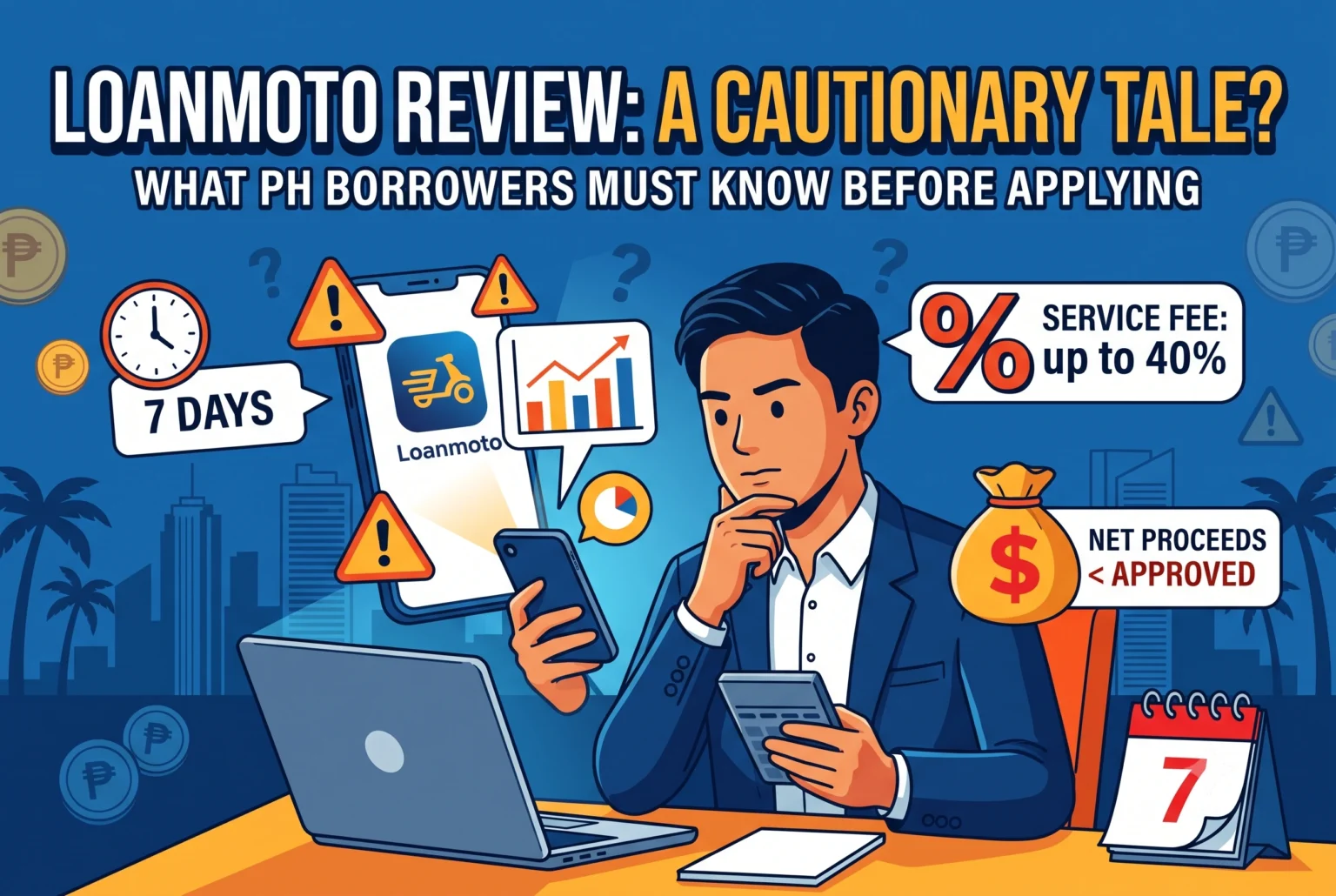
Many Filipinos turn to online lending applications like Loanmoto to bridge the gap during unexpected financial emergencies. However, the difference between an app’s advertised loan amounts and the money actually disbursed can catch borrowers completely off guard. Before downloading the application or submitting sensitive government identification, it is necessary to understand exactly who operates this platform, how the deductions are calculated, and what financial consequences follow if a payment is missed. This review examines Loanmoto’s published terms, regulatory standing, and typical borrower feedback to provide a clear picture of the actual cost of borrowing.
Summary:
Loanmoto is a mobile lending application operating in the Philippines that provides short-term unsecured cash loans. While the platform advertises credit limits of up to ₱20,000 and flexible repayment terms, public disclosures and consistent borrower reports indicate that first-time applicants typically receive much smaller amounts. These initial loans are frequently subject to substantial upfront processing fees and strict 7-to-14-day repayment windows. Borrowers must carefully review the final disclosure statement before accepting the loan, as the deducted fees drastically increase the effective cost of borrowing. This credit product is generally suited only for absolute emergencies where a guaranteed repayment source is already secured.
| Borrower Question | Current Finding | Why It Matters |
| Legal Operator | Requires verification of the specific SEC-registered company on the loan contract. | Ensures you are dealing with a regulated entity subject to Philippine financial laws. |
| Advertised Limit | Up to ₱20,000. | Marketing maximums rarely reflect the actual limit offered to new applicants. |
| Actual Disbursed | Often 20% to 40% less than the approved principal. | Upfront service and processing fees significantly reduce the cash you actually receive. |
| Repayment Term | Advertises 91+ days, but frequently defaults to 7-14 days. | A 7-day term heavily increases the risk of default if it falls before your next payday. |
| Late Payments | High daily penalties and persistent collection tactics reported. | Missed deadlines quickly inflate the debt and lead to stressful communications. |
Is Loanmoto legitimate and properly authorized in the Philippines?
Loanmoto operates as an online lending platform, but borrowers must identify its exact corporate operator in their specific loan agreement. A legitimate app must be backed by a company holding a valid SEC Certificate of Authority to operate as a lending or financing company.
Verifying the Corporate Entity
Online lending platforms in the Philippines frequently operate as consumer-facing brands owned by larger corporate entities. To confirm legal legitimacy, borrowers should not rely solely on an app’s presence in the Google Play Store or Apple App Store. The Securities and Exchange Commission (SEC) requires all lending and financing companies to display their exact corporate name, SEC Registration Number, and Certificate of Authority (CA) Number prominently on their platforms and marketing materials.
When reviewing the app listing and public documentation for Loanmoto, applicants should cross-reference the stated corporate operator with the official SEC list of registered lending and financing companies. The corporate name on the SEC list must match the entity issuing the loan contract.
Why Regulatory Supervision Matters
If a disclosure statement does not clearly identify the legal lender, or if the SEC registration has been suspended, borrowers face elevated risks. SEC and Bangko Sentral ng Pilipinas (BSP) regulations protect consumers from abusive interest rates and unfair debt collection. Dealing with an authorized entity ensures that the borrower has a formal channel for grievances through government regulators if the lender violates data privacy or collection rules.
How much can you actually borrow from Loanmoto?
While Loanmoto promotional materials suggest maximum limits of ₱20,000, initial credit lines for new borrowers generally range between ₱2,000 and ₱5,000. Higher limits are typically restricted to repeat users with established payment histories.
Advertised Limits vs. First-Time Approvals
Marketing for Philippine fintech applications heavily emphasizes maximum borrowing limits to attract users. However, the underwriting process for unsecured online credit restricts initial exposure to minimize the lender’s risk. The application flow indicates that an algorithm evaluates the borrower’s submitted profile, verified income data, and alternative credit signals to assign a starting limit.
Borrowers expecting an immediate ₱20,000 disbursement for a major emergency will likely find their initial approval falls far short of that expectation. Based on typical lending practices in this specific sector, limit increases depend heavily on completing early, short-term borrowing cycles successfully without any late payments.
Underwriting Friction
Approval is not guaranteed. Applicants frequently encounter friction during the automated underwriting process. Common reasons for rejection or delayed approval include mismatched names between the submitted government ID and the designated receiving bank or e-wallet account. Freelance or self-employed workers may also face stricter limits compared to salaried employees because irregular cash flows are harder for automated systems to verify.
What does a Loanmoto loan really cost?
The true cost of a Loanmoto loan is often driven by upfront service and processing deductions rather than the nominal interest rate. These fees can consume 20% to 40% of the approved principal before disbursement.
Upfront Deductions vs. Interest Rates
A major source of borrower confusion in the digital lending space involves the difference between the approved loan amount and the net proceeds actually transferred to the borrower. The stated interest rate does not reflect the total borrowing cost.
In many online lending structures, the platform deducts a “service fee,” “processing fee,” or “evaluation fee” directly from the loan before releasing the funds. For example, if a borrower is approved for a ₱3,000 principal and the app applies a 30% processing deduction, the borrower receives only ₱2,100 in their account. However, the borrower remains contractually obligated to repay the full ₱3,000 on the due date.
Calculating the Effective Peso Cost
This structure creates a massive discrepancy between the advertised rate and the effective cost. When calculating affordability, applicants must look exclusively at the net disbursement compared to the total repayment amount required. If you receive ₱2,100 but must repay ₱3,000 in seven days, the peso cost of borrowing that cash is ₱900 – a steep price for a single week of liquidity.
How long do you actually have to repay?
Despite app store descriptions mentioning terms of 91 to 180 days, the actual repayment schedule offered to new users frequently defaults to 7 or 14 days. This aggressive timeline is a major source of default risk.
The 91-Day Claim vs. 7-Day Reality
The disparity between advertised loan terms and actual contracts is a persistent issue in the Philippine digital lending sector. App listings often highlight 91-day minimum terms to comply with platform policies, such as Google Play’s financial services requirements. However, the actual loan agreement generated after approval often dictates a single balloon payment due within one to two weeks.
Borrowers must verify the exact due date on the final disclosure statement before clicking to accept the funds. A 7-day turnaround means the loan will likely come due before the borrower’s next salary payout, forcing them to find alternative funds or incur severe financial penalties.
What happens if you pay late?
Missing a Loanmoto payment typically triggers immediate daily penalty charges and intense collection efforts. Unpaid accounts accrue late fees that quickly inflate the total debt, while collection agents rely heavily on frequent calls and messaging.
Financial Penalties
The financial consequences of default on short-term digital loans escalate rapidly. The loan agreement typically outlines a fixed penalty for missing the due date, followed by an additional daily percentage charge applied to the outstanding balance. These cumulative fees can cause the debt to double in a matter of weeks, trapping the borrower in a cycle of unmanageable obligations.
Collection Practices and Borrower Rights
Late payment initiates the lender’s collection protocol. The SEC (via Memorandum Circular No. 18, Series of 2019) and the National Privacy Commission (NPC) strictly prohibit unfair collection practices. Lenders are forbidden from using threats, posting false statements online, or contacting individuals in the borrower’s phonebook without explicit, verified consent as a named guarantor.
If a collection agency acts aggressively or breaches privacy, Philippine borrowers have the right to file formal complaints with the SEC and the NPC. It is also important to note that ordinary civil debt does not lead to imprisonment under Philippine law, provided the borrower did not commit criminal fraud, such as submitting forged documents or fake IDs during the application process.
What personal data does the app collect?
The Loanmoto application requires extensive device permissions, including access to the camera, location data, and network information. Borrowers must review the privacy policy to understand exactly how this personal data is processed and shared.
App Permissions
Fast approval times in the fintech space rely on automated underwriting, which requires alternative data. During installation and application, the app requests permissions that allow it to verify identity and assess credit risk. Requesting camera access for a real-time selfie and ID capture is standard for anti-fraud compliance, as is basic location data.
Contact List and Privacy Concerns
Borrowers should remain vigilant about permissions concerning their contact lists. Current NPC guidelines heavily restrict how lending applications can access, store, and utilize a user’s phonebook. Applicants should carefully read the privacy prompts on their mobile devices and decline any permissions that are not strictly necessary for executing the loan transaction.
What are borrowers saying about Loanmoto?
Recent anecdotal feedback across app stores highlights a mix of fast disbursement for approved users alongside heavy criticism regarding high hidden fees, short repayment terms, and stressful collection communications.
Positive Patterns
Analyzing public reviews provides insight into the typical borrower journey, though individual anecdotal experiences vary widely. Positive feedback generally centers on the speed of the transaction. Users who possess valid primary IDs and matching bank or e-wallet accounts frequently report fast processing, with funds arriving via InstaPay or PESONet within the same day.
Recurring Complaints
Conversely, negative feedback mirrors the established friction points of the short-term lending sector. Several recent reviewers reported shock at the size of the upfront deductions, explicitly stating that the money received was significantly less than they needed to cover their emergency. Other common grievances involve technical issues with payment posting. Borrowers report making on-time payments via GCash, Maya, or 7-Eleven, but the app fails to reflect the transaction immediately, resulting in automated penalty warnings and premature collection messages.
Frequently Asked Questions
Can I pay my Loanmoto loan before the due date?
Yes. Philippine lending regulations allow borrowers to settle their debts prior to the maturity date. However, paying early on a short-term online loan rarely results in a refund or reduction of the upfront processing fees that were already deducted during disbursement.
What happens if the disbursement fails but the app shows an active loan?
Disbursement failures usually occur due to an invalid bank account number or a name mismatch. If this happens, you must contact customer service immediately with proof (such as a bank statement or e-wallet screenshot) showing the funds were never received. Do not ignore the active loan status, as the automated system will still trigger late fees.
Will an unpaid Loanmoto account affect my credit score?
Authorized lending and financing companies in the Philippines are mandated to submit credit data to the Credit Information Corporation (CIC). A defaulted loan with a regulated entity will appear on your CIC credit report, which can severely impact your ability to secure loans from traditional banks, car dealerships, and housing funds in the future.
How do I stop the app from accessing my phone data after repayment?
Once the loan is fully settled, you can revoke app permissions in your device settings and uninstall the application. To request the deletion of your personal data from their servers, you must send a formal data deletion request to their official data protection officer, invoking your rights under the Data Privacy Act of 2012.
Borrower Decision Framework
Accepting a short-term online loan requires calculating your exact capacity to repay. If the net proceeds from Loanmoto are sufficient to resolve an immediate, severe crisis, and you have guaranteed funds arriving before the 7-to-14-day deadline, the platform offers a fast liquidity option.
However, you should avoid this product if you intend to use the funds for non-essential purchases, or if you plan to pay off another lending app using this credit. The high upfront deductions and aggressive late penalties create a mathematical trap that easily leads to an unsustainable debt cycle.
Before accepting any offer, borrowers must demand and review the official Disclosure Statement mandated by the Truth in Lending Act. Check the exact net cash you will receive, the total amount due, and the specific repayment date. If the numbers do not align with your upcoming salary, do not sign the digital contract.
References
-
Securities and Exchange Commission PhilippinesOrganization: Securities and Exchange CommissionResource: List of Registered Lending and Financing Companies
-
National Privacy CommissionOrganization: National Privacy CommissionResource: NPC Circular No. 20-01: Guidelines on the Processing of Personal Data for Loan-Related Transactions
-
Official Gazette of the PhilippinesOrganization: Government of the PhilippinesResource: Republic Act No. 3765 (Truth in Lending Act)
Last Updated: October 1, 2026 by The Nomad Finance Girl (Jaycee)
