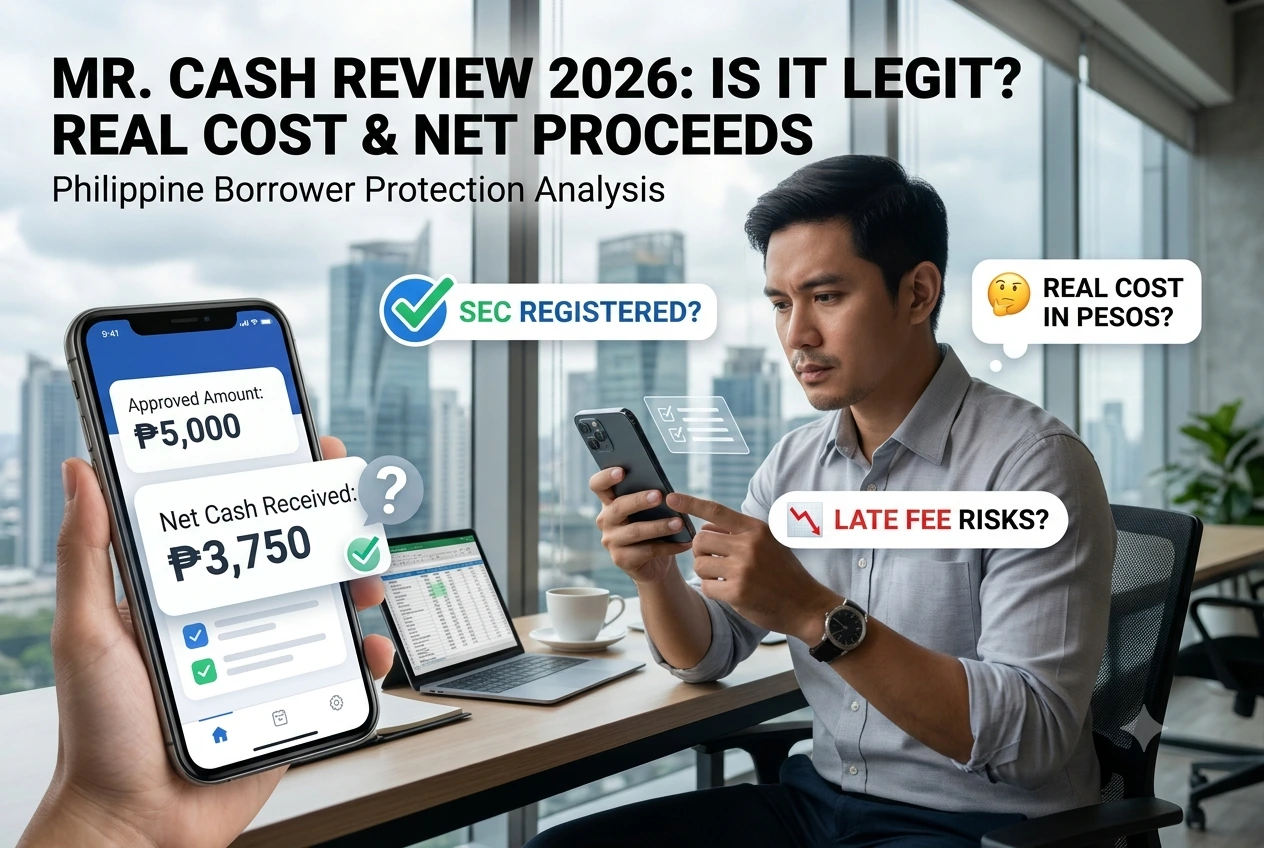
Filipino borrowers facing financial emergencies often turn to digital lending apps like Mr. Cash, drawn by marketing that highlights fast approvals and minimal documentary requirements. However, the urgency of needing funds quickly can cause applicants to overlook the actual cost of borrowing. The gap between the loan amount you are approved for and the cash you actually receive is a critical detail that frequently catches users off guard.
This review investigates the current legal status of Mr. Cash, explains how its fee structure affects actual loan proceeds, and evaluates recurring borrower feedback. The goal is to provide a clear, evidence-based look at how the product functions so you can evaluate whether the terms align with your capacity to repay.
Summary:
Mr. Cash is a registered online lending platform in the Philippines operated by e-Generation Financial Services, Inc., an SEC-authorized financing company. While the application offers rapid digital disbursement, borrowers frequently report substantial upfront service fee deductions, meaning the cash disbursed is noticeably lower than the approved principal. Advertised loan terms extend up to 180 days, but first-time borrowers often experience much shorter repayment windows. Before accepting a Mr. Cash offer, applicants must manually compare the exact net cash proceeds against the total repayment amount on the final disclosure statement to understand the true peso cost of the loan.
| Borrower question | Current finding | Why it matters |
| Legal operator | e-Generation Financial Services, Inc. | Ensures the app is tied to an identifiable, registered Philippine corporation. |
| Regulatory status | Registered financing company with the SEC. | The lender is subject to Philippine financial and debt collection regulations. |
| Net proceeds | Often lower than the approved loan amount. | Upfront processing and service fees are deducted before disbursement. |
| Loan terms | Advertised up to 180 days; shorter in practice for new users. | You may have less time to gather funds for repayment than the marketing implies. |
| Late payment | Daily penalties apply upon default. | Missed due dates rapidly inflate the cost of borrowing up to BSP-mandated caps. |
Is Mr. Cash legitimate and properly authorized in the Philippines?
Yes. Mr. Cash operates legally under e-Generation Financial Services, Inc., which holds an SEC Certificate of Authority to operate as a financing company. However, legal registration means the company is identifiable, not necessarily that its loan products are inexpensive or suitable for every borrower.
Who legally operates Mr. Cash?
The consumer-facing brand “Mr. Cash” is the registered online lending platform of e-Generation Financial Services, Inc. According to the Securities and Exchange Commission (SEC) list of authorized financing companies, the entity holds SEC Registration No. CS201913340 and Certificate of Authority No. 3060.
Borrowers must differentiate between the app interface they use and the legal entity that funds the loan. When you sign a digital loan contract through Mr. Cash, your legal obligation is to e-Generation Financial Services, Inc.
The limits of SEC registration
A common misunderstanding among borrowers is treating an SEC registration as an endorsement of the lender’s interest rates. The SEC confirms that the corporation exists and has the legal authority to lend money. It does not mean the loan is cheap. Legitimate, licensed lenders can still offer expensive, short-term credit products.
What does a Mr. Cash loan really cost?
A Mr. Cash loan costs more than the advertised interest rate suggests. Upfront processing and service fees are typically deducted directly from the approved amount, meaning you receive less cash than you are contractually required to repay.
Advertised interest rates versus upfront deductions
Online lenders frequently advertise low nominal interest rates. However, the true cost of a Mr. Cash loan is heavily driven by service fees. According to the platform’s public disclosures and recent borrower reports, the app deducts processing charges before releasing the funds.
If you are approved for a ₱5,000 loan, you will not receive ₱5,000 in your bank account or e-wallet. After platform and service fees are subtracted, the net proceeds sent to you will be lower, but your repayment obligation remains the full ₱5,000 plus any applicable interest. This structure significantly increases the effective cost of the money you actually get to use.
The reality of the repayment schedule
While app store listings often market repayment terms ranging from 90 to 180 days, actual loan offers vary strictly based on the applicant’s credit profile. Evidence from borrower reviews indicates that first-time users are routinely approved only for short-term cycles, often spanning just 7 to 14 days. Borrowers relying on the advertised three-to-six-month windows may find themselves facing a payment deadline before their next salary arrives.
How does Mr. Cash actually work?
The application is entirely digital, requiring a valid government ID, a selfie, and an active receiving account. While marketed as instant, actual payout speeds depend on your credit profile, automated review triggers, and your chosen disbursement channel.
Who can apply?
Based on the lender’s public requirements, applicants must be Filipino citizens of legal age with a valid government-issued ID (such as a UMID, Driver’s License, or Passport) and a registered mobile number. You must also have a valid bank account or a verified e-wallet like GCash or Maya to receive the funds.
Operational friction and approval limits
Borrowers should expect strict identity verification. Name mismatches between the submitted ID and the receiving bank account will cause automated rejections or delays. Additionally, a new user is highly unlikely to access the maximum advertised loan limit. Digital lenders use tiered limit systems; first-time borrowers are typically granted a small limit to test repayment behavior, which may gradually increase upon successful, on-time settlements.
What happens if you pay Mr. Cash late?
Missing a payment triggers late penalties that compound your debt daily. Under current Bangko Sentral ng Pilipinas (BSP) rules, total late fees and interest combined cannot exceed 100% of the outstanding principal.
Penalties and the BSP cap
If you fail to settle your balance by the due date, Mr. Cash will apply late fees. In compliance with BSP Circular No. 1133, which regulates short-term online lending, lenders face specific ceilings:
-
Nominal interest cannot exceed 15% per month.
-
Late payment penalties cannot exceed 5% per month on the outstanding balance.
-
The total cost of the loan (interest, fees, and penalties combined) cannot exceed 100% of the total amount borrowed.
Despite these caps, daily late fees accumulate quickly. A short-term loan that becomes delinquent can double in cost over time.
Collection practices
When accounts fall past due, the lender’s collection department will initiate contact through SMS, phone calls, and email. Philippine regulators strictly prohibit unfair collection practices, including the use of threats, public shaming, or accessing a borrower’s phone contacts to harass third parties. If a collection agent violates these rules, borrowers have the right to file formal complaints with the SEC and the National Privacy Commission (NPC).
How does Mr. Cash handle your personal data?
The app requires specific device permissions during installation to assess credit risk and verify identity. Borrowers must review the privacy policy closely to understand exactly what information the platform accesses.
App permissions and data privacy
Digital lenders rely heavily on alternative data to underwrite loans for applicants lacking traditional credit scores. The Mr. Cash app requests permissions that typically include location data, camera access (for the ID and selfie), and device information.
While legitimate apps use this data for anti-fraud purposes and risk modeling, borrowers should always check the app settings. Ensure the application is not demanding unnecessary access to your personal contact list, as unauthorized third-party messaging is a violation of NPC guidelines.
What are borrowers saying about Mr. Cash?
Anecdotal reports on the Google Play Store and consumer forums highlight a mix of utility and frustration.
Positive patterns:
-
Speed of disbursement: Many users praise the fast transition from approval to having funds in their GCash accounts, especially during after-hours emergencies.
-
Ease of application: The interface is frequently described as straightforward, with a simple ID upload process.
Recurring complaints:
-
Net proceeds shock: The most common negative feedback involves borrowers surprised by the size of the upfront fee deductions.
-
Short terms: Many negative reviews stem from users expecting a 90-day installment plan but receiving a 7-day single-payment term instead.
-
Collection intensity: As with many digital lenders, borrowers who fall behind report high-frequency collection calls that begin immediately upon default.
What are the main advantages and disadvantages of Mr. Cash?
Advantages:
-
Operated by a clearly identifiable, SEC-registered financing company.
-
Requires no collateral and no physical paperwork.
-
Supports disbursement to major e-wallets, accommodating the unbanked.
Disadvantages:
-
Service fees materially increase the actual cost of borrowing.
-
Initial loan limits are low, and actual terms are often shorter than advertised.
-
High penalty exposure if you miss the strict due date.
What should you check before accepting a Mr. Cash loan?
Do not rely on the initial marketing screens. Before you tap “Confirm” or “Accept” in the app, the law requires the lender to present a formal Disclosure Statement.
You must check exactly three numbers on this screen:
-
The Net Proceeds: The exact peso amount that will enter your account.
-
The Total Repayment: The exact peso amount you must send back.
-
The Due Date: The exact calendar day the payment is expected.
Subtract the net proceeds from the total repayment to see the true cost of the loan. If you cannot afford to part with that difference, or if the due date falls before your next paycheck, you should decline the offer.
References
-
Securities and Exchange Commission PhilippinesOrganization: Securities and Exchange CommissionResource: List of Financing Companies
-
Bangko Sentral ng PilipinasOrganization: Bangko Sentral ng PilipinasResource: Circular No. 1133 – Ceilings on Interest Rates and Other Fees for Specific Loans
-
Mr. Cash App ListingOrganization: Google PlayResource: Mr. Cash – Fast Cash Loan
Last Updated: October 1, 2026 by The Nomad Finance Girl (Jaycee)
