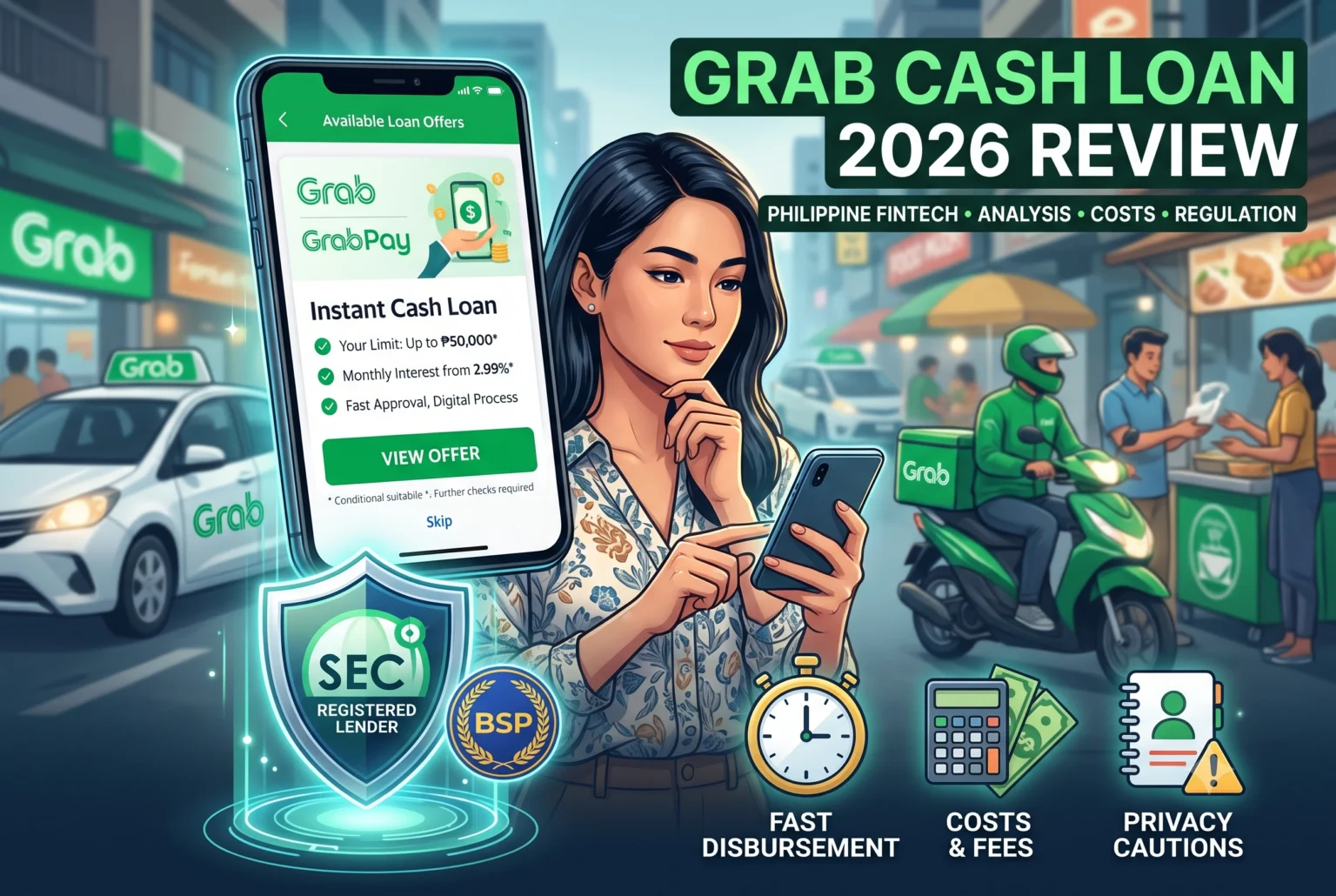
Finding a legitimate source of emergency credit often requires sorting through predatory apps and unclear terms. As major technology platforms expand into digital banking, the ride-hailing and delivery application Grab has introduced its own lending products. Many Filipinos who use the app for daily transport or food delivery are now seeing invitations to apply for a Grab Cash Loan directly on their mobile screens.
The immediate question for most users is whether this feature is a secure financial product or just another high-interest online lending scheme. Because the loan is deeply integrated into an app many people already use daily, the friction of applying is remarkably low. However, convenience can sometimes obscure the actual cost of borrowing.
This review investigates the 2026 framework of Grab’s consumer and merchant lending options in the Philippines. We examine the exact legal entity providing the funds, dissect the published interest rates and processing fees, clarify the automatic collection mechanics tied to the GrabPay wallet, and identify exactly what a borrower agrees to when accepting an offer.
Summary:
Grab Cash Loan is a legitimate, SEC-registered credit product operated by Grab Financial Services Philippines, Inc. Unlike public loan apps, it is an invitation-only facility available exclusively to whitelisted Grab users based on their platform activity. Consumer loans offer up to ₱50,000 with interest rates starting at 2.99% per month, while merchant and driver-partner limits can reach ₱300,000. Funds are disbursed quickly without requiring traditional paperwork. However, borrowers must understand that accepting the loan grants Grab a “first ranking assignment” over their GrabPay wallet, meaning the company can automatically sweep available balances to cover missed payments.
| Borrower Question | Current Finding | Why It Matters |
| Legal Operator | Grab Financial Services Philippines, Inc. (SEC Reg. CS201905977). | Confirms you are dealing with a licensed lending entity, not an unregulated shadow lender. |
| Eligibility | Invitation-only (whitelisted by an internal algorithm). | You cannot simply download the app and apply; you must build a history within the Grab ecosystem first. |
| Loan Range | Up to ₱50,000 for consumers; up to ₱300,000 for merchants. | First-time consumer offers are typically smaller and scale up based on repayment history. |
| Interest Rate | Starts at 2.99% per month for consumers. | Costs are competitive with digital banks but remain higher than traditional bank salary loans. |
| Net Proceeds | Processing fees may be amortized rather than deducted upfront. | You are more likely to receive the full requested principal instead of a heavily reduced payout. |
| Collection Method | Automatic deduction via GrabPay. | You must ensure funds are available on due dates to avoid immediate late penalties. |
Is Grab Cash Loan legitimate and properly authorized in the Philippines?
Yes. Grab Cash Loan is legitimate. The service is legally operated by Grab Financial Services Philippines, Inc., which holds a valid SEC registration (CS201905977) and the necessary authority to operate as a lending entity in the Philippines.
When evaluating any online credit product, the first step is separating the consumer-facing brand from the legal entity responsible for the loan contract. In this case, the brand equity of Grab is backed by a specific corporate subsidiary registered with the Securities and Exchange Commission (SEC).
Grab Financial Services Philippines, Inc. is listed on the SEC’s official registry of authorized lending corporations. This legal standing means the company is bound by the Truth in Lending Act, requiring them to issue clear disclosure statements before a loan is finalized. It also places the lender under the regulatory oversight of the Bangko Sentral ng Pilipinas (BSP) concerning electronic payments and settlements, given the heavy reliance on the GrabPay ecosystem. Borrowers have formal channels for grievance redress, which provides a layer of security entirely absent in unauthorized lending operations.
How does the Grab Cash Loan actually work?
Unlike standard online lenders, Grab Cash Loan is an invitation-only product. The system automatically whitelists eligible applicants based on their Grab platform history, meaning there is no public application form for new or inactive users.
Most digital lenders require you to upload pay slips, bank statements, and certificates of employment. Grab bypasses this traditional friction by using a closed-ecosystem underwriting model. You do not apply for a Grab Cash Loan; rather, Grab invites you to accept one.
To even be considered by the internal algorithm, an individual generally needs to be a Filipino citizen between 21 and 65 years old with a fully verified Grab account that has been active for at least three months. The system tracks your transaction velocity – how often you book rides, order food, and cycle funds through GrabPay – to build an alternative credit score.
If you meet their unpublicized threshold, a “Loans” tile becomes active on your home screen or within your GrabPay wallet interface. Because the company already possesses your verified identity and financial behavior data, the actual application process requires nearly zero additional documentation.
How much can you borrow from the Grab ecosystem?
Consumer loan limits typically cap at ₱50,000, while merchant and driver-partner loans can reach up to ₱300,000. Your exact approved principal is determined by an internal algorithm that evaluates your Grab ecosystem activity.
Grab segments its lending into distinct categories based on your relationship with the platform.
For ordinary app users, the standard Cash Loan tops out at ₱50,000. However, actual first-time offers are frequently much lower, often starting in the ₱5,000 to ₱15,000 range. The limit expands only after the borrower successfully completes a payment cycle.
For Grab merchant-partners (such as restaurant owners using GrabFood) and driver-partners, the limits are substantially higher. The “Quick Cash” facility for merchants can offer up to ₱300,000 with a repayment term stretching up to 12 months. Driver-partners receive custom offers based on their historical daily earnings. These commercial-tier limits reflect the fact that Grab has deep visibility into the revenue streams of its partners, significantly reducing the lender’s risk.
What does a Grab Cash Loan really cost?
Consumer interest rates start at 2.99% per month, with flexible terms of up to six months. Processing fees of up to 2% may apply, and official terms indicate these fees are sometimes amortized into your monthly payments rather than deducted upfront.
Evaluating the true cost of a loan requires looking past the advertised monthly rate and examining the exact deductions.
For consumer loans, the interest rate begins at 2.99% per month. While this is steep compared to a traditional bank loan (which might charge 1.2% to 1.5% monthly), it remains well below the predatory rates charged by informal lenders and some short-term payday apps. Merchant partners benefit from lower rates, sometimes advertised as low as 1.49% to 1.75% per month, reflecting their verified business cash flow.
A notable structural advantage of the Grab Cash Loan involves how they handle processing fees. Many online lenders deduct processing and service fees upfront, meaning a borrower requesting ₱10,000 might only receive ₱8,500. Grab’s published Terms and Conditions detail a calculation where the processing fee (typically 1% to 2%) is divided and added to the monthly installment.
Cost calculation example:
If you borrow ₱10,000 for 3 months with a 1% processing fee, you actually receive the full ₱10,000. The processing fee equates to ₱100 in total. Grab divides this by three, adding approximately ₱33.33 to each monthly payment. This amortization is highly favorable to the borrower because it maximizes the net cash received during an emergency.
How fast is approval and disbursement?
Because applicants are pre-vetted based on existing platform data, approval is often immediate. Funds are disbursed directly to your activated GrabPay wallet or a linked bank account, typically within the same day.
The primary advantage of alternative data underwriting is speed. When a whitelisted user clicks through the loan offer, the system does not need to forward the application to a human credit officer for review. The algorithm has already assessed the risk before the offer was even displayed.
Once the digital contract is accepted, disbursement happens swiftly. For consumers and driver-partners, the funds are credited directly to their GrabPay Cash Wallet. From there, the borrower can transfer the money to a linked traditional bank account via InstaPay or use it directly for merchant transactions. For small business owners utilizing the Quick Cash product, funds can take slightly longer to settle directly into their designated business bank accounts, though typical timelines remain under a few days.
How does repayment work and what happens if you pay late?
Repayments are usually collected via automatic deduction from your GrabPay wallet. If you miss a due date, the platform charges a 3% late fee on the overdue amount and holds a contractual right to sweep available wallet funds.
Convenience in disbursement is matched by automated strictness in collection. Borrowers do not need to manually pay over the counter at a convenience store. Instead, Grab initiates an auto-debit from the GrabPay wallet on the scheduled due date. For driver and merchant partners, repayments are often structured as micro-deductions from daily earnings rather than large monthly lump sums.
The published terms contain a specific legal clause borrowers must understand. By accepting the loan, you grant Grab a “first ranking assignment and a first ranking fixed charge” over your GrabPay wallet. In plain English, this means Grab has the contractual right to take whatever funds enter your GrabPay account to satisfy an outstanding loan balance before you can withdraw or spend that money.
If your wallet lacks sufficient funds on the due date, an Event of Default occurs. The published penalty is a 3% late fee applied specifically to the overdue amount. If the delinquency continues, these charges accumulate, and the lender reserves the right to escalate collection efforts, which can include reporting the default to credit bureaus, thereby impacting your future ability to borrow from traditional banks.
How does Grab handle your personal data?
Grab leverages alternative data to underwrite loans. Beyond basic identity verification, the application relies on your transaction history, location data, and usage patterns within the Grab ecosystem to assess credit risk.
Borrowers often worry about aggressive online lenders accessing their phone contacts to harass relatives. Because Grab Financial Services Philippines is heavily regulated and tied to a major multinational tech brand, they do not engage in illegal contact-list scraping or public shaming.
They do, however, process a vast amount of behavioral data. The privacy policy governing the loan allows the platform to use your ride-hailing habits, delivery frequencies, and wallet transaction volume to evaluate your financial stability. While this data sharing happens internally within the Grab ecosystem, it is a trade-off: you are exchanging your digital behavioral footprint for frictionless credit access.
What are the main advantages and disadvantages?
Potential Advantages:
-
Zero Upfront Deductions: Amortizing the processing fee means borrowers receive their exact requested principal.
-
Frictionless Process: Pre-approved users bypass paperwork entirely.
-
Regulated Operator: Borrowers are protected by SEC and BSP oversight, eliminating the risk of rogue collection harassment.
-
Micro-deductions: For merchants and drivers, daily fractional payments are often easier to manage than large monthly bills.
Potential Disadvantages:
-
Not Open to the Public: You cannot simply apply; you must wait for the algorithm to whitelist your account.
-
Wallet Sweeping: The “first ranking assignment” means any money you top up into GrabPay will be automatically seized if you are past due.
-
Cost: While fair for the digital space, a 2.99% monthly rate remains an expensive way to borrow money compared to bank alternatives.
Who may find this loan relevant, and who should be cautious?
This product is highly relevant for existing Grab ecosystem users facing a short-term cash flow gap. If you need funds quickly to cover an unexpected medical bill or home repair, and you have the confirmed income to settle the auto-debit within three to six months, the lack of hidden upfront deductions makes this a transparent option. It is similarly advantageous for Grab merchants needing working capital to manage inventory without visiting a bank branch.
Borrowers should be cautious if they rely heavily on GrabPay for their daily budget. Because the lender holds a first-ranking charge over the wallet, failing to meet a loan payment will paralyze your ability to use the wallet for ordinary expenses until the debt is cleared. If you are already struggling with multiple debts, taking a loan with automated, unavoidable wallet deductions can severely disrupt your daily cash flow.
What should you check before accepting a Grab Cash Loan?
Borrowers should verify their exact monthly interest rate, confirm the total processing fees, and ensure they are comfortable with Grab’s automatic deduction authority over their GrabPay balances before signing the digital contract.
Do not click through the agreement screens merely because the money is available. Stop and read the exact Disclosure Statement provided in the app. Confirm the actual peso amount that will be deducted each month. Calculate your existing monthly expenses and guarantee that your salary schedule aligns with the automated deduction dates. Finally, ensure your GrabPay wallet is funded adequately ahead of the due date to prevent the immediate 3% late penalty from triggering.
Frequently Asked Questions
Can I apply for a Grab Cash Loan if I do not have the app?
No. The loan is strictly an in-app feature restricted to users who have an established transaction history on the platform.
Will checking my loan offer affect my credit score?
No. Viewing your pre-approved offer inside the app does not trigger a hard inquiry on your traditional credit report.
Can I pay off my loan earlier than the scheduled term?
Yes. The terms allow for prepayment. If you settle the balance early, Grab may rebate unaccrued interest, though this is subject to their internal calculation policies at the time of settlement.
What happens to my driver incentives if I take a loan?
For driver-partners, participating in the loan program does not alter your existing incentive structures or earning rates. The loan operates as a separate financial facility.
References
-
Securities and Exchange Commission PhilippinesOrganization: Securities and Exchange CommissionResource: SEC Registered Lending Corporations List
-
Grab PhilippinesOrganization: Grab Financial Services Philippines, Inc.Resource: Cash Loan Terms and Conditions
-
GrabFinance HubOrganization: Grab PhilippinesResource: Quick Cash Business Financing
Last Updated: October 1, 2026 by The Nomad Finance Girl (Jaycee)
