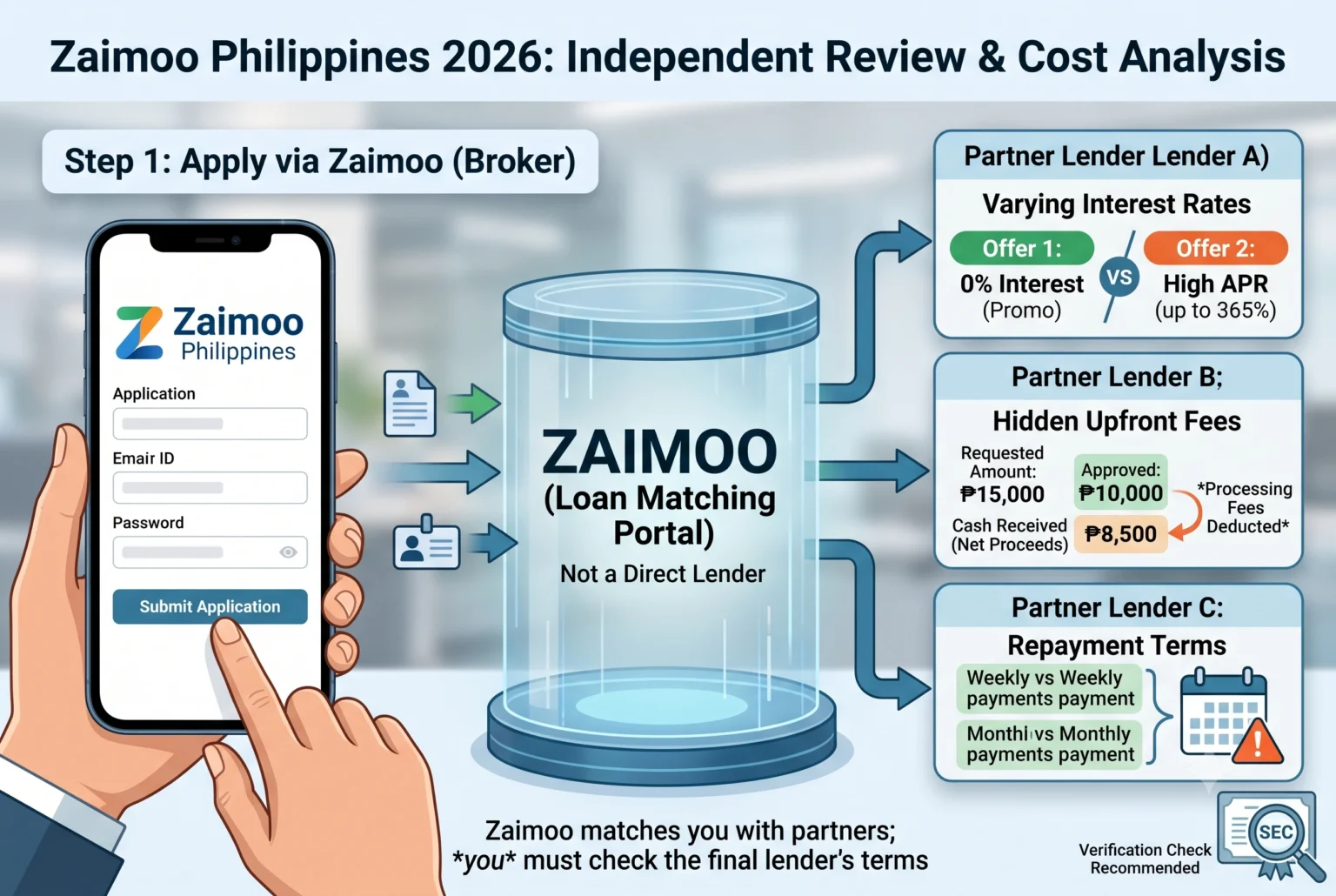
When facing a financial emergency, many Filipinos turn to online loan platforms for immediate relief. However, the exact source of those funds can often be confusing. Borrowers frequently ask whether the website they are applying on is the actual company lending them money, or if it is merely collecting their data to pass on to someone else. This distinction is critical when evaluating interest rates, hidden fees, and data privacy.
This review investigates Zaimoo, a prominent financial platform operating in the Philippines. We analyze public disclosures, current app listings, and lending documentation to determine who legally operates the service, how the matching process works, and what borrowers realistically face in terms of repayment costs. While online platforms provide convenience, understanding the difference between an advertised rate and the final peso cost can protect you from taking on unmanageable debt.
Summary: Zaimoo is not a direct lender; it is an online loan-matching portal operated by Densure LLC. It forwards borrower applications to third-party Philippine lenders who evaluate the request and provide the actual loan offers. While Zaimoo connects applicants to SEC-registered financing companies, the final interest rates, processing fees, and repayment schedules are determined entirely by the matched lender, not Zaimoo. Borrowers may see loan offers ranging from ₱1,000 to ₱25,000 with Annual Percentage Rates (APRs) reaching up to 365%. The primary risk is that borrowers must independently evaluate the third-party lender’s specific loan agreement, net disbursement, and collection policies before accepting any funds.
| Borrower question | Current finding | Why it matters |
| Is Zaimoo a direct lender? | No. It is a loan-matching portal that forwards applications to third-party lenders. | You will not sign a contract with Zaimoo, but with a separate financing company. |
| Who legally operates it? | Densure LLC, an international entity. | Your application data is processed by a broker before reaching a local lender. |
| How much can you borrow? | Advertised limits range from ₱1,000 to ₱25,000. | First-time borrowers usually qualify for much lower amounts than the advertised maximum. |
| What is the interest rate? | Varies by partner lender, ranging from 11.9% to a maximum APR of 365%. | Zaimoo does not control the final cost; the matched lender dictates the actual fees. |
| Is the first loan really 0%? | Only if the specific matched lender offers a short-term promotional rate. | Promotional rates often apply only to a brief initial period (e.g., 7 to 10 days). |
Is Zaimoo legitimate and properly authorized in the Philippines?
Yes, the platform operates as an active online lead generator, but it is not a Philippine SEC-registered lending or financing company. Zaimoo functions strictly as an intermediary managed by Densure LLC, matching borrowers with separate, legally licensed lending institutions in the Philippines.
Who legally operates Zaimoo?
According to the platform’s public disclosures and privacy records, Zaimoo is operated by Densure LLC, an international corporate entity. Because it is a financial aggregator rather than a direct provider of consumer credit, it does not hold a Certificate of Authority (CA) from the Philippine Securities and Exchange Commission (SEC) to operate as a lending or financing company. Instead, it serves as a marketing and technology bridge.
Is Zaimoo itself the lender or only a platform?
Zaimoo explicitly states on its official website that it is “not a credit institution and does not issue loans, microcredits and other credit products to users of the site.” When you submit your personal information on the platform, you are asking the system to forward your profile to its network of partner lenders. These partners – such as MoneyCat, Online Loans Pilipinas, and others – are the entities that actually hold SEC registration, assess your creditworthiness, disburse the funds, and eventually collect payments.
How does Zaimoo actually work?
Zaimoo collects a single loan application and distributes it to multiple partner lenders. If a partner approves the profile, the borrower receives a specific loan offer and completes the transaction directly on the partner lender’s separate platform.
Who can apply?
To use the matching service, applicants generally need to meet the standard criteria set by Philippine online lenders. This typically includes being at least 18 years old, holding Philippine citizenship, possessing a valid government-issued ID, and maintaining an active mobile number and bank account or e-wallet for disbursement.
What information or documents may be required?
During registration, the platform asks for basic personal details, contact information, and estimated monthly income. However, because the actual underwriting is handled by third parties, the matched lender will likely require further verification. The public application flow indicates that borrowers may be asked by the final lender to provide a selfie, upload a physical ID, and authorize access to certain device data before a final offer is generated.
How much can you borrow through Zaimoo?
The platform advertises loan amounts ranging from ₱1,000 to ₱25,000, though maximum limits are rarely granted immediately. The actual approved principal is determined entirely by the third-party lender’s internal credit scoring.
What limits are advertised?
Promotional materials and the site’s own rate disclosures highlight loans up to ₱25,000, with some marketing tiles even mentioning ₱50,000. These figures represent the theoretical maximums available from the largest lenders within their network.
Why might a first-time borrower receive less?
Online lenders mitigate risk by limiting exposure to new clients. A borrower using Zaimoo for the first time is typically matched with lenders offering entry-level limits – often between ₱1,000 and ₱3,000. Only after a borrower establishes a reliable repayment history with that specific partner lender do the limits increase toward the advertised maximums.
What does a loan through Zaimoo really cost?
Because Zaimoo is a broker, it does not set loan costs. Depending on the matched lender, interest rates range from a minimum of 11.9% per annum to a maximum Annual Percentage Rate (APR) of 365%, exclusive of processing fees.
What interest and fees are disclosed?
The platform advertises that some partner lenders offer a 0% interest promotion for first-time borrowers. However, borrowers must read the fine print of the final offer carefully. The published terms state that standard maximum APRs can reach 365%. Furthermore, the nominal interest rate often does not reflect the total borrowing cost. Many Philippine lending apps deduct heavy processing or service fees upfront, meaning the cash actually received is less than the approved principal.
How much would a sample loan cost in pesos?
If a partner lender approves a ₱5,000 loan with an equivalent APR of 145% over a 3-month (90-day) period, the interest alone would add roughly ₱1,785 to the balance. If the lender also deducts a 10% upfront processing fee (₱500), the borrower receives only ₱4,500 but remains responsible for repaying the full ₱6,785. Borrowers should always calculate the cost relative to the net proceeds received.
How fast is approval and disbursement?
Partner lenders often provide initial approval decisions within minutes. While the marketing claims instant disbursement, the actual time it takes to receive funds depends heavily on bank clearing schedules and e-wallet limits.
What can slow approval?
Friction in the underwriting process usually stems from mismatched data. If the name on the submitted government ID does not perfectly match the name on the requested bank account or GCash/Maya wallet, the partner lender’s automated system will likely flag the application for manual review. Unclear ID photos or inconsistent income declarations also cause significant delays.
When can bank or e-wallet settlement delay the money?
Even if a partner lender approves the loan instantly, the actual cash transfer relies on standard banking rails (like InstaPay or PESONet). Applications approved late at night, on weekends, or during banking holidays may experience posting delays until the next business day.
What happens if you pay late?
Zaimoo is not responsible for debt collection; the partner lender handles late payments. Delinquency will trigger penalty fees, aggressive collection communications, and potential negative reporting to credit bureaus.
What charges may apply?
Each financing company in the Zaimoo network enforces its own penalty structure. Most online lenders in the Philippines impose a fixed daily late fee alongside the compounding standard interest. Borrowers who miss their due dates often see their balances inflate rapidly within just a few days of default.
Can delinquency affect your credit record?
Yes. Many SEC-registered financing companies are mandated submitting entities to the Credit Information Corporation (CIC). Defaulting on a loan secured through a Zaimoo partner will likely appear on your centralized credit report, which can impair your ability to secure housing loans, auto financing, or standard bank credit cards in the future.
How does Zaimoo handle your personal data?
As an aggregator, Zaimoo collects your data specifically to share it with third-party lenders. Borrowers must consent to their personal information being transmitted across multiple financial institutions for credit evaluation.
What data does the application collect?
The initial registration requires basic identity and financial data. Because this data is immediately routed to partners, borrowers are effectively providing their information to multiple entities at once.
Can the lender contact people in your phone?
While Zaimoo’s web portal itself does not scrape phone contacts, the subsequent mobile apps of the matched partner lenders often request extensive device permissions. Philippine regulations prohibit lenders from accessing a borrower’s full contact list to harass third parties for debt collection. Borrowers should heavily scrutinize the app permissions requested by the final lender before downloading their software.
What are the main advantages and disadvantages?
Advantages:
-
Convenience: A single application form allows borrowers to see which lenders might approve them, reducing the time spent applying on multiple individual sites.
-
Broad Network: Connects applicants to known, SEC-registered financing companies.
-
Promotional Access: Makes it easier to find which lenders are currently offering 0% introductory rates for first-time borrowers.
Disadvantages:
-
Lack of Control: The borrower does not know the exact interest rate, fee structure, or net disbursement amount until a third party generates an offer.
-
Data Sharing: Personal and financial data is distributed to third parties as a fundamental part of the business model.
-
Cost Variability: The maximum APR of 365% means that some matched loans are highly expensive emergency products.
Who may find Zaimoo relevant, and who should be especially cautious?
This matching service is most relevant for individuals who need immediate emergency funds but do not know which specific lending apps currently accept their profile type. It acts as a time-saving filter.
However, a borrower should be especially cautious if they are easily confused by financial terminology. Because Zaimoo is not the lender, the borrower must have the financial literacy to critically evaluate the subsequent contract presented by the partner company. If the offered net proceeds are heavily reduced by hidden fees, or if the borrower intends to repay the loan by taking out yet another loan, they should not proceed.
What should you check before accepting a loan offer?
Before signing an electronic contract provided by one of Zaimoo’s partners, verify the following:
-
The Exact Legal Lender: Check the partner company’s name against the SEC’s published list of authorized lending and financing companies.
-
Net Disbursement: Confirm exactly how many pesos will land in your account after all processing fees are deducted.
-
Total Repayment: Calculate the exact total you must return and divide it by the days you have the money to understand the true daily cost.
-
Due Date: Ensure the repayment date aligns with your actual salary or income schedule to avoid immediate late penalties.
Frequently Asked Questions
Is Zaimoo an SEC-registered lending app?
No. Zaimoo is an online financial comparison and matching portal operated by Densure LLC. It connects users to SEC-registered lenders but does not lend money itself.
Does Zaimoo charge a fee for matching?
The available public documentation indicates that Zaimoo’s matching service is free for the borrower. The platform generates revenue through lead-generation agreements with its partner lenders.
How do I cancel an application on Zaimoo?
If you have only filled out the matching form, you can simply close the site. If a partner lender has already issued a contract, you must decline the offer on that specific lender’s platform before electronically signing it.
Who do I contact if I have a problem with my loan?
All customer service issues regarding repayment, late fees, or technical glitches during disbursement must be directed to the specific partner lender that issued the loan. Zaimoo cannot modify loan terms, waive fees, or process payments.
Conclusion
Zaimoo provides a highly efficient way to navigate the fragmented Philippine online lending market by distributing a single application to multiple licensed lenders. However, this convenience comes with a critical trade-off: uncertainty. Because Zaimoo is a broker and not a direct lender, borrowers have no guarantee regarding the final interest rate, exact loan limits, or hidden deductions until a third-party partner makes a specific offer.
The ultimate safety of using this platform depends entirely on the borrower’s willingness to scrutinize the final loan agreement. If a matched lender deducts excessive processing fees or demands an unmanageable 365% APR, the borrower must be prepared to walk away. Use the platform to find available credit, but never accept an offer without calculating the exact net cash received versus the total repayment required.
References
-
ZaimooOrganization: Densure LLCResource: Registration for a loan – Terms and Conditions
-
Ploan.phOrganization: Ploan.phResource: Zaimoo – Borrow up to 25,000 pesos
-
ScamAdviserOrganization: ScamAdviserResource: zaimoo.ph Reviews | check if the site is a scam or legit
Last Updated: October 1, 2026 by The Nomad Finance Girl (Jaycee)
