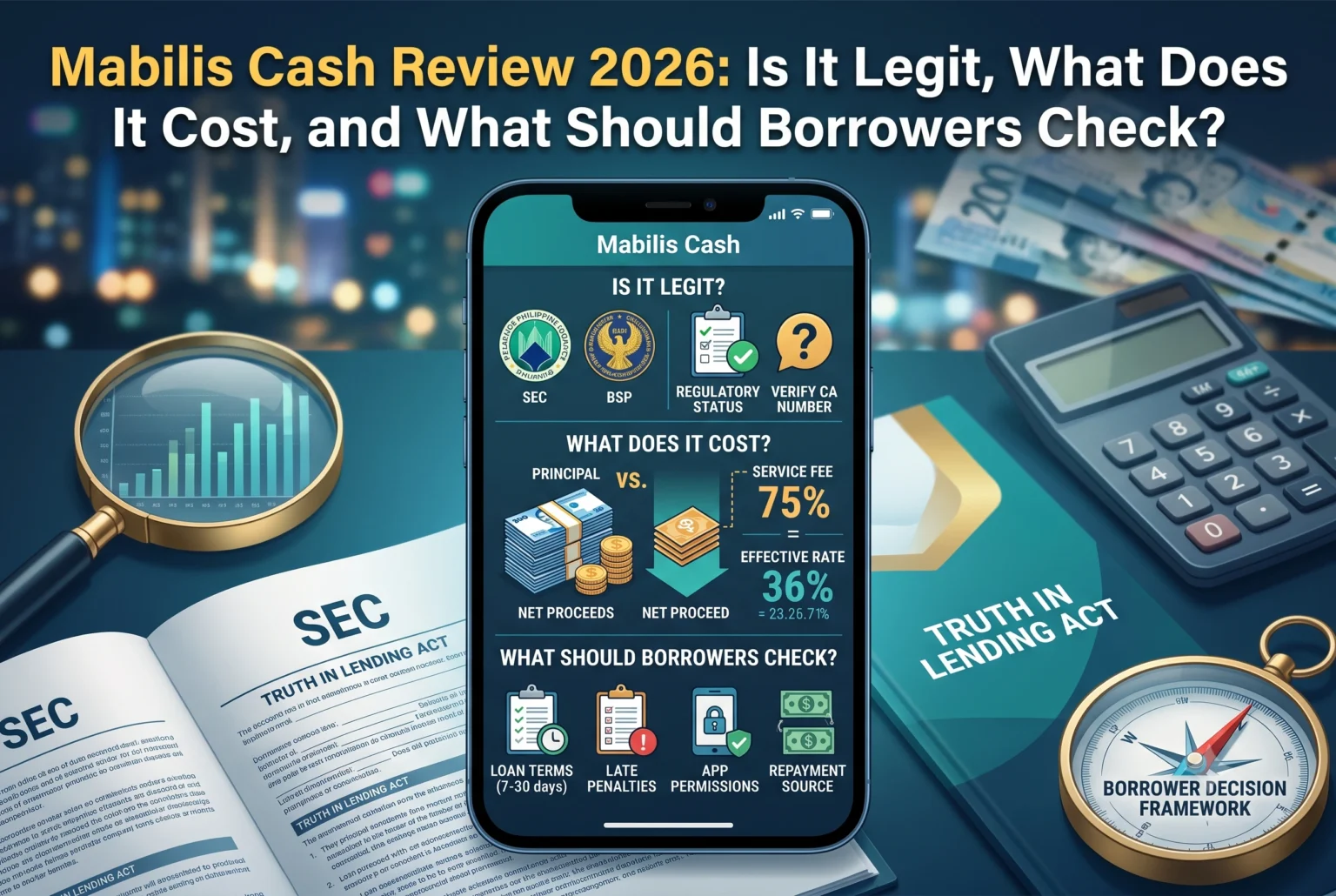
Many Filipinos turn to digital lending platforms when faced with immediate financial shortfalls, prioritizing speed over traditional banking requirements. However, the convenience of online borrowing often masks complex fee structures and aggressive collection terms. For borrowers considering Mabilis Cash, the primary concerns usually revolve around the exact amount they will actually receive, the total cost of repayment, and whether the platform operates within Philippine regulatory boundaries.
This review investigates the publicly available terms, regulatory footprint, and actual cost mechanisms of Mabilis Cash. By analyzing current app store disclosures, standard lending contracts, and recent borrower feedback, we break down what applicants need to know before agreeing to a loan.
Summary:
Mabilis Cash operates as a digital lending application in the Philippines, targeting borrowers who need short-term, uncollateralized credit. While the platform is accessible and promotes fast approval times, applicants must carefully distinguish between the advertised loan limit and the net cash they will actually receive. Like many fast-cash applications, the true cost of borrowing often stems from substantial upfront service or processing fees rather than the nominal interest rate alone. Borrowers should verify the platform’s active Certificate of Authority with the Securities and Exchange Commission (SEC) before applying, closely review the mandatory Disclosure Statement to understand the effective interest rate, and only accept the funds if they have a clear repayment source to avoid steep late penalties.
| Borrower question | Current finding | Why it matters |
| Legal operator | Must be verified via the SEC’s current list of Online Lending Platforms (OLPs). | A registered corporation still requires a specific Certificate of Authority (CA) to lend legally. |
| Loan range | Advertises varying limits, but first-time borrowers typically receive much lower initial approvals. | You cannot rely on receiving the maximum advertised amount for an emergency. |
| Net proceeds | Upfront service and processing fees are frequently deducted before disbursement. | You may receive significantly less cash than the principal amount you are required to repay. |
| Repayment terms | Often structured around short-term cycles (e.g., 7 to 30 days) depending on the borrower’s risk profile. | Short payment windows increase the risk of default and compounding late penalties. |
| Data privacy | The application requires access to specific device data to process the loan. | Overbroad permissions can expose your personal contacts and device information to the operator. |
Is Mabilis Cash legitimate and properly authorized in the Philippines?
According to public app listings, Mabilis Cash operates under a corporate entity registered to provide lending services. However, borrowers must locate the operator’s specific Certificate of Authority (CA) number in the app and verify it against the SEC’s 2026 master list of authorized online lending platforms, as regulatory statuses can change.
Who legally operates Mabilis Cash?
In the Philippine digital lending sector, the consumer-facing brand name (the app) is often different from the registered corporate entity providing the funds. A lending platform is only legitimate if the corporation managing it holds an active Certificate of Authority to Operate as a Lending or Financing Company from the SEC.
Borrowers checking the legitimacy of Mabilis Cash should look at the developer information on the Google Play Store or Apple App Store, and read the application’s terms and conditions to identify the exact corporate name. Simply having an SEC company registration number is not enough; the entity must have a CA specifically for lending, and the SEC must formally list Mabilis Cash as one of its recognized Online Lending Platforms (OLPs).
Regulatory boundaries and consumer protection
The SEC and the Bangko Sentral ng Pilipinas (BSP) strictly regulate interest rate caps, billing practices, and collection methods. If Mabilis Cash operates legally, it is bound by SEC Memorandum Circular No. 18, series of 2019, which explicitly prohibits unfair debt collection practices, including the use of threats, insults, or contacting individuals in your phonebook who were not named as guarantors.
What does a Mabilis Cash loan really cost?
The true cost of a short-term online loan usually lies in upfront deductions, not just the monthly interest rate. Our review of standard digital lending models indicates that processing or service fees often reduce the actual cash disbursed, pushing the Effective Interest Rate (EIR) significantly higher than advertised.
Advertised interest versus effective cost
A common point of friction for online borrowers is the difference between the principal loan amount and the net proceeds received. Lending applications frequently market low nominal interest rates but offset this by charging administrative, service, or processing fees.
For example, if a borrower is approved for a ₱5,000 loan but the platform deducts a 25% processing fee upfront, the borrower only receives ₱3,750 in their bank account or e-wallet. However, upon the due date, the borrower is still required to repay the full ₱5,000 plus any applicable interest. This mechanism makes the actual peso cost of borrowing much higher than a simple percentage rate implies.
The importance of the Disclosure Statement
Under the Philippine Truth in Lending Act (Republic Act No. 3765), all lenders are required to provide a clear Disclosure Statement before the borrower accepts the loan. This document must break down the exact principal, all deducted fees, the net proceeds, the schedule of payments, and the total amount to be repaid. Borrowers reviewing Mabilis Cash must pause at this step in the application flow and calculate whether the net cash received is worth the total repayment burden.
How fast is the approval and disbursement process?
Public application flows suggest that Mabilis Cash utilizes automated underwriting requiring a valid government ID and facial recognition. While marketing materials claim rapid disbursement, actual funding times depend heavily on the clearing schedules of the receiving bank or e-wallet.
Application requirements and friction points
To apply, borrowers generally need a smartphone, an active mobile number, and at least one valid primary government ID (such as a Passport, Driver’s License, UMID, or National ID). The application process typically involves filling out personal details, employment information, and emergency contacts, followed by a live selfie for identity verification.
Common reasons for application friction include:
-
Mismatched names between the ID and the designated receiving bank account.
-
Poor image quality or glare on the uploaded ID.
-
Failure to pass the live facial recognition check.
Disbursement timelines
Once approved, funds are usually transferred via InstaPay or PESONet to the borrower’s designated bank account or e-wallet (such as GCash or Maya). While InstaPay facilitates real-time crediting, manual reviews by the lender or network maintenance on the receiving bank’s end can delay the arrival of funds.
What happens if you pay late?
Failing to repay a Mabilis Cash loan on time triggers late payment penalties that compound daily. Persistent non-payment leads to account turnover to internal or third-party collection agencies, which will initiate frequent communication to recover the debt.
Penalties and compounding charges
Short-term loans are unforgiving when it comes to missed due dates. If a borrower fails to settle the balance by the specified deadline, the platform will immediately apply a late penalty – often a fixed fee plus a daily percentage of the outstanding balance. Because these terms are outlined in the loan agreement, borrowers are legally obligated to pay them, and a small debt can quickly balloon into an unmanageable amount within weeks.
Debt collection and legal realities
Borrowers frequently express anxiety about imprisonment for unpaid digital loans. In the Philippines, the Constitution states that no person shall be imprisoned for non-payment of a simple civil debt.
However, borrowers must separate civil debt from fraudulent acts. Evading a loan entirely is a breach of contract. The lender retains the right to employ collection agencies, file civil claims, and report the default to the Credit Information Corporation (CIC), which will severely damage the borrower’s ability to secure loans, credit cards, or mortgages from traditional banks in the future.
How does the app handle your personal data?
The application requires access to specific mobile device functions, such as the camera for identity verification and location services for fraud prevention. Borrowers must review the privacy policy to ensure the app does not unlawfully scrape contact lists.
Device permissions
When installing any financial application, users are prompted to grant device permissions. A legitimate lending app requires camera access (for ID scanning) and coarse location data (to verify the applicant is in the Philippines).
The National Privacy Commission (NPC) strictly prohibits online lending applications from accessing a borrower’s entire contact list or photo gallery to use as leverage during debt collection. Borrowers should inspect the app permissions in their device settings. If an app refuses to function without access to your entire phonebook, it represents a significant privacy risk.
What are borrowers saying about Mabilis Cash in 2026?
Recent anecdotal feedback from digital platforms like Google Play and local financial forums highlights a divide: many users appreciate the accessibility and speed, while negative reviews consistently point to high upfront fee deductions and rigid repayment windows.
Positive patterns
Borrowers who leave positive feedback generally focus on the lack of bureaucratic friction. Freelancers, gig-economy workers, and those without formal credit histories often successfully secure funds when traditional banks reject them. The automated nature of the application allows for weekend and holiday processing, which provides genuine utility during medical or family emergencies.
Recurring complaints
Conversely, negative borrower reports typically center on the cost structure. A recurring theme across Philippine loan app reviews is “fee shock” – where a borrower anticipates a certain amount based on the approved limit, only to receive a substantially smaller sum due to processing charges. Additionally, users frequently report frustration with aggressive reminder texts that begin days before the actual due date.
Pros and Cons of Mabilis Cash
Potential Advantages:
-
Accessible to individuals with limited formal credit history.
-
Fully digital application process without physical paperwork.
-
Disbursement options usually include popular e-wallets like GCash.
-
Automated processing allows for rapid approval decisions.
Potential Drawbacks:
-
First-time borrowers are usually restricted to low credit limits.
-
Upfront processing fees drastically reduce the net cash received.
-
Short repayment terms require quick liquidity.
-
Late fees accumulate rapidly, making default highly expensive.
Who should consider this loan, and who should avoid it?
Short-term digital loans serve a highly specific purpose and are not suitable for general financial management.
Mabilis Cash or similar platforms may be relevant for a borrower who has an absolute financial emergency, requires funds outside of banking hours, and knows with certainty that a paycheck or incoming remittance will allow them to clear the debt in full by the due date.
Borrowers should avoid this type of loan if they are trying to pay off another existing debt. Using a high-cost, short-term loan to settle another obligation traps the borrower in a debt cycle. Furthermore, individuals with unstable income should not rely on platforms with rigid, short-term repayment windows and high daily late fees.
Final Verdict: What to check before you accept
The decision to use an online lending application should be based on math, not just urgency. Before clicking the final acceptance button on Mabilis Cash, execute these three steps:
-
Check the Operator: Look at the app’s terms for the corporate name and verify its Certificate of Authority on the SEC website.
-
Read the Disclosure Statement: Find the line item that shows the exact net proceeds. Subtract that number from the total repayment amount. That difference is your actual cost of borrowing.
-
Assess the Timeline: Check the exact due date. If your salary or expected income arrives even one day after that due date, the late fees will likely erase any convenience the loan provided.
If the exact peso cost feels too high for the amount of cash you actually receive, decline the terms and explore alternatives such as SSS salary loans, employer cash advances, or formally licensed pawnshops.
References
-
Securities and Exchange Commission PhilippinesOrganization: Securities and Exchange Commission (SEC)Resource: List of Registered Online Lending Platforms
-
Official Gazette of the PhilippinesOrganization: Government of the PhilippinesResource: Republic Act No. 3765 (Truth in Lending Act)
-
Securities and Exchange Commission PhilippinesOrganization: Securities and Exchange Commission (SEC)Resource: SEC Memorandum Circular No. 18, Series of 2019 (Prohibition on Unfair Debt Collection Practices)
-
National Privacy CommissionOrganization: National Privacy Commission (NPC)Resource: Issuances on Data Privacy in Online Lending Apps
Last Updated: September 29, 2026 by The Nomad Finance Girl (Jaycee)
