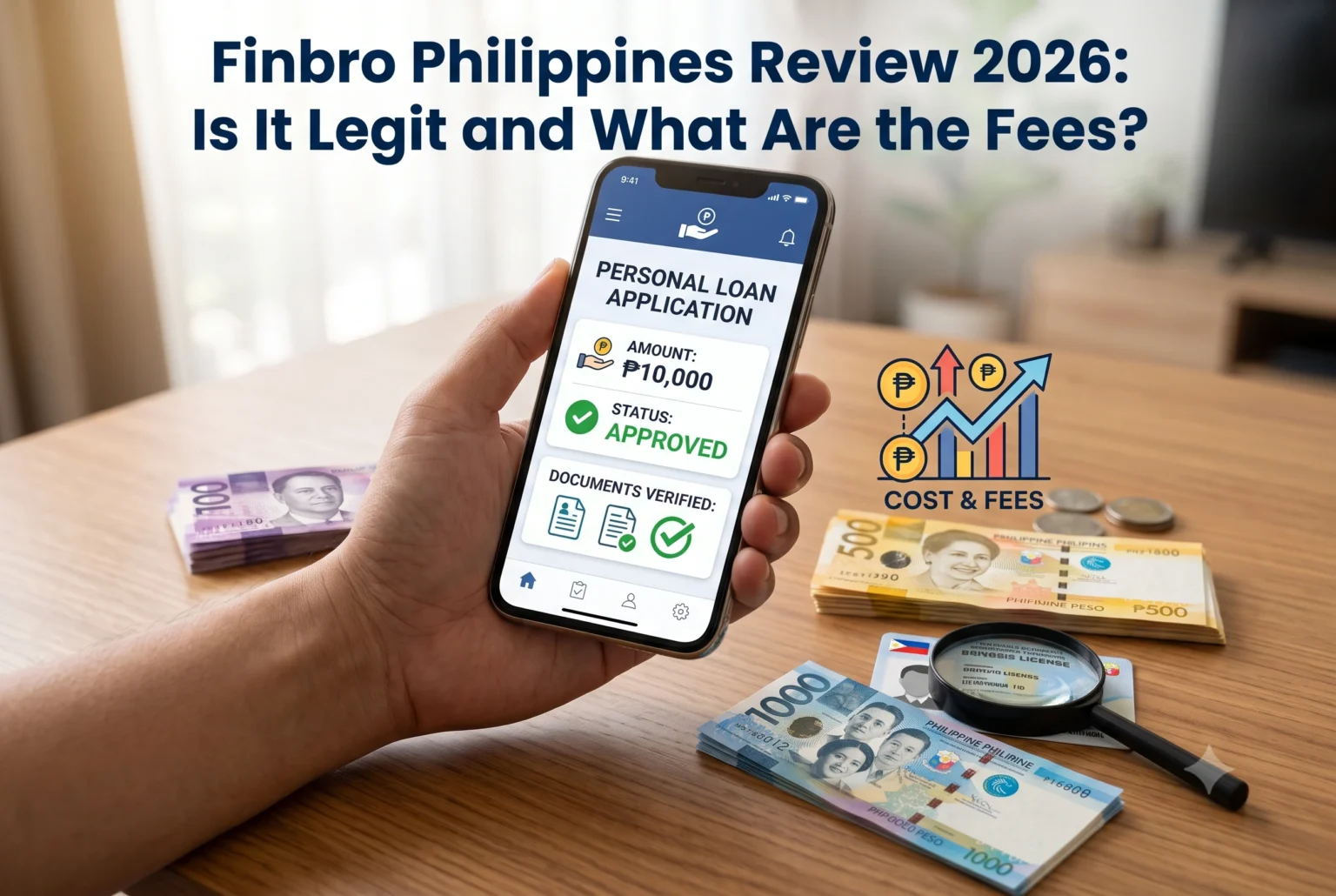
When unexpected financial needs arise, borrowers in the Philippines often look to digital lending apps for immediate cash. However, a common frustration with online loans is the gap between the advertised loan limit and the actual money disbursed after upfront deductions. Evaluating a platform like Finbro requires looking past the marketing claims to understand the exact corporate operator, the true cost of borrowing, and the data permissions requested by the application. This review examines Finbro’s current legal status, published loan terms, and structural costs to help Filipino consumers make informed financial decisions.
Summary: Finbro is a legitimate online loan service operated by Sofi Financing Inc., a registered financing company in the Philippines holding SEC Registration No. CS201908275 and Certificate of Authority No. 1324. The platform advertises loans up to ₱50,000 with terms up to 12 months. While it provides a regulated alternative to informal lenders, the actual cost of borrowing can be substantial, with the maximum Annual Percentage Rate (APR) reaching up to 144% depending on the applicant’s credit profile. Borrowers must carefully review the disclosure statement, as processing fees materially increase the total repayment burden beyond the base interest rate.
| Borrower question | Current finding | Why it matters |
| Who legally operates Finbro? | Sofi Financing Inc. (SEC Reg. CS201908275, CA No. 1324). | Confirms you are dealing with an authorized Philippine financing company subject to local regulations. |
| How much can I borrow? | Advertised limits range from ₱1,000 to ₱50,000. | First-time applicants usually qualify for a lower limit until a positive repayment history is established. |
| What are the actual costs? | Advertised interest is up to 6% per month, but total APR can reach 144%. | High processing and service fees are added to the interest, significantly increasing the final repayment amount. |
| Are there physical addresses? | 23rd Floor BGC Stopover Corporate Center, Taguig City. | Having a verified local office provides a channel for legal correspondence and regulatory accountability. |
| What data does the app access? | The app requests Camera and Location permissions. | These are standard for identity verification and anti-fraud checks, but require careful review of their privacy policy. |
Is Finbro legit and SEC-registered in the Philippines?
Yes. Finbro is legally operated by Sofi Financing Inc., an authorized financing company registered with the Philippine Securities and Exchange Commission (SEC). While the platform holds the necessary corporate and regulatory credentials, prospective borrowers should still evaluate the actual cost of its loan offers carefully.
Who legally operates Finbro?
Consumer-facing financial apps often use brand names that differ from their legal corporate identities. In this case, the Finbro application and website are the registered operating names of Sofi Financing Inc. According to its current 2026 Google Play Store disclosures and official website, the entity holds SEC Registration No. CS201908275 [1, 2]. More importantly, it possesses Certificate of Authority (CA) No. 1324, which grants the legal right to operate as a financing company in the Philippines.
Is Finbro itself the lender or only a platform?
Some mobile loan applications act strictly as brokers, matching users with third-party lenders. Based on public documentation, Sofi Financing Inc. is a direct financing company. When a consumer accepts an offer through Finbro, they are entering a financial contract directly with Sofi Financing Inc., meaning the company is responsible for funding the loan, defining the terms, and managing the collection process.
How does Finbro actually work?
Finbro operates as a fully digital lending platform where applicants submit personal details, identity documents, and income information via a mobile app or website. An automated credit assessment then determines the approved loan limit, applicable interest rate, and required fees.
Who can apply?
To meet basic eligibility requirements, applicants must be Philippine citizens residing in the country. The published age requirement spans from 20 to 65 years old. The lender explicitly requires applicants to possess a stable source of income, meaning the product targets employed individuals, business owners, or freelancers who can demonstrate repayment capacity.
What information or documents may be required?
The digital application flow requires identity verification. Borrowers are typically prompted to provide a valid government-issued ID (such as a Passport, Driver’s License, UMID, or SSS ID) along with an active mobile phone number. The platform utilizes camera permissions for live selfie verification and location tracking to deter fraudulent applications.
How much can you actually borrow from Finbro?
Finbro advertises personal loans ranging from ₱1,000 to ₱50,000. However, the maximum limit is rarely granted to new users. Initial approvals are generally conservative, with higher amounts unlocked only after the borrower successfully completes prior repayment cycles.
What limits are advertised?
The official marketing materials and app listings highlight a maximum borrowing limit of ₱50,000 with repayment tenors stretching up to 12 months. These figures represent the ceiling of what the platform can technically issue.
Why might a first-time borrower receive less?
Digital lenders manage credit risk by testing new borrowers with small principal amounts. A first-time applicant should realistically expect an initial offer much closer to the minimum threshold. If the first loan is settled on time, the system’s algorithm typically increases the credit limit and may offer extended repayment terms on subsequent applications.
What does a Finbro loan really cost?
The true cost of a Finbro loan extends beyond its monthly interest rate. Due to processing charges and service fees, the total Annual Percentage Rate (APR) can reach up to 144%. Borrowers must evaluate the exact total repayment figure rather than just the principal.
What interest and fees are disclosed?
Finbro publicly advertises monthly interest rates starting at roughly 6%. However, looking exclusively at the nominal monthly rate is a mathematical trap for borrowers. The lender’s official app store listing discloses that the maximum APR – which factors in processing costs and administrative fees – can hit 144%, depending on the user’s credit profile [3].
How much would a sample loan cost in pesos?
To illustrate the financial impact of non-interest deductions, consider the exact repayment example provided in Finbro’s current public disclosures for a ₱1,000 loan over a 12-month term:
-
Loan Amount: ₱1,000
-
Processing Fee: ₱660
-
Interest Rate Charge: ₱660
-
Total Repayment: ₱2,320
In this verified scenario, the cost of borrowing (₱1,320) actually exceeds the original principal requested. This highlights why borrowers must read the final disclosure statement carefully to understand the exact cash disbursed versus the final peso amount owed.
How fast is Finbro approval and disbursement?
Finbro markets its service as providing approval decisions within minutes. Once approved, funds are transferred electronically to the borrower’s bank account or e-wallet, though actual receipt times depend heavily on standard banking settlement schedules.
What can slow approval?
While the algorithmic credit check is nearly instantaneous, friction often occurs during the identity verification phase. Common delays involve blurred ID photos, mismatched names between the application and the bank account, or failure to pass the live selfie check. Applications flagged by the system for inconsistencies require manual review, which negates the automated speed.
When can bank or e-wallet settlement delay the money?
Even if Finbro approves and releases the funds immediately, the borrower’s receiving institution dictates the final posting time. Transfers routed through InstaPay usually reflect in real time, but those relying on PESONet or processed outside standard banking hours (such as late evenings, weekends, or public holidays) may not be available until the next clearing cycle.
What happens if you pay Finbro late?
Failure to meet the scheduled due date triggers late payment penalties that rapidly inflate the outstanding balance. Prolonged delinquency will result in collection efforts and negative reporting to Philippine credit registries.
What charges may apply?
Like all registered financing companies, Finbro applies penalty fees on past-due accounts. Because the baseline interest and processing fees are already substantial, adding daily or one-time late penalties makes the debt significantly harder to clear. The exact penalty structures are formalized in the loan agreement provided prior to disbursement.
Can delinquency affect your credit record?
Yes. Under Republic Act No. 9510 (the Credit Information System Act), authorized financing companies are mandated to submit basic credit data – both positive and negative – to the Credit Information Corporation (CIC). Defaulting on a Finbro loan will degrade your credit profile, making it difficult to secure traditional bank loans, mortgages, or credit cards in the future.
How does Finbro handle your personal data?
Finbro collects specific personal information governed by the Philippine Data Privacy Act of 2012. The mobile application formally requests device permissions limited to camera access for identification and location services for fraud prevention.
What data does the application collect?
The current version of the Finbro app explicitly limits its mandatory device permissions. It accesses the camera exclusively for scanning government IDs and capturing a live selfie. It also pulls geolocation data to verify that the applicant is physically within the Philippines and to track potentially fraudulent IP behavior.
Are there unauthorized contacts?
In the past, unregulated lending apps in the Philippines gained notoriety for scraping contact lists to harass a borrower’s friends and family. Because Sofi Financing Inc. is an SEC-regulated entity, it is bound by the National Privacy Commission’s strict prohibitions against unauthorized third-party disclosure. Debt collection communications must be restricted to the borrower and specifically designated guarantors or reference persons.
What are the main advantages and disadvantages of Finbro?
Finbro offers a highly accessible, legitimate funding source for urgent cash needs, but its structure relies on steep processing fees that make it an expensive long-term credit solution.
Potential Advantages:
-
Regulatory Compliance: Operated by a verified SEC-licensed financing company, offering a safer alternative to underground lenders.
-
Accessibility: Fully digital application with minimal documentation (one valid ID and proof of income).
-
Payment Channels: Repayments can be processed through multiple standard gateways, including e-wallets, bank transfers, and payment centers.
-
Transparency: The app discloses the total repayment amount and the breakdown of fees before the user digitally signs the agreement.
Potential Disadvantages:
-
High Total Cost: When factoring in processing and service fees, the APR can reach 144%, making the actual peso cost of borrowing exceptionally high.
-
Strict Limits for Beginners: First-time applicants are highly unlikely to receive the advertised maximum amount of ₱50,000.
-
Fast Debt Accumulation: Short tenors combined with high fees mean borrowers can easily fall into a debt trap if they rely on the platform repeatedly.
Who may find Finbro relevant, and who should be especially cautious?
Finbro serves a specific market segment and is not a one-size-fits-all financial solution. Borrowers must evaluate their exact repayment capacity before accepting the platform’s terms.
This product may be relevant for individuals who:
-
Face a temporary, severe cash shortfall that requires immediate funding.
-
Lack the credit history required to secure a traditional bank loan or credit card.
-
Know exactly when and how they will generate the funds to clear the debt on the due date.
A borrower should be especially cautious if:
-
Their income is highly irregular.
-
They intend to use the loan to pay off another existing debt.
-
The heavy deduction of processing fees means the net cash disbursed will not actually cover their emergency.
What should you check before accepting a Finbro loan?
Before tapping the final confirmation button inside the Finbro application, a borrower must pause and review the mandatory Disclosure Statement. The Philippine Truth in Lending Act requires all lenders to present a clear breakdown of the loan.
Check the “Net Proceeds” line to see exactly how many pesos will land in your bank account, and compare it against the “Total Repayment” line. If the gap between the money you receive and the money you must return feels unmanageable for your current income, do not accept the terms. A fast approval is only beneficial if the repayment schedule is financially survivable.
References
-
Securities and Exchange Commission (SEC) PhilippinesOrganization: Securities and Exchange CommissionResource: List of Financing Companies
-
Finbro.phOrganization: Sofi Financing Inc.Resource: Official Website and Terms
-
Google Play StoreOrganization: GoogleResource: Finbro.ph Application Listing
Last Updated: September 29, 2026 by The Nomad Finance Girl (Jaycee)
