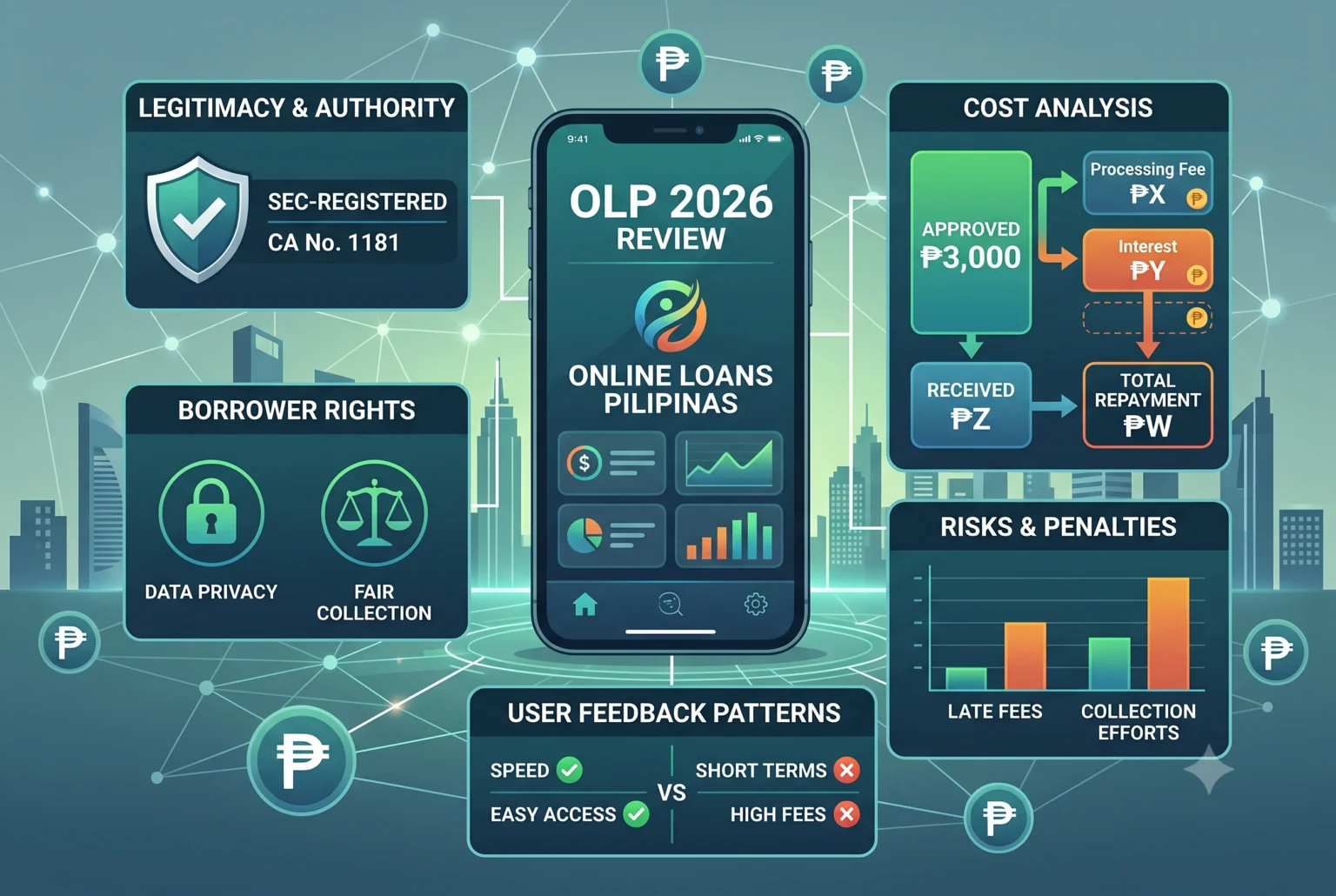
Filipino borrowers seeking emergency credit often encounter a sharp disconnect between the maximum loan amount a platform advertises and the actual net cash deposited into their accounts. When facing urgent financial shortfalls, it is easy to overlook the legal identity of the lender, the precise fee structure, and the consequences of delinquency. This review investigates Online Loans Pilipinas (OLP) by analyzing its regulatory standing, calculating how its terms align with Philippine lending caps, and identifying the friction points applicants typically experience during repayment.
Summary:
Online Loans Pilipinas is operated by Online Loans Pilipinas Financing, Inc., an SEC-registered financing company authorized to operate in the Philippines. The platform issues short-term digital cash loans ranging from ₱1,000 to ₱20,000, though initial approvals usually default to the minimum tier. While the application offers rapid automated disbursement and no collateral requirements, borrowers frequently encounter strict repayment windows that can trigger late penalties. The primary risk involves compounding fees and active collection efforts if a borrower defaults. Always verify the exact net proceeds and the total repayment figure on the mandatory disclosure statement before finalizing any loan agreement.
| Borrower question | Current finding | Why it matters |
| Who legally operates the app? | Online Loans Pilipinas Financing, Inc. (SEC CA No. 1181). | You are dealing with a registered financing entity subject to regulatory oversight, not an anonymous offshore operation. |
| What are the actual loan limits? | ₱1,000 to ₱20,000. | First-time borrowers rarely receive the maximum; expect an initial limit closer to ₱1,000 to ₱5,000. |
| Will I receive the full amount? | Processing fees may be deducted upfront for standard loans. | You must calculate your budget based on the net proceeds deposited, not the gross principal approved. |
| What happens if I pay late? | Penalties apply and collection efforts begin immediately. | Missing a due date increases the debt burden through late fees capped at 5% per month and negatively affects credit standing. |
| Does it require collateral? | No collateral is required. | Approval relies entirely on identity verification, income estimation, and data-driven risk assessment. |
Is Online Loans Pilipinas (OLP) legitimate and properly authorized in the Philippines?
Yes. Online Loans Pilipinas is operated by Online Loans Pilipinas Financing, Inc., which appears in current Securities and Exchange Commission (SEC) records as an authorized financing company under Certificate of Authority No. 1181. This confirms legal status, but does not mean the product is inexpensive.
Who legally operates the platform?
Online lending platforms in the Philippines act as the consumer-facing brand for a registered corporate entity. In this case, the app and the lending entity share the same name. Online Loans Pilipinas Financing, Inc. holds the necessary SEC registration to operate as a financing company. This is a critical distinction from unauthorized lenders, as registered companies are subject to the Fair Debt Collection Practices Act and regulatory audits.
SEC Registration vs. Consumer Safety
Holding a Certificate of Authority means the company is legally permitted to execute consumer loan contracts. It means the company can be formally summoned by regulators if a dispute arises. However, an SEC registration does not endorse the affordability of the loan. Borrowers must evaluate the exact cost parameters of the specific offer presented to them.
How much can you actually borrow from OLP?
While the platform advertises maximum borrowing limits up to ₱20,000, public documentation and borrower feedback indicate that first-time applicants are generally restricted to smaller limits ranging from ₱1,000 to ₱5,000. Higher limits require a history of timely repayments.
Why might a first-time borrower receive less?
Unsecured online lenders manage default risk through tiered limit increments. Because the lender cannot seize physical collateral if you default, they test new borrowers with small amounts. Only after you successfully clear your initial obligations does the algorithmic underwriting system unlock higher principal amounts. Borrowers planning to finance a ₱15,000 emergency with a first-time OLP account should prepare a secondary funding strategy.
What does an OLP loan really cost?
The true cost depends heavily on borrower history. OLP occasionally markets a 0% interest promotional rate for first-time users paying on time. For standard loans, the Bangko Sentral ng Pilipinas (BSP) caps total monthly borrowing costs at 15% for loans under ₱10,000.
Understanding Philippine Regulatory Caps
For short-term, unsecured loans below ₱10,000 with tenors of up to four months, BSP Circular 1133 imposes strict limits. The nominal interest rate cannot exceed 5% per month (or approximately 0.17% per day). Furthermore, the total cost of credit – which includes processing fees, service charges, and interest – cannot exceed 15% per month.
Advertised Amount vs. Net Proceeds
A common point of friction in Philippine fintech lending involves upfront deductions. If a borrower is approved for a ₱3,000 standard loan (outside of specific promos), the platform may deduct processing fees before disbursement. Consequently, the net proceeds hitting the borrower’s bank account might be lower than ₱3,000, but the repayment obligation remains based on the full ₱3,000 principal plus applicable interest. Always check the mandatory Disclosure Statement before clicking “accept,” as it legally must separate the gross principal from the net cash received.
How fast is OLP approval and disbursement?
The platform advertises automated processing, often yielding application decisions within minutes. However, actual disbursement speed depends on banking infrastructure; funds transferred late in the day, on weekends, or via certain e-wallets may experience settlement delays.
What can slow approval?
While the algorithmic review is fast, manual intervention slows the process. If a borrower uploads a blurry government ID, if the selfie verification fails to match, or if the registered bank account name does not exactly mirror the verified ID name, the system will flag the application.
Payment Channel Constraints
Disbursements routed to major e-wallets like GCash or Maya typically post faster than traditional bank transfers routed through the PESONet system, which observes specific banking cut-off times.
What happens if you pay late?
Failing to pay on time triggers immediate late penalties, capped by the BSP at 5% per month on the outstanding balance. Delinquency also initiates automated collection messages, phone calls, and potentially a negative report to the Credit Information Corporation (CIC).
Penalties and the Cost of Default
If a borrower misses the repayment window, the cost of the loan increases rapidly. While the BSP caps the late penalty at 5% per month on the unpaid balance, this is applied in addition to the standard interest. A loan that was marginally affordable at disbursement can quickly become unmanageable if rolled over with penalties.
Debt Collection Practices
Registered financing companies must adhere to SEC Memorandum Circular No. 18, series of 2019, which strictly prohibits unfair debt collection practices. This means collectors cannot use threats, public humiliation, or violent language. However, borrowers report that authorized lenders still employ persistent, daily communication through SMS, email, and automated phone calls to recover funds.
How does OLP handle your personal data?
The application collects government identification, facial recognition data, and specific device information for underwriting. Under current National Privacy Commission (NPC) rules, lenders are strictly prohibited from harvesting your entire phonebook.
Device Permissions and Privacy
To assess fraud risk, fintech apps require certain device permissions. OLP will require access to the camera (for live ID capture) and location data.
It is vital to note that NPC Circular 20-01 banned online lenders from accessing a borrower’s full contact list. The application will ask you to manually nominate emergency contacts. The lender may contact these specific individuals if you become completely unreachable during a default, but they are not legally permitted to text your entire phonebook to shame you.
What are borrowers saying about OLP?
Recent anecdotal reviews across app stores frequently praise the absence of physical paperwork and the speed of disbursement. Conversely, recurring complaints center on short repayment windows and the high cost of processing fees on repeat loans.
Positive Patterns
Borrowers who understand the product – specifically those using it strictly as a bridge to a guaranteed paycheck – report satisfaction with the frictionless UI and the reliability of fund transfers.
Common Friction Points
A notable pattern in user feedback involves surprise regarding the payment schedule. Borrowers who do not read the disclosure statement carefully often assume they have a full month to repay, only to realize their specific contract dictates a shorter window (e.g., 10 or 15 days). Furthermore, some users report frustration when attempting to reach human customer support to negotiate payment extensions.
What are the main advantages and disadvantages of OLP?
Potential Advantages
-
Identifiable Operator: Operated by an SEC-registered financing company, providing regulatory accountability.
-
Rapid Processing: Automated underwriting allows for same-day funding for clean applications.
-
No Collateral: Access to credit based entirely on identity and income estimation rather than physical assets.
-
Digital Accessibility: Full application process completed via smartphone without visiting a branch.
Potential Drawbacks
-
High Effective Cost: When factoring in processing fees and interest, the cost relative to the net proceeds is expensive compared to traditional bank credit.
-
Low Initial Limits: The amounts available to new users are often insufficient for major emergencies.
-
Strict Timelines: Short repayment cycles leave little margin for error if a borrower’s salary is delayed.
-
Collection Pressure: Defaulting triggers aggressive, albeit legal, communication sequences.
Who may find OLP relevant, and who should be cautious?
Suitable for:
Borrowers who face a brief, acute cash shortfall and have absolute certainty that sufficient funds will arrive before the due date. If a borrower needs ₱3,000 to cover an emergency and knows their salary will clear in exactly five days, the cost of the loan may be mathematically preferable to the consequence of the emergency.
Should be especially cautious:
Borrowers whose income is unstable, or who are considering using OLP to pay off another online lending app. Because the fees and interest are high relative to the principal, using this product for long-term debt restructuring or rolling over existing loans will rapidly trap the borrower in a cycle of compounding penalties.
Frequently Asked Questions
Can OLP access my phone contacts?
Under Philippine privacy laws, online lenders cannot indiscriminately scrape your phonebook. You will be required to manually nominate specific emergency contacts during the application, and the lender is restricted to contacting only those individuals if you abscond.
Can I pay off my OLP loan early?
Yes. Philippine consumer protection standards generally allow borrowers to settle their obligations before the due date. Check the app for the exact computation of your early settlement amount, as interest is often calculated based on the days the funds were actually utilized.
Will an unpaid OLP loan result in imprisonment?
Under the Philippine Constitution, no person shall be imprisoned for non-payment of a civil debt. However, if a borrower deliberately uses forged documents or fake identities to obtain the loan, they may face separate criminal charges for fraud or estafa.
Does OLP report to the credit bureau?
Registered financing companies are mandated by law to submit basic credit data to the Credit Information Corporation (CIC). A history of timely payments can build your credit profile, while defaults will be recorded and may prevent you from securing bank loans in the future.
What should you check before accepting an OLP loan?
Before you tap the final confirmation button inside the OLP application, you must review the digital Disclosure Statement. Ignore the large, bolded “Approved” number and locate the exact figure labeled “Net Proceeds.” This is the actual cash you will receive.
Next, locate the “Total Amount Due” and the precise “Due Date.” Subtract the net proceeds from the total amount due to find your actual peso cost of borrowing. If you cannot comfortably surrender that total amount from your upcoming paycheck while still covering your basic living expenses, you should decline the offer and explore less expensive financial alternatives.
References
-
Securities and Exchange Commission PhilippinesOrganization: Securities and Exchange Commission (SEC)Resource: List of Financing Companies
-
Bangko Sentral ng PilipinasOrganization: Bangko Sentral ng Pilipinas (BSP)Resource: Circular No. 1133, Series of 2021 (Ceiling on Interest Rates and Other Fees)
-
National Privacy CommissionOrganization: National Privacy Commission (NPC)Resource: NPC Circular 20-01 (Guidelines on the Processing of Personal Data for Loan-Related Transactions)
Last Updated: September 29, 2026 by The Nomad Finance Girl (Jaycee)
