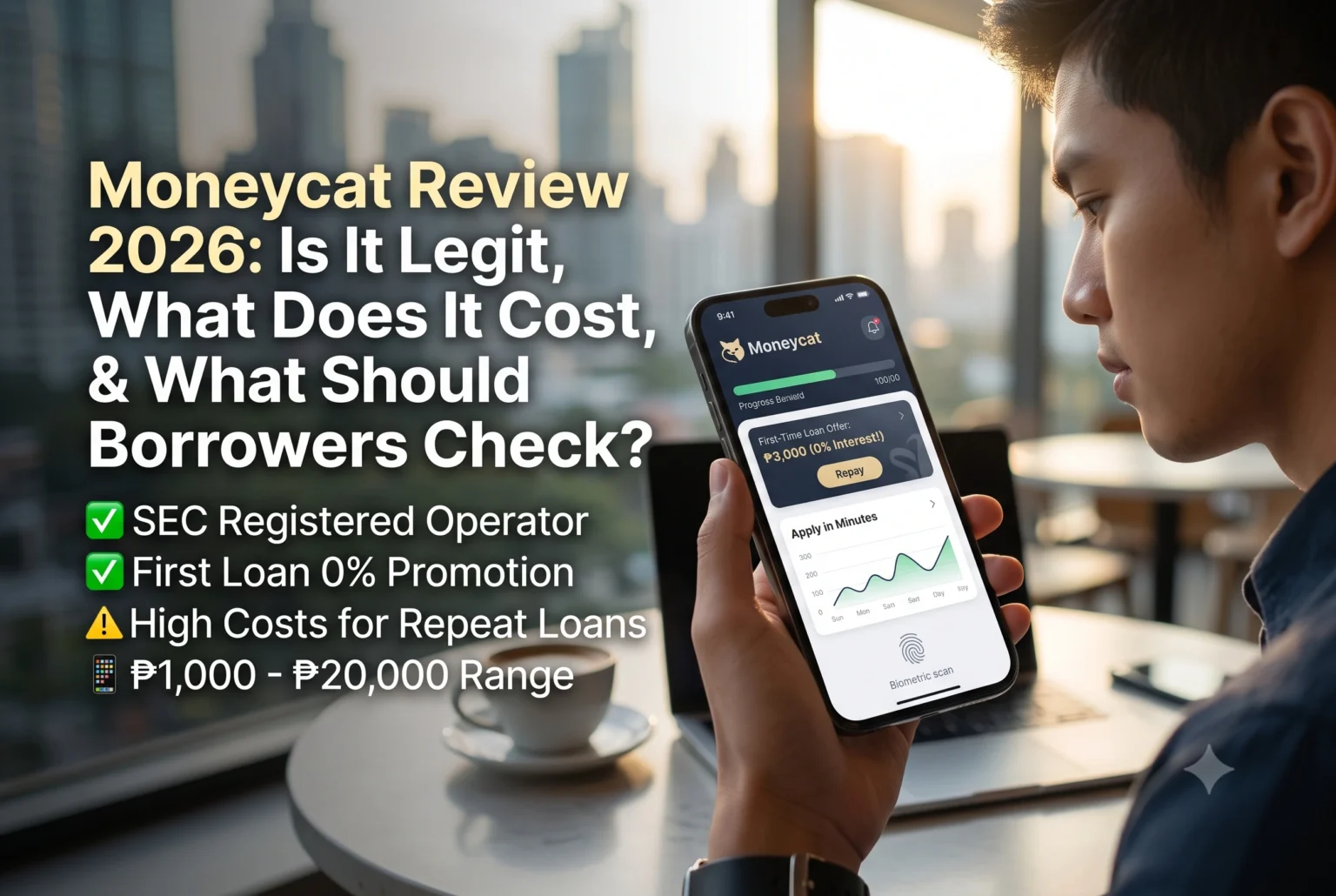
When an unexpected financial shortfall occurs, the urgency to find bridge funds often competes with the fear of hidden fees, short repayment windows, and aggressive debt collection. Moneycat is one of the most visible online lending platforms in the Philippines, aggressively marketing its fast approval and zero-interest first-loan promotions to underserved borrowers. However, the gap between an advertised maximum loan limit and the actual cash deposited into a borrower’s account can be significant.
This review investigates Moneycat’s legal authorization, its actual borrowing costs, its privacy policies, and the real-world operational friction borrowers encounter. By comparing the platform’s marketing claims against Philippine regulatory limits and public disclosure documents, we aim to provide a clear, evidence-based framework to help you decide if this product aligns with your financial capacity.
Summary:
Moneycat is a legitimate, SEC-registered financing company in the Philippines, operating legally under the name Moneycat Financing Inc. While it is fully authorized to lend, borrowers should be aware that advertised loan limits of up to ₱20,000 are rarely accessible to first-time applicants, who typically receive approvals between ₱1,000 and ₱3,000. Although the zero-interest promotional offer for new users is genuine, subsequent loans carry steep effective interest rates and service fees that can quickly compound. The most significant borrower risk involves short initial repayment tenors and severe late-payment penalties. Before accepting any offer, borrowers must verify the exact net disbursement amount and the actual calendar due date, as weekends and holidays do not extend the repayment deadline.
| Borrower question | Current finding | Why it matters |
| Legal operator | Moneycat Financing Inc. | Confirms the platform is run by an identifiable, legally accountable local corporation. |
| Regulatory status | SEC-registered with a valid Certificate of Authority (CA). | Subjects the lender to Bangko Sentral ng Pilipinas (BSP) rate caps and SEC collection guidelines. |
| Advertised loan range | ₱1,000 to ₱20,000. | Sets expectations, though first-time borrowers usually qualify only for the lowest tier. |
| Advertised rate vs. actual cost | 0% for the first loan; high effective rates thereafter. | The promotional rate is a marketing acquisition tool; repeat borrowing is highly expensive. |
| Net disbursement | Processing fees may be deducted upfront on repeat loans. | You may receive less cash than the principal amount you are required to repay. |
| Late payment risk | Strict daily penalties up to the BSP mandated cap. | Missing a payment rapidly increases the debt burden and triggers active collection efforts. |
Is Moneycat legitimate and properly authorized in the Philippines?
Yes. Moneycat is a legitimate financing platform operated by Moneycat Financing Inc., which holds a valid Certificate of Authority from the Securities and Exchange Commission (SEC) to operate as a financing company. This confirms it is a regulated entity, though SEC registration does not imply that its loans are inexpensive or suitable for all budgets.
Who legally operates Moneycat?
The consumer-facing brand “Moneycat” is legally operated by Moneycat Financing Inc. (SEC Registration No. CS201916150, Certificate of Authority No. 1254). Distinguishing the brand from the legal entity is an important step in verifying legitimacy. Because it is a registered financing company, it is legally bound by Philippine lending regulations, including mandatory disclosures of the Truth in Lending Act (Republic Act No. 3765).
What are its SEC and data privacy obligations?
As an authorized operator, Moneycat must comply with the BSP’s caps on short-term online loans (Circular No. 1133) and the SEC’s Memorandum Circular No. 18 series of 2019, which strictly prohibits unfair debt collection practices. Furthermore, it falls under the jurisdiction of the National Privacy Commission (NPC), meaning it is legally barred from unauthorized harvesting of a borrower’s phone contact list for collection purposes.
How much can you actually borrow from Moneycat?
While Moneycat advertises maximum loans of up to ₱20,000, public lending parameters and borrower reports indicate that first-time applicants are generally restricted to limits between ₱1,000 and ₱3,000. The maximum limit is typically reserved for repeat borrowers with established repayment histories.
Advertised limits versus first-time approvals
The platform’s marketing materials heavily emphasize the maximum ₱20,000 limit to attract applicants. However, underwriting models for unsecured online credit inherently limit initial exposure. First-time borrowers without a repayment history on the platform are tested with micro-loans. Only after one or more successful, on-time repayments will the algorithmic limit gradually increase.
Net proceeds versus approved principal
A common point of friction in Philippine fintech lending involves deductions. Borrowers must read the disclosure statement carefully to understand if processing fees or service charges are deducted prior to disbursement. If a borrower is approved for ₱3,000 but a service fee is deducted upfront, the net proceeds sent to the borrower’s GCash, Maya, or bank account will be lower, even though the borrower remains legally obligated to repay the full ₱3,000 principal.
What does a Moneycat loan really cost?
The cost depends entirely on whether it is your first loan. Moneycat frequently offers a 0% interest promotion for first-time users paying within a short tenor. For repeat loans, the effective cost includes both the nominal interest rate and service fees, which are legally capped by the BSP at a maximum effective rate of 15% per month.
The 0% interest promotional offer
Our review of the published terms confirms that the 0% interest offer for first-time borrowers is a legitimate customer acquisition strategy. If a first-time borrower is approved for ₱1,000 and pays exactly on the due date, they repay exactly ₱1,000. However, this promotion immediately voids if the borrower misses the payment deadline, at which point standard rates and penalties retroactively apply.
Standard rates, fees, and the BSP ceiling
For repeat borrowers, the cost of capital is high. Under BSP Circular No. 1133, unsecured loans below ₱10,000 with tenors up to 30 days are subject to specific caps:
-
A maximum nominal interest rate of 5% per month.
-
A maximum effective interest rate (EIR) – which includes processing and service fees – of 15% per month.
-
A cap on total penalties at 5% per month on the outstanding principal.Borrowers should expect Moneycat’s pricing for repeat loans to hover near these regulatory maximums. When calculating your repayment, focus on the total peso amount due rather than the monthly interest percentage, as service fees often comprise the bulk of the borrowing cost.
How fast is the Moneycat application and disbursement process?
Moneycat utilizes automated underwriting, meaning decisions are often rendered within minutes of submitting a completed profile and ID. However, actual disbursement speeds depend heavily on the accuracy of the borrower’s data and the clearing schedules of the receiving bank or e-wallet.
Underwriting friction and verification
The application requires a valid government-issued ID and a real-time selfie verification. The most frequent operational friction occurs during identity matching. The platform’s automated systems require the name on the submitted ID to perfectly match the registered name on the destination bank account or e-wallet. Minor discrepancies – such as a missing middle initial or a misspelled surname – will trigger manual review or outright rejection.
Actual settlement timelines
While the app may indicate “approved” instantly, the transfer of funds relies on third-party payment gateways (like InstaPay or PESONet). Disbursements to mainstream e-wallets like GCash or Maya are generally credited within 24 hours. Bank transfers requested late on a Friday or before a public holiday may not settle until the next banking day, effectively reducing the time the borrower has the funds before the first payment is due.
What happens if you pay late?
Missing a due date results in immediate financial penalties, capping at 5% per month on the outstanding balance, and initiates active collection efforts. Unpaid accounts may also be reported to the Credit Information Corporation (CIC), impairing future borrowing capacity.
Financial penalties
There is no grace period. If a loan is due on a Tuesday and payment is not posted by the cutoff time, late fees apply by Wednesday. Philippine regulations mandate that the total of all interest, fees, and penalties cannot exceed 100% of the total loan amount. Therefore, a ₱2,000 loan can never legally result in a debt higher than ₱4,000, regardless of how long it remains unpaid.
Collection practices and borrower reports
Moneycat utilizes internal or third-party collection agents to recover late payments. The SEC strictly prohibits the use of threats, insults, or public shaming, as well as contacting people in your phonebook who were not explicitly named as guarantors. While earlier years of Philippine online lending were notorious for contact-list harassment, current regulations have tightened. Nonetheless, borrowers should expect frequent SMS, email, and phone calls demanding payment immediately following a missed due date.
How does Moneycat handle your personal data?
Moneycat requires access to specific device data to assess credit risk and prevent fraud. According to standard privacy disclosures, this includes location data, camera access for identity verification, and device identifiers, but it is legally prohibited from scraping your entire contact list.
App permissions and privacy concerns
During installation, the app will request permissions. Borrowers must review these carefully. The National Privacy Commission (NPC) has issued explicit directives that online lending apps cannot require access to a borrower’s full contact list. Moneycat’s current public listings conform to these guidelines by requesting only essential permissions (camera, location, network state). If an app update ever demands access to your contacts to proceed with an application, borrowers should decline and report the incident to the NPC.
What are borrowers saying about Moneycat in 2026?
Recent borrower reviews highlight the speed and convenience of the 0% promotional loan as major positives. Conversely, the most recurring complaints involve unexpectedly short initial repayment tenors and aggressive follow-up calls immediately preceding the due date.
Positive patterns
Analysis of public app store feedback and local financial forums indicates that borrowers who understand the terms value the predictability of the first-time promotional offer. When users ensure their ID and GCash details align perfectly, they report smooth, frictionless disbursements.
Recurring complaints
A persistent theme in user feedback involves the loan tenor. While marketing materials suggest flexible repayment windows of up to several months, many approved users report that their specific offer is restricted to 7, 14, or 30 days. Additionally, borrowers frequently report receiving payment reminder calls one to two days before their loan is actually due, which many find intrusive.
Moneycat Pros and Cons
Pros:
-
Identifiable Operator: Operated by an SEC-registered financing company, providing regulatory accountability.
-
True 0% First Loan: The promotional offer for new users waives interest and fees if paid strictly on time.
-
Accessible Requirements: Requires only a primary government ID and a smartphone; no collateral or extensive paperwork is necessary.
-
Clear Payment Channels: Integrates well with standard Philippine payment networks (GCash, Maya, 7-Eleven, major banks).
Cons:
-
High Cost of Repeat Borrowing: Effective interest rates and service fees push the cost of subsequent loans near the regulatory maximum.
-
Short Tenors: Initial approved loan terms are often much shorter than the maximum tenors advertised.
-
Low Initial Limits: The ₱20,000 maximum is a ceiling for top-tier repeat borrowers, not a realistic expectation for new applicants.
-
Pre-Due Date Reminders: Collection departments are reportedly aggressive with reminders even before the loan is technically in default.
Who may find Moneycat relevant, and who should be cautious?
Moneycat is most relevant for a salaried employee or gig worker facing an immediate, quantifiable cash shortfall – such as a utility bill deadline – who is absolutely certain they will receive their paycheck within the 7 to 14-day repayment window. The 0% first-time offer makes it a rational choice for a one-time emergency bridge.
A borrower should be highly cautious if their income source is delayed or uncertain. Taking a short-term, high-interest loan with the hope of finding the money later frequently leads to a debt spiral. Furthermore, borrowers who are already managing multiple online lending app debts should avoid adding another, as the compounding late fees across multiple platforms quickly become unmanageable.
What should you check before accepting a Moneycat loan?
Before tapping “Accept” on the digital contract, verify the following:
-
The Net Proceeds: Look past the “Approved Amount.” Find the exact peso amount that will be deposited into your account.
-
The Total Repayment Amount: Identify the exact total you owe. Subtract the net proceeds from the total repayment to see your actual peso cost of borrowing.
-
The Exact Due Date: Check the calendar. If the due date falls on a Sunday or a holiday, ensure you know how to make a payment on that specific day, as automated systems will still apply late penalties.
-
The Penalty Terms: Read the disclosure statement to confirm the exact daily penalty fee if you miss the deadline.
References
-
Securities and Exchange Commission (Philippines)Organization: Securities and Exchange CommissionResource: List of Registered Financing Companies
-
Bangko Sentral ng PilipinasOrganization: Bangko Sentral ng PilipinasResource: BSP Circular No. 1133 Series of 2021 (Ceiling on Interest Rates and Other Fees)
-
Moneycat PhilippinesOrganization: Moneycat Financing Inc.Resource: Official Website and Public Terms of ServiceURL: https://moneycat.ph/
Last Updated: September 29, 2026 by The Nomad Finance Girl (Jaycee)
