
It happens to almost every borrower. You see a promotional text or an ad for a bank offering a shockingly low 1.2% monthly interest rate. You do the quick mental math, realize the monthly payment fits perfectly into your budget, and sign the digital contract. But when the funds finally hit your account, the cash is thousands of pesos short of what you applied for. Then your first billing statement arrives, and the actual monthly deduction feels suffocating. You aren’t bad at math; you are just experiencing the harsh reality of banking structures designed to spotlight the lowest possible number while burying the true cost of borrowing in the fine print. Unpaid debts will not land you in jail in the Philippines, but hidden fees can easily trap you in a cycle of financial distress.
Summary:
Comparing personal loan interest rates in the Philippines requires looking past the advertised monthly add-on rate. Banks and digital lenders deduct non-refundable processing fees and government-mandated Documentary Stamp Tax (DST) directly from your approved principal before releasing the funds. Because of how these deductions shrink your actual cash received, combined with the fact that you pay fixed interest on the original loan amount even as your balance decreases, the Effective Interest Rate (EIR) is often double the advertised add-on rate. Protecting your finances means demanding the exact net proceeds and the true EIR before signing any digital agreement.
Key Takeaways: The True Cost of Borrowing
| Fee / Rate Component | Advertised Reality | The Hidden Reality | Impact on Borrower |
| Monthly Add-On Rate | Usually 1.2% to 1.5% | Fixed against the original principal. | Creates a false sense of affordability. |
| Effective Interest Rate (EIR) | Rarely advertised upfront. | Usually ranges from 24% to 36% annually. | Reflects the true mathematical cost of the debt. |
| Documentary Stamp Tax (DST) | Mentioned in fine print. | PHP 1.50 per PHP 200 of the loan amount. | Deducted from your payout; you pay interest on money you never received. |
| Processing Fee | “Minimal fees apply.” | PHP 1,500 to PHP 3,000 flat rate. | Severely reduces the net proceeds of smaller loans. |
Why Is There A Difference Between Add-On Rates And The Effective Interest Rate (EIR)?
The add-on rate calculates interest on the original principal for the entire term, while the Effective Interest Rate (EIR) reflects the true cost of borrowing by including compounding periods and processing fees on a diminishing balance.
How Do Banks Calculate The Monthly Add-On Rate?
Banks multiply your total loan amount by the monthly add-on percentage, then multiply that by your loan term in months to get the fixed total interest.
Lenders love the monthly add-on rate because it looks highly manageable on paper. If you borrow PHP 100,000 at a 1.2% add-on rate, the bank simply calculates 1.2% of PHP 100,000 (which is PHP 1,200) and multiplies it by a 12-month term to get PHP 14,400. They add this fixed interest to your principal and divide it by 12, resulting in a flat monthly amortization of PHP 9,533.
This calculation method is perfectly legal, but it creates a psychological trap. It makes you feel like you are paying a tiny fraction of interest each month. However, this flat rate ignores the operational reality of how you pay back the debt.
What Makes The Effective Interest Rate (EIR) So Much Higher?
EIR is higher because it factors in the reality that your principal balance decreases with every monthly payment, yet you are still paying interest as if you owed the full amount.
Think about your 11th payment on that PHP 100,000 loan. By month 11, you have already paid back the vast majority of the original principal. You might only owe the bank PHP 10,000 in actual debt at that point. Yet, because of the flat add-on structure, the interest portion of your monthly bill is still calculated as if you hold the full PHP 100,000.
The Effective Interest Rate exposes this math. By 2026 standards, the Bangko Sentral ng Pilipinas (BSP) mandates that lenders disclose the EIR because it represents the actual annualized cost of the loan on a diminishing balance, factoring in all upfront deductions. A 1.2% add-on rate almost always translates to an EIR hovering between 25% and 27%.
What Are The Hidden Fees Buried In Philippine Bank Loans?
Lenders embed upfront deductions like Documentary Stamp Tax (DST) and processing charges into the contract, shrinking your payout while keeping your monthly repayment tied to the gross loan amount.
How Is Documentary Stamp Tax (DST) Calculated For Loans?
By Philippine law, the Documentary Stamp Tax (DST) on loans is strictly calculated at PHP 1.50 for every PHP 200 of the loan amount, legally mandated by the Bureau of Internal Revenue (BIR).
Many borrowers feel cheated when they notice a tax deduction on a personal loan, assuming the bank is pocketing the difference. In reality, the DST is a government requirement applied to debt instruments.
Because the formula is fixed at PHP 1.50 per PHP 200 (or 0.75%), a PHP 100,000 loan will always incur a PHP 750 DST charge. The friction point here is not the tax itself, but how it is collected. Banks do not ask you to pay this out of pocket; they deduct it directly from your approved loan amount. You are borrowing money to pay a tax, and then paying interest on that borrowed tax money for the next 12 to 36 months.
Why Do Processing And Disbursement Fees Eat Into Your Cash?
Lenders deduct non-refundable processing and disbursement fees directly from your approved loan proceeds before releasing the funds, significantly reducing your actual cash on hand.
When applying for a personal loan, borrowers often ignore the flat processing fee, assuming it is negligible. Traditional banks typically charge anywhere from PHP 1,500 to PHP 3,000 to process the paperwork and release funds via InstaPay or PESONet.
When our team tested a major digital bank’s loan portal earlier this year, the initial dashboard prominently displayed a PHP 50,000 approval. It was only on the final confirmation screen that a PHP 2,500 processing fee was revealed as a direct deduction. For a PHP 50,000 loan, losing PHP 2,500 upfront means you instantly lose 5% of your cash liquidity, pushing the true EIR even higher.

What Happens If You Decide On An Early Loan Settlement?
Paying off your loan early triggers a pre-termination penalty—usually 4% to 8% of the unbilled principal or a flat fee—which often cancels out any interest savings you hoped to gain.
It seems logical that if you receive a year-end bonus and pay off your remaining debt early, the bank should reward you by waiving the remaining interest. Unfortunately, Philippine banking contracts usually view early settlement as a breach of the agreed profit schedule.
If you attempt to close an account on month six of a 12-month term, the bank will charge a pre-termination penalty. Depending on the lender, this is either a flat rate (like PHP 2,500) or a percentage of your outstanding balance. We have reviewed contracts where the early settlement fee was so aggressively priced that it was actually cheaper for the borrower to just let the monthly amortizations run their normal course.
How Much Does A PHP 100,000 Personal Loan Actually Cost?
A PHP 100,000 loan with a 1.2% add-on rate over 12 months will cost you PHP 114,400 in repayments, but after mandatory deductions, you only receive around PHP 96,750 in actual cash.
Let’s break down the exact peso amounts to show why the math feels so punishing for regular consumers. We will use a standard commercial bank structure for this “Real Cost Calculator” narrative.
- Gross Approved Principal: PHP 100,000
- Term: 12 Months
- Monthly Add-on Rate: 1.2%
First, the bank calculates your repayment.
1.2% of 100,000 is PHP 1,200 per month.
Over 12 months, the total interest is PHP 14,400.
Your total obligation to the bank is PHP 114,400, making your monthly payment exactly PHP 9,533.33.
Now, let’s look at the disbursement—the money that actually hits your ATM account.
The bank deducts the BIR-mandated DST of PHP 750 (PHP 100,000 / 200 * 1.5).
The bank deducts a standard processing fee of PHP 2,500.
Net Cash Received: PHP 96,750.
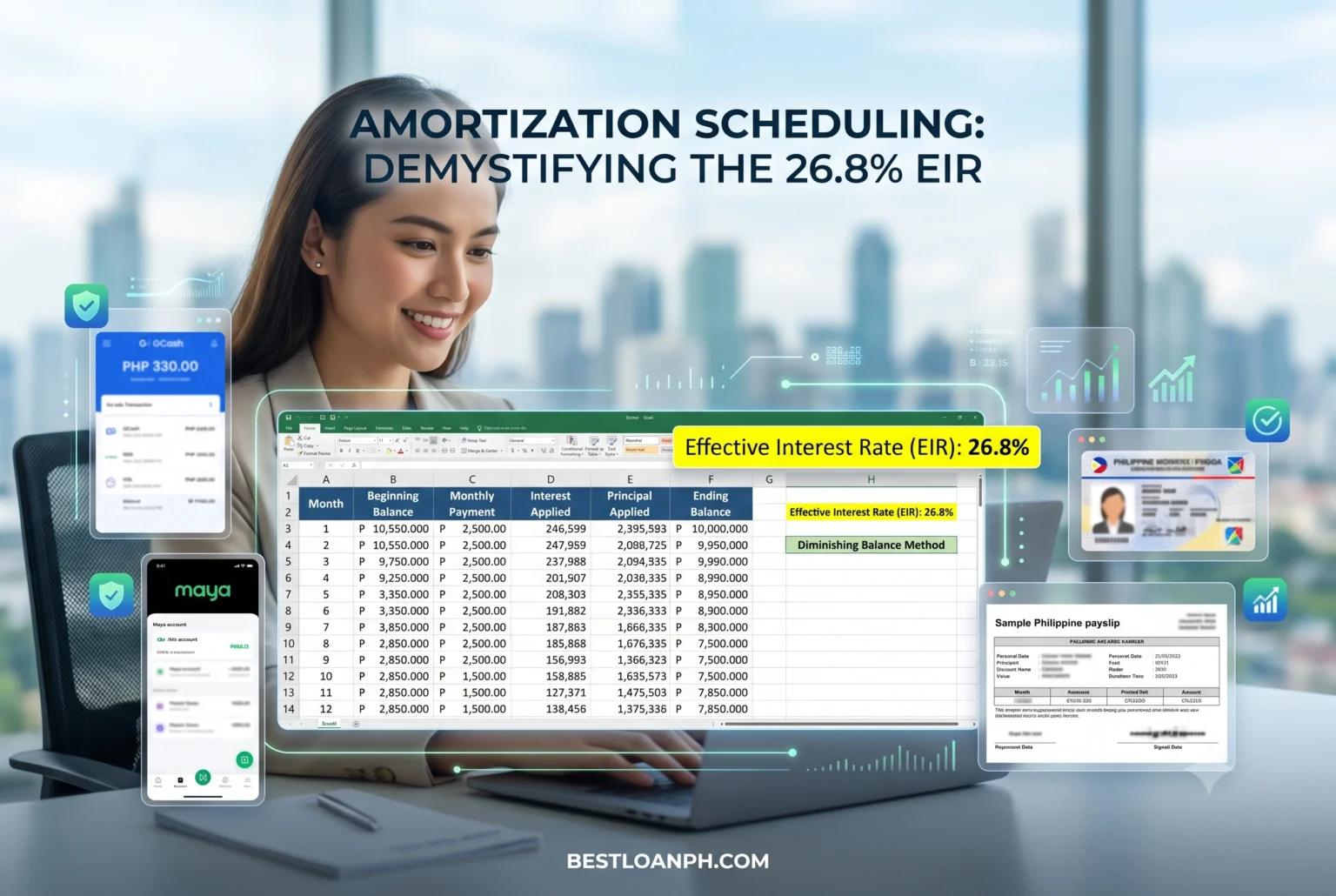
You are paying PHP 14,400 in interest for the privilege of holding PHP 96,750. When you factor in the missing cash and the diminishing balance, the real annual cost (EIR) of this specific setup sits at roughly 26.8%.
How Can Borrowers Protect Themselves Before Signing A Loan Contract?
Always demand to see the mandatory Truth in Lending Act (TILA) disclosure statement before clicking accept, which legally must reveal the exact net proceeds and the true Effective Interest Rate.
Where Should You Look For The True Cost In The Mobile App?
Scroll past the promotional banners on the final approval screen to locate the TILA breakdown, which is often minimized into a tiny hyperlink just above the terms and conditions checkbox.
In our experience testing fast online personal loans across various platforms, UI designers know exactly how to guide your eyes away from the bad news. They use bright, high-contrast buttons for the “Accept Funds” call to action, while burying the actual fee deductions in pale gray text.
The Philippine Truth in Lending Act (Republic Act No. 3765) strictly requires all creditors to provide a clear written statement of the cash actually delivered to the borrower and the true finance charges. You must actively look for this disclosure. If you are rushing through the screens because you need cash immediately, you will miss it.
Furthermore, expect operational friction during the approval process itself. For example, when running our field tests this year, we noticed that automated eKYC (Know Your Customer) systems frequently reject older UMID cards if the blue borders are slightly faded. This triggers a manual review process that can delay your funds by 24 to 48 hours. Lenders will not waive processing fees just because their automated systems are slow.
Before committing, pause on the final screen. Calculate your exact net proceeds. Divide your total repayment by the cash you will actually receive. If the resulting cost feels too heavy to carry, it is safer to step away and explore credit cooperatives or salary loans through your employer, which typically feature far more transparent fee structures.
References
- Bangko Sentral ng PilipinasOrganization: BSPResource: Manual of Regulations for Banks (MORB) – Truth in Lending ActURL: https://www.bsp.gov.ph/Regulations/MORB/Part3.pdf
- Bureau of Internal RevenueOrganization: BIRResource: Documentary Stamp Tax RatesURL: https://www.bir.gov.ph/index.php/tax-information/documentary-stamp-tax.html
- Securities and Exchange Commission PhilippinesOrganization: SECResource: Financial Consumer Protection GuidelinesURL: https://www.sec.gov.ph/public-information-2/financial-consumer-protection/
Last Updated: August 24, 2026 by The Nomad Finance Girl (Jaycee)
